Frequently Asked Questions
Q: What does Exodus 25:37 mean when it talks about the seven lamps?
A: Exodus 25:37 refers to the Menorah (candelabra) in the Mishkan (Tabernacle), which had seven branches with lamps. According to Rashi, the seven lamps symbolize wisdom and divine light. The Torah instructs that the lamps should be arranged so their light faces the center stem of the Menorah, representing unity and focus on spiritual enlightenment.
Q: Why is the Menorah's lighting described in such detail in the Torah?
A: The detailed instructions for the Menorah's lighting (including the seven lamps in Exodus 25:37) emphasize the importance of bringing spiritual light into the world. The Rambam explains that the Menorah represents the light of Torah wisdom, and its proper lighting symbolizes the continuous duty to spread divine knowledge and holiness.
Q: What practical lesson can we learn from Exodus 25:37 today?
A: The verse teaches that just as the Menorah's lamps were directed to shine toward the center, we should focus our actions and intentions toward holiness and unity. The Talmud (Shabbat 22b) derives from this that we should strive to illuminate our surroundings with Torah values and good deeds, just as the Menorah illuminated the Mishkan.
Q: How were the seven lamps of the Menorah arranged according to Jewish tradition?
A: The Menorah had one central stem with three branches on each side, totaling seven lamps. Rashi explains that the six side lamps were angled toward the middle lamp, fulfilling the verse's instruction that 'they may give light over against it.' This arrangement symbolizes that all wisdom should be directed toward divine truth.
Q: Is there a connection between the Menorah's seven lamps and Shabbat?
A: Yes, the Menorah's seven lamps correspond to the seven days of creation, with Shabbat being the central spiritual 'light.' The Midrash (Bamidbar Rabbah 15:7) connects the eternal flame of the Menorah to the 'light' of Shabbat observance, which illuminates the entire week just as the Menorah illuminated the Mishkan.

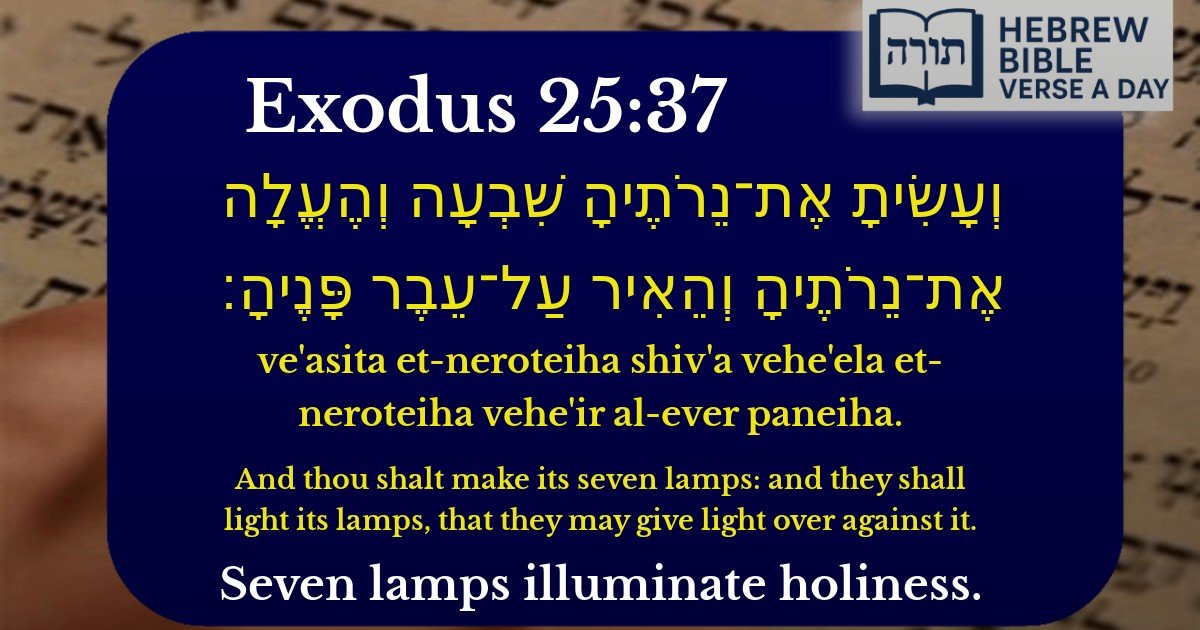

The Seven Lamps of the Menorah
The verse (Exodus 25:37) describes the construction of the Menorah, specifically its seven lamps (nerot), which were to be lit so that their light would shine "over against it" (al ever panav). Rashi explains that the phrase "over against it" means the six outer lamps were to be tilted toward the central lamp, symbolizing unity and the centrality of the Divine light. This arrangement teaches that all wisdom and spiritual illumination must be directed toward a higher, unified purpose.
Symbolism of the Seven Lamps
The Rambam (Hilchot Beit HaBechirah 3:12) emphasizes that the Menorah represents wisdom and Torah study, as stated in Proverbs 6:23: "For the commandment is a lamp, and the Torah is light." The seven lamps correspond to the seven branches of wisdom, all of which must be aligned with the light of Torah. The Midrash (Bamidbar Rabbah 15:7) further connects the seven lamps to the seven days of Creation, illustrating that the light of the Menorah sanctifies time and space.
Practical Halachic Implications
Spiritual Lessons
The Seforno teaches that the Menorah's light shining "over against it" signifies that the illumination of the Beit HaMikdash must extend outward, influencing the entire world. Similarly, the Chofetz Chaim (in Mishna Berura) applies this idea to individual conduct: just as the lamps were directed inward, a person's actions should reflect inward purity and outward righteousness, bringing light to others.