
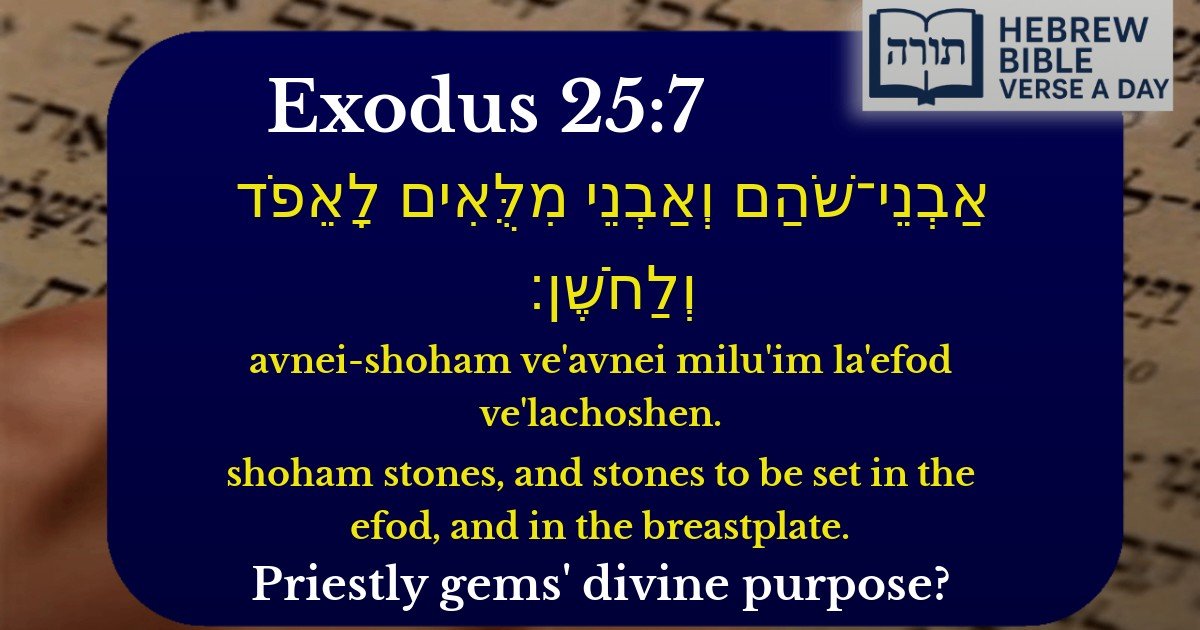

Exodus 25:7 - Priestly gems' divine purpose?

Exodus 25:7 - שמות 25:7

Hebrew Text

אַבְנֵי־שֹׁהַם וְאַבְנֵי מִלֻּאִים לָאֵפֹד וְלַחֹשֶׁן׃

English Translation

shoham stones, and stones to be set in the efod, and in the breastplate.

Transliteration

Avnei-shoham ve'avnei milu'im la'efod ve'lachoshen.

Hebrew Leining Text

אַבְנֵי־שֹׁ֕הַם וְאַבְנֵ֖י מִלֻּאִ֑ים לָאֵפֹ֖ד וְלַחֹֽשֶׁן׃

🎵 Listen to leining

Parasha Commentary

Shoham Stones and Milu'im Stones in the Efod and Choshen

The verse (Shemot 25:7) mentions two types of stones: אבני־שהם (shoham stones) and אבני מלואים (stones to be set). These were designated for the אפוד (efod) and חושן (breastplate), key components of the Kohen Gadol's priestly garments.

Rashi's Explanation

Rashi (on Shemot 25:7) identifies the שהם (shoham) stone as the ברקת</strong (bareket), which is often translated as onyx or emerald. He explains that these stones were used for the shoulder pieces of the אפוד, upon which the names of the twelve tribes were engraved (Shemot 28:9-12). The אבני מלואים refer to the twelve precious stones set in the חושן, each representing one of the tribes (Shemot 28:17-21).

Rambam's Perspective

In Hilchos Klei HaMikdash (9:1), Rambam elaborates that the אבני מלואים were specifically fitted into gold settings on the חושן, forming a mosaic of precious stones. He emphasizes that each stone corresponded to one of the tribes, symbolizing their unity before Hashem.

Midrashic Insights

  • The מדרש רבה (Shemot Rabbah 38:8) teaches that the אבני שהם on the אפוד atoned for the sin of the Golden Calf, while the אבני מלואים on the חושן atoned for errors in judgment.
  • The זוהר (Zohar II:230a) connects these stones to the divine light of creation, suggesting they channeled spiritual energy to assist the Kohen Gadol in his service.

Symbolism of the Stones

Rabbeinu Bachya (on Shemot 25:7) explains that the stones represent the diversity and uniqueness of each tribe, yet their placement in a unified garment symbolizes how Klal Yisrael functions as one nation under Hashem. The אפוד and חושן thus served not only as ritual objects but as reminders of national cohesion.

📚 Talmud Citations

This verse is quoted in the Talmud.

📖 Yoma 71b
The verse is referenced in a discussion about the stones of the breastplate (Choshen) and their significance in the High Priest's garments.
📖 Sotah 48b
Mentioned in the context of the cessation of the Urim and Thummim, which were associated with the breastplate containing these stones.

Frequently Asked Questions

Q: What are the 'shoham stones' mentioned in Exodus 25:7?
A: The 'shoham stones' (אַבְנֵי־שֹׁהַם) are precious stones that were used in the Kohen Gadol's (High Priest's) garments, specifically in the ephod (shoulder garment) and the choshen (breastplate). According to Rashi and other commentaries, the shoham stone is identified as onyx, a beautiful black and white layered stone. These stones were engraved with the names of the tribes of Israel (Exodus 28:9-12).
Q: Why were stones set in the ephod and breastplate important?
A: The stones set in the ephod and breastplate were essential because they represented the twelve tribes of Israel (Exodus 28:21). According to the Talmud (Yoma 73b), the breastplate (choshen) was used for divine communication—letters on the stones would light up to convey messages from Hashem. The Rambam (Hilchos Klei HaMikdash 9:7) explains that these stones were a reminder of the Jewish people's connection to Hashem and their role as a holy nation.
Q: What can we learn from the mention of precious stones in the Mishkan (Tabernacle)?
A: The use of precious stones in the Mishkan teaches us the importance of beautifying mitzvos (commandments). The Midrash (Shemos Rabbah 33:1) explains that Hashem desires beauty in holiness, which is why the Mishkan and its vessels were made with the finest materials. This principle applies today—when performing mitzvos, we should strive to do them in the most honorable and beautiful way possible.
Q: How were the stones for the ephod and breastplate obtained?
A: The stones were donated by the Jewish people as part of the voluntary contributions for the Mishkan (Exodus 25:2-7). The Midrash (Tanchuma, Terumah 5) teaches that these precious stones miraculously came with Bnei Yisrael from Egypt, showing that even in exile, Hashem prepared them for future holiness. This teaches that everything we have can be elevated for a sacred purpose.