Frequently Asked Questions
Q: Who is the 'she' in Exodus 2:6 who finds the baby Moses?
A: The 'she' refers to Pharaoh's daughter, Batya (sometimes spelled Bithiah). According to the Midrash (Shemot Rabbah 1:23), she went to bathe in the Nile not for idolatrous purposes (as Egyptians worshipped the Nile), but because she converted to monotheism. Her name 'Batya' means 'daughter of God,' showing her righteousness.
Q: Why was the baby Moses crying in Exodus 2:6?
A: Rashi (on Exodus 2:6) explains that Moses was crying because he refused to nurse from Egyptian women, as his mouth was destined to speak with the Divine Presence. The Midrash (Shemot Rabbah 1:25) adds that Miriam (Moses' sister) then suggested a Hebrew wet-nurse—who was actually Moses' mother, Yocheved—to Pharaoh's daughter.
Q: What does it mean that Pharaoh's daughter 'had compassion' on Moses?
A: The Torah emphasizes her compassion (וַתַּחְמֹל עָלָיו) to teach that God orchestrated events so that Moses would be raised in Pharaoh's palace. The Talmud (Sotah 12b) states that she stretched out her arm miraculously to reach Moses' basket, showing divine intervention. Her compassion contrasts with Pharaoh's cruelty, highlighting how kindness can change history.
Q: Why does Exodus 2:6 call Moses both a 'child' (יֶלֶד) and a 'boy' (נַעַר)?
A: Rashi explains the dual terms: 'child' refers to Moses' physical infancy, while 'boy' (נַעַר) hints at his 'youthful voice' (i.e., he cried like a newborn, but his voice was unusually strong). The Midrash (Shemot Rabbah 1:24) adds that his cry was heard throughout Egypt, foreshadowing his future role as the leader who would liberate the Hebrews.
Q: How does Exodus 2:6 show the importance of kindness in Judaism?
A: Pharaoh's daughter's act of saving Moses—despite her father's decree to kill Hebrew boys—demonstrates the Torah's value of חסד (loving-kindness). The Talmud (Megillah 13a) teaches that because she showed mercy, she merited a long life and is identified as one of the few righteous converts in Tanach. This teaches that kindness can defy even the worst oppression.


Context of the Verse
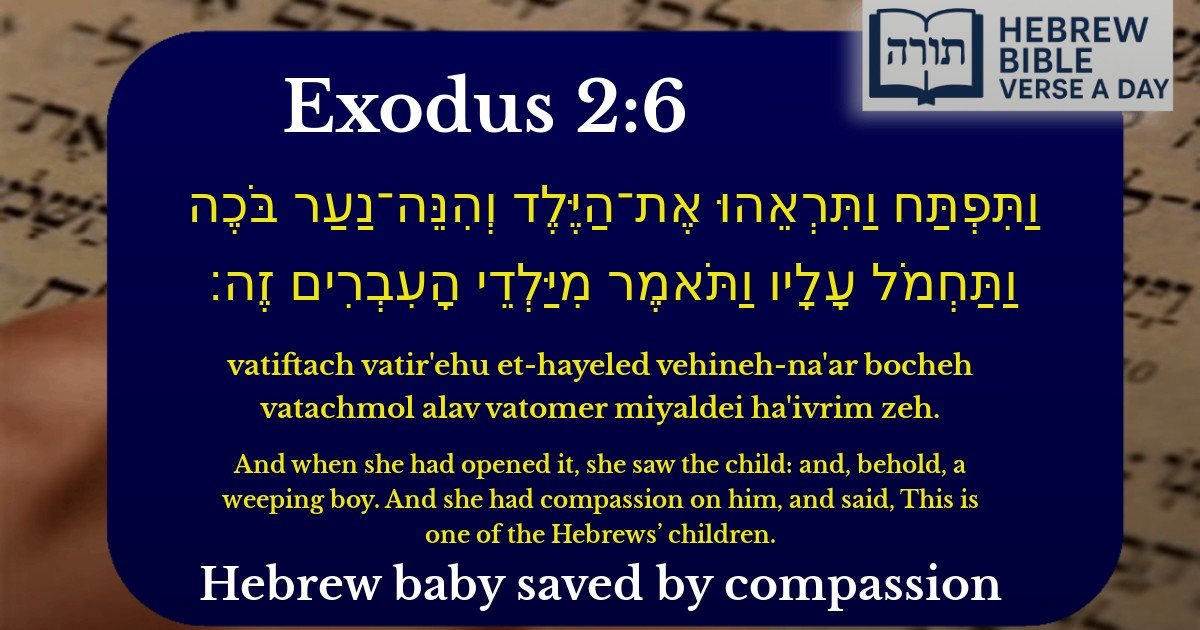
The verse (Shemot 2:6) describes the moment when Pharaoh's daughter discovers the infant Moshe in a basket among the reeds of the Nile. This occurs during the period when Pharaoh had decreed that all newborn Hebrew boys be cast into the river (Shemot 1:22). The verse highlights her immediate reaction of compassion upon seeing the crying child.
Rashi's Commentary
Rashi explains that the phrase "וַתִּפְתַּח וַתִּרְאֵהוּ אֶת־הַיֶּלֶד" ("she opened and saw the child") indicates that she first opened the basket and then saw the child. Rashi notes that the Torah emphasizes her act of opening because it demonstrates her willingness to investigate and her curiosity, which led to her discovery.
Regarding "וְהִנֵּה־נַעַר בֹּכֶה" ("and behold, a weeping boy"), Rashi comments that the term "נַעַר" (na'ar) is unusual for an infant, suggesting that Moshe's voice was unusually strong, like that of an older child. This may hint at his future role as a leader.
Midrashic Insights
Rambam's Perspective
Rambam (Hilchos Yesodei HaTorah 8:1) discusses Divine Providence and how Hashem orchestrates events for the righteous. The discovery of Moshe by Pharaoh's daughter—a seemingly chance event—was actually part of Hashem's plan to save the future redeemer of Israel.
Pharaoh's Daughter's Recognition
The phrase "מִיַּלְדֵי הָעִבְרִים זֶה" ("This is one of the Hebrews’ children") shows her immediate recognition of Moshe's identity. The Talmud (Sotah 12b) explains that she recognized him as a Hebrew child either through circumcision (indicating he was Jewish) or because of his exceptional beauty, which was a sign of divine favor.
Moral Lessons