
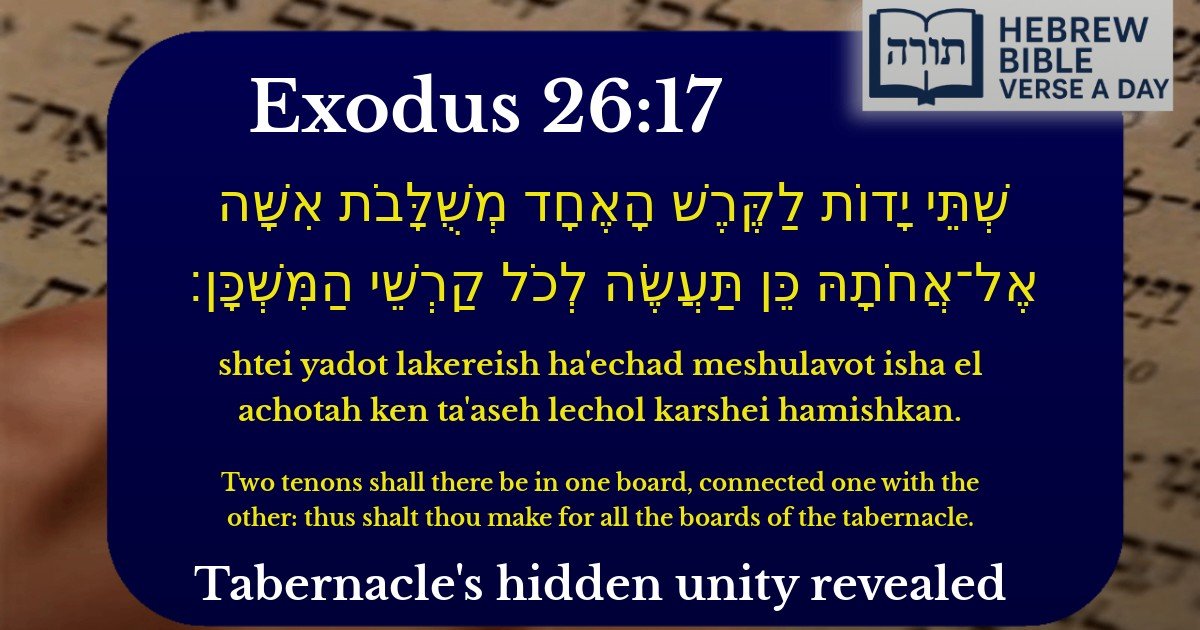

Exodus 26:17 - Tabernacle's hidden unity revealed

Exodus 26:17 - שמות 26:17

Hebrew Text

שְׁתֵּי יָדוֹת לַקֶּרֶשׁ הָאֶחָד מְשֻׁלָּבֹת אִשָּׁה אֶל־אֲחֹתָהּ כֵּן תַּעֲשֶׂה לְכֹל קַרְשֵׁי הַמִּשְׁכָּן׃

English Translation

Two tenons shall there be in one board, connected one with the other: thus shalt thou make for all the boards of the tabernacle.

Transliteration

Shtei yadot lakereish ha'echad meshulavot isha el achotah ken ta'aseh lechol karshei hamishkan.

Hebrew Leining Text

שְׁתֵּ֣י יָד֗וֹת לַקֶּ֙רֶשׁ֙ הָאֶחָ֔ד מְשֻׁ֨לָּבֹ֔ת אִשָּׁ֖ה אֶל־אֲחֹתָ֑הּ כֵּ֣ן תַּעֲשֶׂ֔ה לְכֹ֖ל קַרְשֵׁ֥י הַמִּשְׁכָּֽן׃

🎵 Listen to leining

Parasha Commentary

Explanation of the Verse

The verse (Exodus 26:17) describes the construction of the kerashim (boards) of the Mishkan (Tabernacle), specifying that each board must have two yadot (tenons or projections) that interlock with one another. This design ensured structural stability and unity among the boards, symbolizing the cohesion of the Jewish people in serving Hashem.

Rashi's Commentary

Rashi (Exodus 26:17) explains that the term yadot refers to wooden pegs or projections extending from the bottom of each board. These pegs fit into silver sockets (adanim), as described later in the Torah (Exodus 26:19). Rashi emphasizes that the phrase m'shulavot isha el achota ("connected one with the other") means the tenons were aligned precisely to ensure a secure fit, preventing the Mishkan from collapsing.

Symbolism of the Interlocking Boards

The Midrash (Tanchuma, Terumah 11) and later commentators highlight the deeper meaning behind this construction:

  • Unity of Klal Yisrael: The interlocking boards symbolize the unity of the Jewish people, where each individual supports the other, just as the boards held each other upright.
  • Dependence on Torah and Mitzvot: The sockets (adanim) made of silver, acquired through the half-shekel donation, represent the foundation of Torah and mitzvot that uphold the Jewish nation.
  • Mutual Responsibility: The phrase isha el achota ("one with the other") teaches that just as the boards were interdependent, so too must Jews strengthen one another in avodas Hashem (service of G-d).

Halachic and Structural Insights

The Rambam (Hilchos Beis Habechira 1:12) derives from this verse principles for building sacred structures, emphasizing precision and durability. The Talmud (Shabbos 98b) discusses how the Mishkan’s construction avoided any imbalance, reflecting the need for harmony in spiritual and communal life.

Practical Lesson

The Malbim (Exodus 26:17) notes that the repetition of ken ta'aseh l'chol karshei haMishkan ("thus shalt thou make for all the boards") teaches consistency—every component of the Mishkan, and by extension, every Jew, must be fashioned with the same care and dedication to fulfill their role in the collective mission.

📚 Talmud Citations

This verse is not quoted in the Talmud.

Frequently Asked Questions

Q: What does Exodus 26:17 mean when it talks about 'two tenons' in the boards of the Mishkan?
A: The verse describes the construction of the Mishkan (Tabernacle). Each wooden board had two tenons (protruding pegs or tabs) that fit into corresponding sockets in the base. Rashi explains that these tenons were arranged in a way that they interlocked ('meshulavot'), ensuring the boards stood firmly upright. This was part of Hashem's precise instructions for building a stable and holy structure.
Q: Why was it important for the Mishkan's boards to have interlocking tenons?
A: The interlocking design ensured the Mishkan's structural integrity, symbolizing unity and strength in serving Hashem. The Midrash Tanchuma notes that just as the boards supported each other, the Jewish people must stand united in holiness. Rambam (Hilchot Beit HaBechirah) also derives from this that holy structures require careful craftsmanship to honor their divine purpose.
Q: How does Exodus 26:17 apply to us today?
A: The verse teaches timeless lessons: (1) Precision in fulfilling mitzvot matters—just as the Mishkan's details mattered. (2) Unity is foundational—like the interlocking boards, we strengthen our communities through cooperation. The Sforno adds that the Mishkan's construction mirrors how individuals must 'fit together' harmoniously in collective service of Hashem.
Q: What materials were used for the Mishkan's boards and tenons?
A: The Torah (Exodus 26:15) specifies 'shittim wood' (acacia) for the boards. Rashi cites the Talmud (Yoma 72a) that these trees were planted by Yaakov Avinu in Egypt for this purpose. The tenons and sockets were likely made of silver (see Exodus 26:19), showing the importance of durable, precious materials for sacred objects.