Frequently Asked Questions
Q: What does Exodus 26:18 mean when it talks about the 'boards for the tabernacle'?
A: This verse describes the construction of the Mishkan (Tabernacle), the portable sanctuary built by the Israelites in the desert. The 'boards' (קְּרָשִׁים) were wooden frames that formed the walls of the Mishkan. Rashi explains that these boards were made of acacia wood and stood upright, forming the structure's southern side. The number 'twenty' specifies how many boards were needed for this section.
Q: Why does the Torah specify the exact number of boards (20) for the south side of the Mishkan?
A: The precise measurements in the Mishkan's construction teach us the importance of detail in serving Hashem. The Talmud (Eruvin 2a) discusses how every measurement in the Mishkan has significance. The Rambam (Hilchos Beis Habechira 1:4) explains that these specifications reflect divine wisdom, showing that even physical structures used for holiness must be built with exactitude and intention.
Q: What is the significance of the Mishkan's south side being mentioned first in Exodus 26:18?
A: The Midrash (Bamidbar Rabbah 12:19) notes that the south is associated with wisdom, as King Solomon says in Koheles (1:16), 'I have gotten great wisdom.' By starting with the south side, the Torah may be hinting that the Mishkan - a place of divine connection - is rooted in wisdom and Torah study, which are central to Jewish life.
Q: How do the materials of the Mishkan apply to our lives today?
A: The Chofetz Chaim teaches that just as the Mishkan was built from physical materials (like the acacia wood boards) to create a dwelling place for the Divine Presence, so too we must use our physical world - our actions, speech, and possessions - to make a 'dwelling' for Hashem in our lives. Every mitzvah we do with our physical beings is like building another board in our personal Mishkan.
Q: Why was acacia wood used for the Mishkan's boards?
A: Rashi (on Exodus 25:5) explains that the acacia wood (שִׁטִּים) was chosen because it was readily available in the desert, showing that the Israelites used what they had to serve Hashem. The Midrash Tanchuma (Teruma 9) adds that Yaakov Avinu prophetically brought these trees from Canaan to Egypt, teaching that we must prepare in advance for opportunities to do mitzvos.

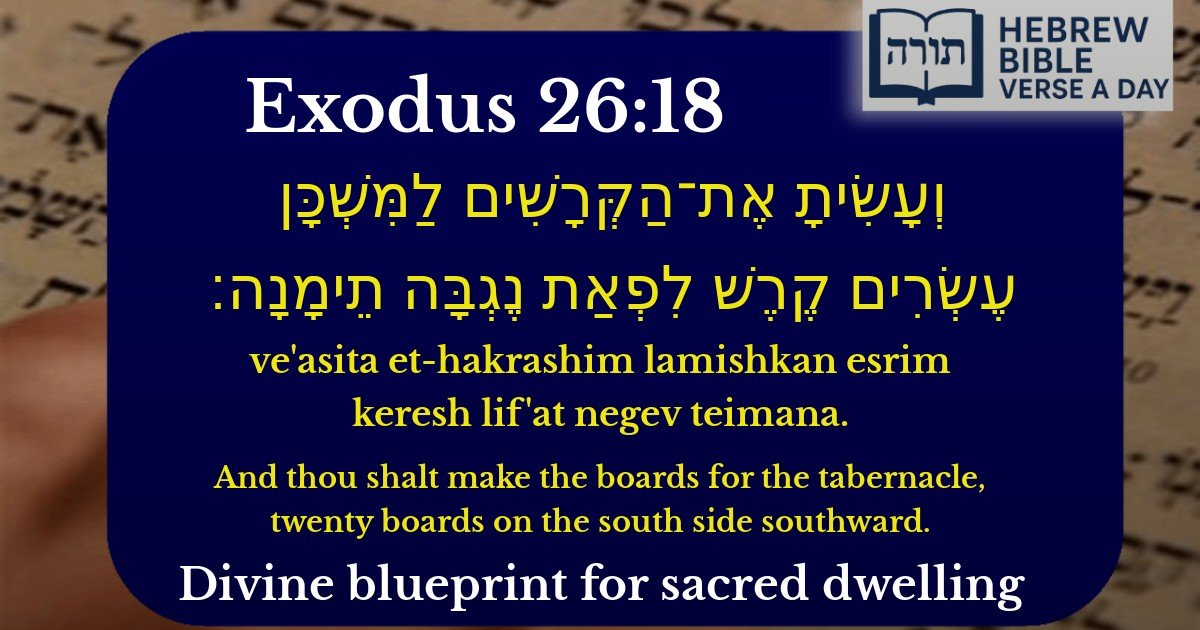

The Construction of the Mishkan's Southern Wall
The verse (Shemot 26:18) commands the construction of twenty kerashim (boards) for the south side of the Mishkan. Rashi explains that these boards were made of shittim (acacia) wood, standing upright and overlaid with gold. Each board was 10 cubits high and 1.5 cubits wide, forming a solid wall on the southern side of the Mishkan.
Symbolism of the Number Twenty
The Midrash (Tanchuma, Terumah 9) notes that the number twenty corresponds to the twenty generations from Adam until Avraham Avinu. This teaches that the Mishkan—a dwelling place for the Divine Presence—was a rectification (tikkun) for the spiritual state of those generations before Avraham brought monotheism to the world.
Structural Details from the Talmud
The Directional Significance of "South"
The south side (negev) is associated with wisdom, as King Shlomo writes (Kohelet 1:16), "I have acquired great wisdom." The Zohar (Terumah 152a) connects this to the Torah's light emanating from the south, symbolizing the divine wisdom housed in the Mishkan.