Frequently Asked Questions
Q: What are the 'sockets of silver' mentioned in Exodus 26:19?
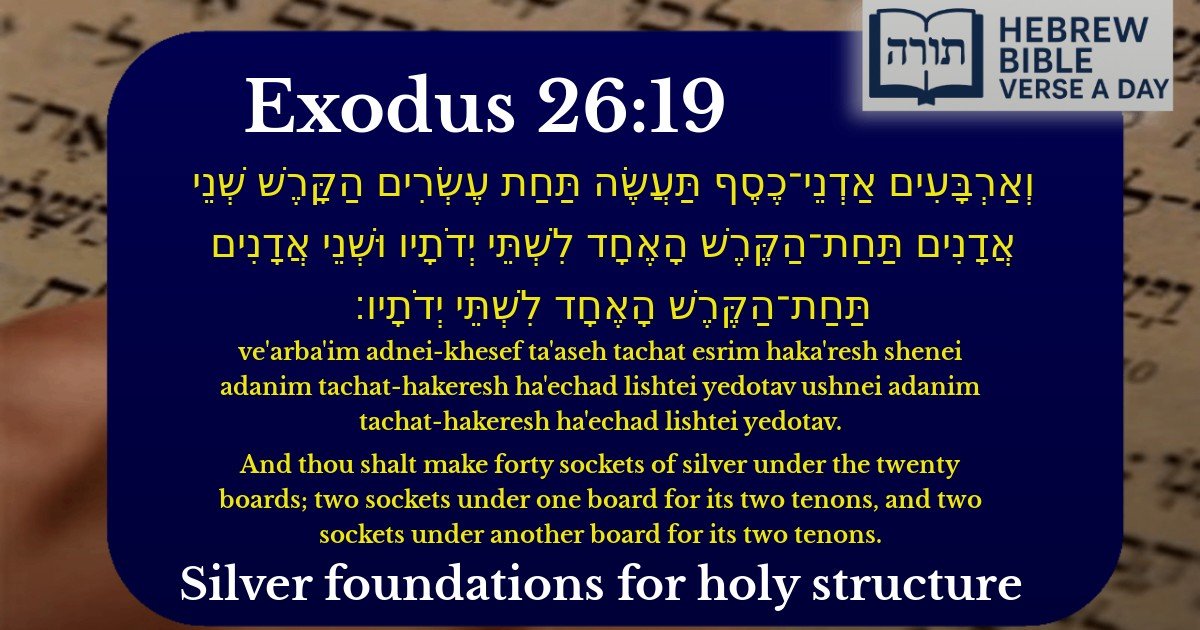
A: The 'sockets of silver' (אַדְנֵי־כֶסֶף) were the foundation bases made of silver that supported the wooden boards of the Mishkan (Tabernacle). Each board had two tenons (projections) that fit into two sockets, providing stability to the structure. Rashi explains that these sockets were essential for holding the boards upright, forming the walls of the Mishkan.
Q: Why were there specifically forty sockets for twenty boards?
A: The Torah specifies forty silver sockets for twenty boards because each board required two sockets—one for each of its two tenons (Exodus 26:19). This precise count ensured the Mishkan's structural integrity. The Midrash teaches that every detail in the Mishkan's construction reflects spiritual lessons, emphasizing the importance of order and precision in serving Hashem.
Q: What is the significance of using silver for the sockets?
A: Silver (כֶּסֶף) symbolizes purity and refinement in Jewish tradition. The sockets, which formed the foundation of the Mishkan, were made of silver to represent the importance of a pure and strong foundation in divine service. The Rambam notes that materials used in the Mishkan were chosen for their spiritual symbolism, with silver reflecting devotion and sincerity.
Q: How does the construction of the Mishkan apply to us today?
A: While we no longer build the physical Mishkan, the Talmud (Berachot 8a) teaches that the synagogue is a 'Mikdash Me'at' (a small sanctuary). Just as the Mishkan required careful construction with strong foundations, our spiritual lives and communities must also be built with dedication, unity, and purity of intention, as symbolized by the silver sockets.
Q: What do the 'two tenons' on each board represent?
A: The two tenons (יְדֹתָיו) on each board symbolize the dual foundations of Torah and mitzvot (commandments), which uphold a Jew's spiritual life. The Midrash Tanchuma compares the Mishkan's structure to a person's service of Hashem—just as the boards stood firm with two supports, we must ground ourselves in both study and action to remain steadfast in our faith.


Explanation of the Verse
The verse (Shemot 26:19) describes the construction of the sockets (adnei kesef) that supported the boards (kerashim) of the Mishkan (Tabernacle). According to Rashi, the forty silver sockets were placed beneath the twenty boards on the southern and northern sides of the Mishkan, with two sockets per board to hold its two tenons (yadot). This arrangement ensured stability for the structure.
Symbolism of the Silver Sockets
The Midrash (Tanchuma, Terumah 11) explains that silver (kesef) symbolizes atonement, as it recalls the half-shekel (machatzit hashekel) given by Bnei Yisrael for the Mishkan’s construction (Shemot 30:11-16). The sockets, being the foundation, represent the collective merit of the Jewish people, whose contributions—rooted in repentance and unity—supported the sanctity of the Mishkan.
Structural Significance
Rambam (Hilchot Beit HaBechirah 1:12) notes that the precise measurements and placements in the Mishkan reflect divine wisdom. The two sockets per board ensured balance, teaching that spiritual foundations must be firm and evenly distributed. The Talmud (Yoma 72a) further connects the Mishkan’s construction to Torah study, where proper "supports" (i.e., diligent review and understanding) prevent collapse.
Numerical Insight
The number forty appears frequently in Torah (e.g., the Flood, Moshe’s days on Har Sinai) and often signifies preparation or transition. Here, the forty sockets may allude to the forty years Bnei Yisrael would spend in the wilderness, during which the Mishkan was their spiritual anchor.
Key Teachings from Commentators