Frequently Asked Questions
Q: What does Exodus 26:20 mean when it mentions 'twenty boards' for the north side of the Tabernacle?
A: This verse describes the construction of the Mishkan (Tabernacle), specifying that the north side required twenty wooden boards (kerashim) covered in gold. According to Rashi, these boards were made of acacia wood and stood upright, forming the walls of the sacred structure. The precise measurements reflect the importance of following divine instructions exactly in building a place for Hashem's presence.
Q: Why does the Torah give such detailed instructions about the Tabernacle's construction?
A: The Rambam explains that the detailed instructions teach us the value of hiddur mitzvah (beautifying commandments). Every detail of the Mishkan—including the twenty boards on the north side—was designed to create a dwelling place for the Divine Presence (Shechinah). This teaches that serving Hashem requires care, precision, and reverence, even in physical constructions.
Q: What is the significance of the Tabernacle having different sides (north, south, etc.) with specific numbers of boards?
A: The Talmud (Sukkah 5b) notes that each direction in the Mishkan had spiritual symbolism. The north side, with its twenty boards, was associated with judgment (din). The symmetry and structure also reflect the order and balance in Hashem's world. The Midrash (Tanchuma Terumah 11) further connects the Mishkan's design to cosmic harmony.
Q: How does the Tabernacle's construction apply to us today?
A: While we no longer build the physical Mishkan, the Vilna Gaon teaches that every Jew is a 'miniature sanctuary' (mikdash me'at). The care in assembling its parts reminds us to structure our lives with holiness—just as the twenty boards supported the Mishkan, our mitzvot and deeds uphold our spiritual connection to Hashem.

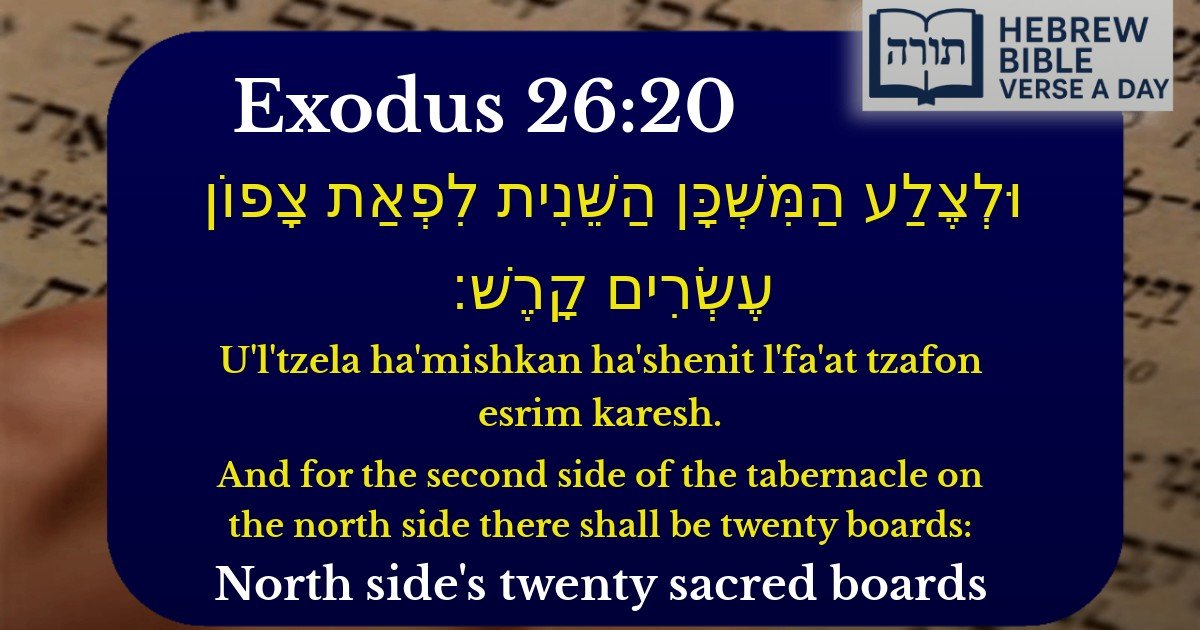

Structural Significance of the Tabernacle's North Side
The verse (Exodus 26:20) describes the construction of the second side of the Mishkan (Tabernacle) on the north side, specifying twenty boards. Rashi (Exodus 26:20) explains that this refers to the northern wall of the Mishkan, which mirrored the southern wall in its dimensions and structure. The symmetry in the Mishkan's design reflects the divine order and balance inherent in Hashem's sanctuary.
Symbolism of the Number Twenty
The number twenty holds significance in Jewish tradition. The Midrash Tanchuma (Pekudei 5) connects it to the twenty generations from Adam to Abraham, suggesting that the Mishkan serves as a rectification (tikkun) for the spiritual deficiencies of those generations. Additionally, the Rambam (Hilchos Beis Habechira 1:12) notes that the number twenty may allude to the completeness of the Mishkan's structure, as it forms a stable foundation for the dwelling of the Shechinah (Divine Presence).
The North Side in Jewish Thought
The north side of the Mishkan is often associated with judgment (din) in Kabbalistic teachings. The Zohar (Terumah 129a) explains that the north represents the attribute of gevurah (strength or severity), contrasting with the south, which symbolizes chesed (kindness). This duality reflects the balance of divine attributes in the world. The placement of the Shulchan (Table of Showbread) on the north side (Menachos 98b) further emphasizes this theme, as bread represents sustenance, which requires both divine kindness and measured judgment.