
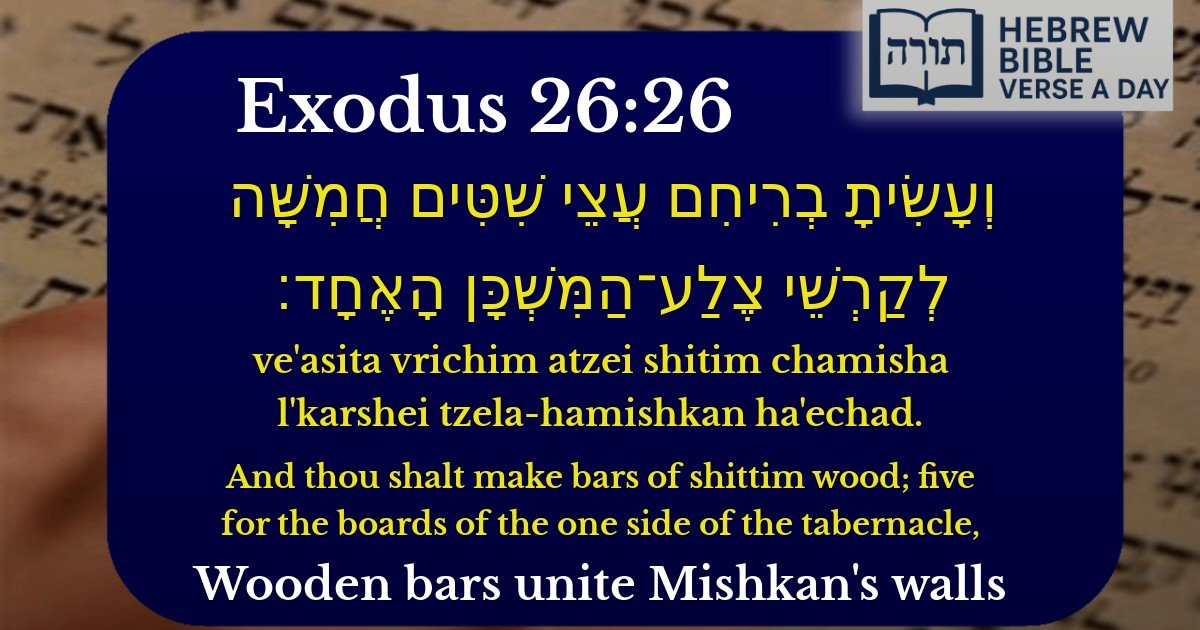

Exodus 26:26 - Wooden bars unite Mishkan's walls

Exodus 26:26 - שמות 26:26

Hebrew Text

וְעָשִׂיתָ בְרִיחִם עֲצֵי שִׁטִּים חֲמִשָּׁה לְקַרְשֵׁי צֶלַע־הַמִּשְׁכָּן הָאֶחָד׃

English Translation

And thou shalt make bars of shittim wood; five for the boards of the one side of the tabernacle,

Transliteration

Ve'asita vrichim atzei shitim chamisha l'karshei tzela-hamishkan ha'echad.

Hebrew Leining Text

וְעָשִׂ֥יתָ בְרִיחִ֖ם עֲצֵ֣י שִׁטִּ֑ים חֲמִשָּׁ֕ה לְקַרְשֵׁ֥י צֶֽלַע־הַמִּשְׁכָּ֖ן הָאֶחָֽד׃

🎵 Listen to leining

Parasha Commentary

The Bars of Shittim Wood

The verse (Exodus 26:26) commands the construction of five horizontal bars made of shittim wood (acacia wood) to reinforce the boards of the Mishkan's walls. Rashi explains that these bars served as crossbeams to hold the upright boards firmly in place, preventing them from swaying or separating. The number five corresponds to the five bars needed for each of the Mishkan's three walls (north, south, and west), ensuring structural integrity.

Symbolism of Shittim Wood

The choice of shittim wood carries deeper meaning. The Midrash (Shemot Rabbah 35:2) notes that shittim wood is durable and resistant to decay, symbolizing the eternal nature of the Torah and the Jewish people. Rambam (Hilchot Beit HaBechirah 1:13) further emphasizes that materials used in sacred structures must be of the highest quality, reflecting the holiness of the Mishkan.

The Five Bars and Their Spiritual Significance

  • Unity: The five bars represent the unifying force of Torah, holding the Jewish people together, much like they held the Mishkan's structure (based on Likutei Torah by the Chassidic masters).
  • Divine Protection: The Zohar (Terumah 152a) suggests that the five bars correspond to the five levels of the soul (Nefesh, Ruach, Neshama, Chaya, Yechida), symbolizing divine protection over Israel.
  • Hidden and Revealed: The Talmud (Yoma 72a) notes that while some bars were visible, others were overlaid with gold and hidden, teaching that some aspects of Torah are revealed, while others remain concealed.

Structural Parallels in Jewish Thought

The Malbim explains that the five bars parallel the five books of the Torah, which serve as the foundation of Jewish life, just as the bars supported the Mishkan. This reinforces the idea that Torah study and observance are the sustaining forces of the Jewish people, much like the bars upheld the Mishkan's structure.

📚 Talmud Citations

This verse is not quoted in the Talmud.

Frequently Asked Questions

Q: What are the 'bars of shittim wood' mentioned in Exodus 26:26?
A: The 'bars of shittim wood' (עֲצֵי שִׁטִּים) were horizontal beams made from acacia wood used to hold together the wooden boards of the Mishkan (Tabernacle). According to Rashi, these bars provided stability and kept the structure firm. Shittim wood was chosen because it was durable and readily available in the desert.
Q: Why were there specifically five bars for one side of the Mishkan?
A: The five bars corresponded to the five wooden boards on one side of the Mishkan, as explained in the Talmud (Shabbat 98b). Each bar helped connect and reinforce the structure. The number five also symbolizes completeness in Jewish tradition, reflecting the Mishkan's sacred purpose.
Q: What is the significance of using shittim (acacia) wood for the Mishkan?
A: Shittim wood was used because it was strong, resistant to decay, and readily available in the wilderness (Midrash Tanchuma, Terumah 9). Additionally, the Rambam notes that its durability symbolized the eternal nature of the Divine presence dwelling among the Jewish people.
Q: How does the construction of the Mishkan apply to us today?
A: Just as the Mishkan was built with precision and care, we learn the importance of dedicating our efforts to holy purposes. The Talmud (Berachot 8a) teaches that synagogues and study halls are considered 'miniature sanctuaries,' reminding us to approach them with the same reverence as the Mishkan.