Frequently Asked Questions
Q: What does Exodus 26:3 mean when it talks about curtains being coupled together?
A: This verse describes the construction of the Mishkan (Tabernacle). The 'curtains' (yeriot) were large woven tapestries made of fine materials like linen and wool. They were joined together in sets of five to form the covering of the Mishkan. Rashi explains that 'coupled together' means they were looped together with golden clasps to create one unified structure.
Q: Why were there two sets of five curtains in the Mishkan?
A: According to the Talmud (Shabbat 98b), the Mishkan had two layers of coverings: an inner layer of fine linen (described here) and an outer layer of goat hair. The two sets of five curtains each created the complete inner covering. The Midrash teaches that this doubling represents both physical protection and spiritual completeness in Hashem's dwelling place.
Q: What can we learn from how the Mishkan's curtains were joined?
A: The Rambam teaches that the precise joining of the curtains symbolizes how all components of Jewish life must connect harmoniously. Just as each curtain had to align perfectly with its counterpart, our mitzvot and community relationships must be properly 'joined' to create holiness. The Talmud Yerushalmi notes this also teaches the importance of unity among the Jewish people.
Q: Why specifically five curtains in each set?
A: The number five appears frequently in the Mishkan's construction. The Midrash (Bamidbar Rabbah 12:16) connects this to the five books of the Torah, showing that the Mishkan - like our lives - should be built upon Torah foundations. Others suggest it represents the five levels of soul (nefesh, ruach, neshamah, chayah, yechidah) that connect us to divine service.
Q: How does this verse about the Mishkan apply to us today?
A: While we no longer have the physical Mishkan, the Talmud (Berachot 8a) teaches that our synagogues and homes can become 'miniature sanctuaries.' Just as the curtains were carefully joined, we must thoughtfully connect the different aspects of our Jewish lives - prayer, Torah study, and acts of kindness - to create sacred spaces in our daily lives.

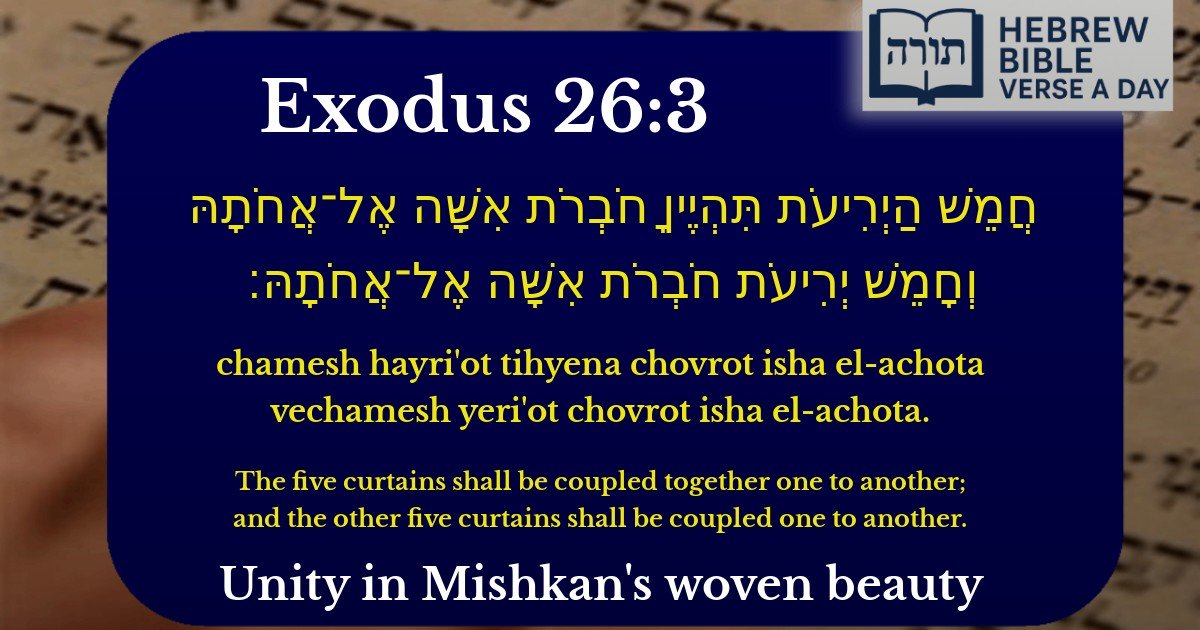

Context in the Mishkan
The verse (Shemot 26:3) describes the construction of the curtains (yeriot) for the Mishkan (Tabernacle). According to Rashi, these curtains were made of fine twisted linen and blue, purple, and scarlet wool, with woven cherubim designs. The instruction to couple five curtains together (choverot isha el achota) and then join another set of five signifies the unity and completeness required in the Mishkan's structure.
Symbolism of the Number Five
Rambam (Maimonides) and other commentators note that the number five often carries symbolic meaning in Torah. In this context, the five curtains may allude to:
Joining the Curtains
The phrase "choverot isha el achota" (coupled one to another) is interpreted by the Midrash (Shemot Rabbah 35:6) as emphasizing harmony and seamless connection. The Talmud (Shabbat 99a) elaborates that the loops (taba'ot) and clasps (vavim) used to join them symbolize unity among the Jewish people, just as the curtains must be perfectly aligned to form a single covering.
Practical Halachic Implications
The Mishneh Torah (Hilchot Beit HaBechirah 1:3) derives from this verse the principle that sacred structures must be assembled with precision and care. The coupling of the curtains teaches that every detail in avodat Hashem (divine service) must be intentional and unified, reflecting the order and beauty of kedushah (holiness).