

Join Our Newsletter To Be Informed When New Videos Are Posted
Hebrew Text
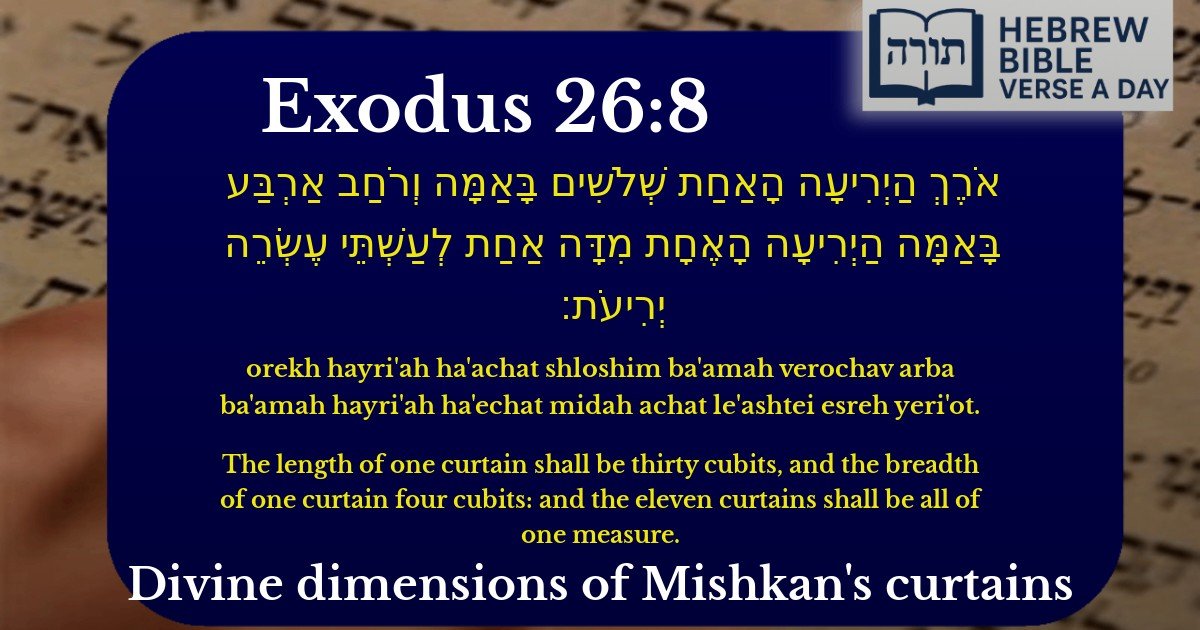
אֹרֶךְ הַיְרִיעָה הָאַחַת שְׁלֹשִׁים בָּאַמָּה וְרֹחַב אַרְבַּע בָּאַמָּה הַיְרִיעָה הָאֶחָת מִדָּה אַחַת לְעַשְׁתֵּי עֶשְׂרֵה יְרִיעֹת׃
English Translation
The length of one curtain shall be thirty cubits, and the breadth of one curtain four cubits: and the eleven curtains shall be all of one measure.
Transliteration
Orekh hayri'ah ha'achat shloshim ba'amah verochav arba ba'amah hayri'ah ha'echat midah achat le'ashtei esreh yeri'ot.
Hebrew Leining Text
אֹ֣רֶךְ&thinsp
🎵 Listen to leining
Parasha Commentary
📚 Talmud Citations
This verse is not quoted in the Talmud.
Dimensions of the Mishkan's Curtains
The verse describes the measurements of the curtains (yeriot) used in the construction of the Mishkan (Tabernacle). Each curtain was 30 cubits long and 4 cubits wide, with all eleven curtains being of identical size. Rashi (Exodus 26:8) explains that these curtains formed the outer covering of the Mishkan, made of goat hair, and were placed over the inner curtains of fine linen.
Symbolism of the Measurements
The Midrash (Shemot Rabbah 35:6) notes that the number thirty alludes to the Luchot HaBrit (Tablets of the Covenant), which were inscribed on both sides. The Talmud (Bava Batra 14a) teaches that each tablet measured 6 cubits in length, 6 in width, and 3 in thickness—totaling 30 cubits when accounting for all dimensions. Thus, the curtains' length hints at the Torah's centrality in the Mishkan.
Eleven Curtains and Their Significance
The Kli Yakar (Exodus 26:7) raises a question: Why were there eleven curtains instead of ten, which would correspond neatly with the ten inner linen curtains? He explains that the extra curtain symbolizes the concept of tikkun (rectification)—just as the world was created with ten utterances but requires human effort to perfect it, the Mishkan's structure includes an "additional" element representing mankind's role in elevating the physical world for divine service.