Frequently Asked Questions
Q: What is the significance of the materials (brass and silver) used in the Mishkan's pillars?
A: According to Rashi and other commentators, brass (nechoshet) symbolizes strength and durability, as it was used for the sockets that supported the Mishkan's structure. Silver (kesef), used for the hooks and joints, represents a higher level of purity and beauty. The combination teaches that both strength (brass) and refinement (silver) are necessary in serving Hashem.
Q: Why does the Torah give such detailed descriptions of the Mishkan's construction?
A: The Rambam explains that every detail of the Mishkan's construction carries deep spiritual lessons. The precise measurements and materials remind us that serving Hashem requires attention to detail, order, and dedication. The Midrash also teaches that the Mishkan is a microcosm of the universe, reflecting divine wisdom in its design.
Q: What do the pillars and sockets represent in a spiritual sense?
A: The Talmud (Yoma 72a) compares the pillars and their sockets to the relationship between Torah scholars (the pillars) and the community (the sockets) that supports them. Just as the brass sockets provided a firm foundation for the silver-adorned pillars, a strong community enables spiritual growth and learning.
Q: How can we apply the lesson of the Mishkan's construction today?
A: The Kli Yakar explains that just as the Mishkan was built with both functional (brass) and beautiful (silver) elements, our lives should balance practical needs with spiritual beauty. Additionally, the unity of different materials teaches that every Jew has a unique role in building a 'dwelling place' for the Divine in this world.
Q: Why were the hooks made of silver while the sockets were brass?
A: Rashi notes that the silver hooks (vavei ha'amudim) held up the curtains, representing the finer details that 'connect' the structure. Brass, being stronger, was better suited for the weight-bearing sockets. This teaches that in spiritual life, some elements require durability (like consistent mitzvah observance), while others require delicacy (like interpersonal relationships).


Context in the Mishkan
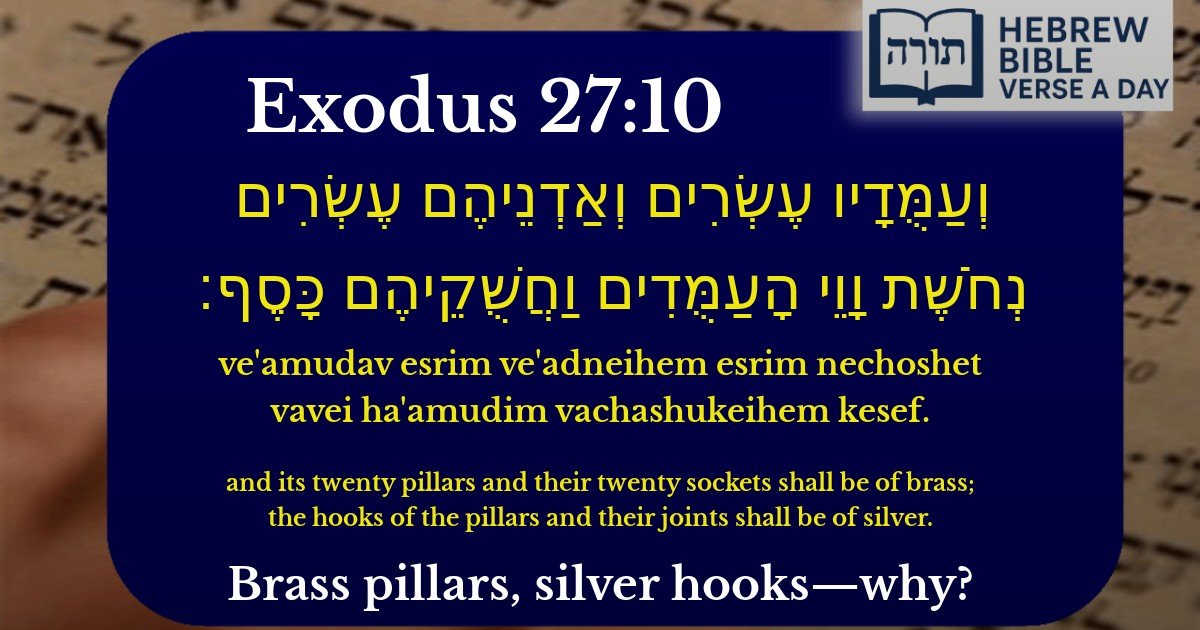
The verse (Shemot 27:10) describes the construction of the courtyard (Chatzer) of the Mishkan (Tabernacle). The twenty pillars with their brass sockets and silver hooks and bands formed part of the enclosure surrounding the sacred space. Rashi explains that these pillars supported the curtains (yeri'ot) that demarcated the boundaries of the Chatzer.
Symbolism of Materials
Structural Details
Rambam (Hilchot Beit HaBechirah 1:15) derives from this verse that the pillars were set into sockets to ensure stability. The hooks (vavim) held the curtains in place, while the bands (chashukim), according to the Malbim, were decorative rings that reinforced the pillars.
Numerical Significance
The number twenty (עֶשְׂרִים) appears twice, emphasizing completeness. The Baal HaTurim connects this to the twenty generations from Adam to Avraham, suggesting that the Mishkan rectified the spiritual deficiencies of those generations.