Frequently Asked Questions
Q: What does Exodus 27:12 describe?
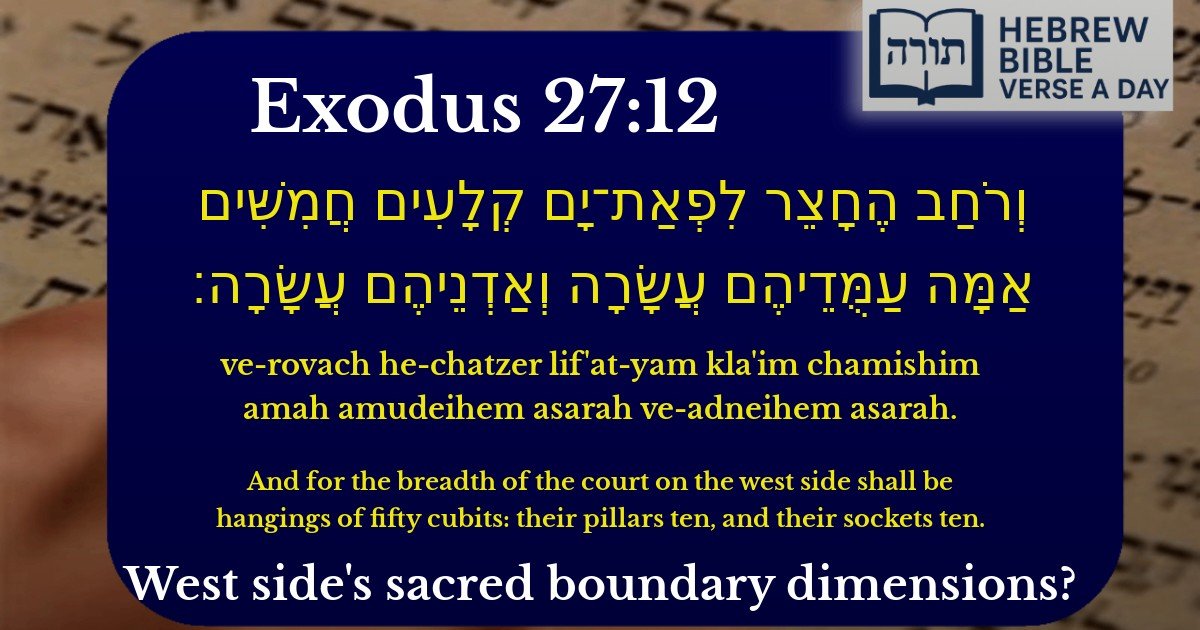
A: Exodus 27:12 describes the measurements and structure of the western side of the courtyard (חָצֵר) of the Mishkan (Tabernacle). It specifies that there were hangings (קְלָעִים) spanning 50 cubits, supported by 10 pillars (עַמֻּדֵיהֶם) with 10 sockets (אַדְנֵיהֶם) as their foundations.
Q: Why is the measurement of the Mishkan's courtyard important?
A: The precise measurements of the Mishkan's courtyard are important because they reflect the divine instructions given to Moshe (Moses) for building a sacred space where Hashem's Presence would dwell (שכינה). The Rambam explains that every detail in the Mishkan's construction teaches us about order, holiness, and devotion to serving G-d properly.
Q: What do the hangings (קְלָעִים) in the verse represent?
A: The hangings (קְלָעִים) were woven screens that separated the holy space of the Mishkan from the outside. Rashi explains that these hangings served as a boundary, teaching us the importance of creating distinctions between sacred and ordinary spaces in our lives, both physically and spiritually.
Q: Why were there exactly 10 pillars and sockets on the west side?
A: The number 10 is significant in Jewish tradition, representing completeness (as in the Ten Commandments or the Ten Utterances of Creation). The Midrash teaches that the 10 pillars on the west side correspond to spiritual concepts, such as the 10 tests of Avraham or the 10 levels of holiness in the Mishkan.
Q: How does this verse apply to us today?
A: Although we no longer have the Mishkan, the principles remain relevant. The verse teaches us about the importance of structure, boundaries, and reverence in serving Hashem. Just as the Mishkan had precise measurements, we apply this by creating designated spaces for prayer, study, and acts of kindness in our daily lives.


Context in the Mishkan (Tabernacle)
This verse (Exodus 27:12) describes the dimensions and structure of the western side of the courtyard (chatzer) surrounding the Mishkan. The courtyard was enclosed by hangings (kelaim) supported by pillars (amudim) and sockets (adanim). The western side measured fifty cubits in breadth, with ten pillars and ten sockets.
Rashi's Explanation
Rashi (Exodus 27:12) clarifies that the fifty-cubit measurement refers to the width of the courtyard's western side. He notes that the ten pillars were spaced evenly, with five cubits between each pillar, as the total length (50 cubits) divided by the number of intervals (nine) yields approximately 5.5 cubits per span. However, Rashi suggests that the pillars were placed slightly closer at the ends to maintain symmetry.
Symbolism of the West Side
The Midrash (Bamidbar Rabbah 12:21) associates the western side of the Mishkan with the tribe of Ephraim, who camped to the west during the Israelites' travels. The west also symbolizes the setting sun, representing humility and submission to Hashem's will, as the sun "bows" at nightfall.
Structural Details from Rambam
In Hilchot Beit HaBechirah (Laws of the Temple), Rambam (Maimonides) explains that the hangings were made of fine twisted linen (Exodus 27:9), and the pillars were likely of acacia wood overlaid with silver (based on Exodus 27:10-11). The sockets, which anchored the pillars, were made of copper (Exodus 38:17).
Numerical Significance
Halachic Implications
The Talmud (Zevachim 59b) derives from this verse that the courtyard's dimensions must be precise, as any deviation would invalidate the sanctity of the Mishkan's service. This teaches the importance of adhering to divine specifications in sacred matters.