

Join Our Newsletter To Be Informed When New Videos Are Posted
Hebrew Text
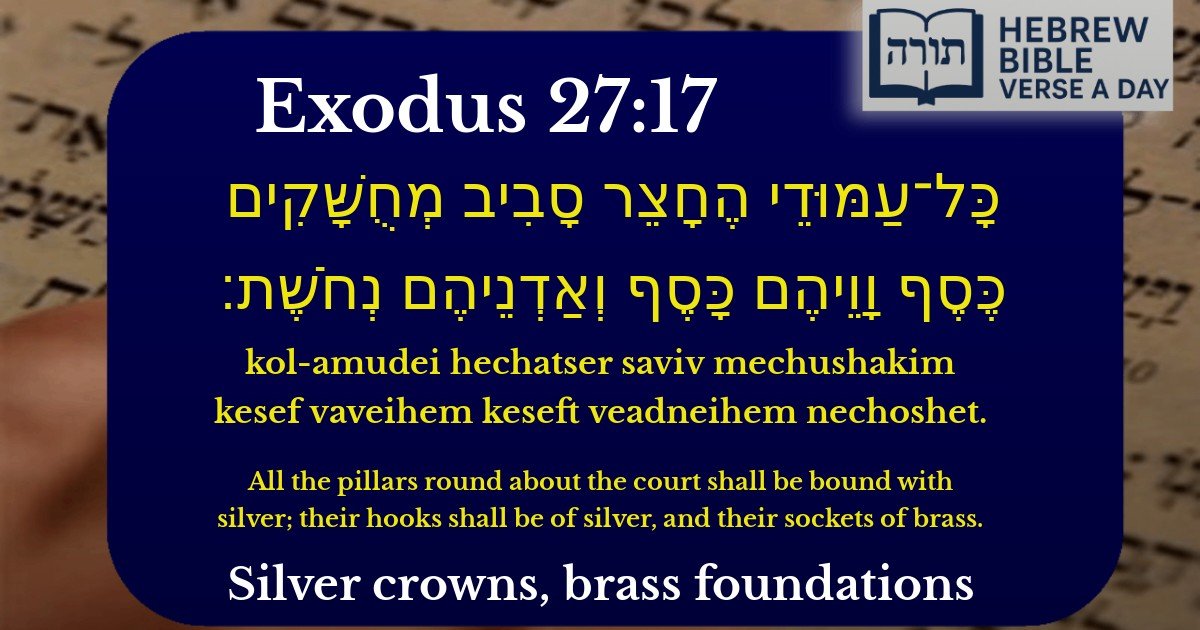
כָּל־עַמּוּדֵי הֶחָצֵר סָבִיב מְחֻשָּׁקִים כֶּסֶף וָוֵיהֶם כָּסֶף וְאַדְנֵיהֶם נְחֹשֶׁת׃
English Translation
All the pillars round about the court shall be bound with silver; their hooks shall be of silver, and their sockets of brass.
Transliteration
Kol-amudei hechatser saviv mechushakim kesef vaveihem keseft veadneihem nechoshet.
Hebrew Leining Text
כׇּל־עַמּוּדֵ֨י הֶֽחָצֵ֤ר סָבִיב֙ מְחֻשָּׁקִ֣ים כֶּ֔סֶף וָוֵיהֶ֖ם כָּ֑סֶף וְאַדְנֵיהֶ֖ם נְחֹֽשֶׁת׃
🎵 Listen to leining
Parasha Commentary
📚 Talmud Citations
This verse is not quoted in the Talmud.
Explanation of the Verse
The verse (Exodus 27:17) describes the construction details of the courtyard (Chatzer) of the Mishkan (Tabernacle), specifying that the pillars surrounding the courtyard were bound with silver, their hooks were made of silver, and their sockets were made of brass (nechoshet).
Symbolism of the Materials
Rashi (Exodus 27:10) explains that the silver used for the hooks (vavim) and the bands (chishuk) around the pillars symbolizes refinement and purity, as silver is a precious metal associated with atonement (see Exodus 30:12-16, where silver is used for the half-shekel offering). The brass (nechoshet) sockets, on the other hand, represent durability and strength, as brass is a strong and enduring material.
Structural and Spiritual Significance
The Midrash (Tanchuma, Terumah 11) elaborates that the silver bands holding the pillars together signify unity among the Jewish people, just as the pillars were bound together to form the structure of the courtyard. The hooks (vavim) of silver, which held the curtains in place, allude to the mitzvot that connect (mechaber) the Jewish people to Hashem.
Hierarchy of Materials
Rabbi Samson Raphael Hirsch (Exodus 27:17) notes that the use of different metals—silver for the upper parts and brass for the foundations—reflects a spiritual hierarchy. Silver, being more refined, represents higher spiritual aspirations, while brass, being more utilitarian, represents the foundational aspects of physical and moral strength necessary to uphold holiness.
Practical Halachic Insight
The Rambam (Hilchot Beit HaBechirah 1:15) derives from this verse that the materials used in sacred structures must be chosen with care, reflecting both functionality and sanctity. The combination of silver and brass teaches that even the supporting elements of the Mishkan must be treated with reverence.