Frequently Asked Questions
Q: What is the significance of the stones in Exodus 28:17?
A: The stones mentioned in Exodus 28:17 were part of the Choshen (breastplate) worn by the Kohen Gadol (High Priest). Each stone represented one of the 12 tribes of Israel (Rashi on Exodus 28:21). The stones served as a constant reminder before Hashem of His covenant with the Jewish people.
Q: Why were there four rows of stones on the breastplate?
A: The four rows (each containing three stones) corresponded to the four matriarchs (Sarah, Rivka, Rachel, and Leah) and the twelve tribes descended from them (Midrash Tanchuma, Tetzaveh 10). This arrangement symbolized the unity of the Jewish people under Hashem's protection.
Q: What was the purpose of the High Priest's breastplate with these stones?
A: The breastplate (Choshen) with its stones served multiple purposes: 1) It was part of the sacred garments required for service in the Mishkan (Tabernacle), 2) The stones helped the Kohen Gadol atone for errors in judgment (Rambam, Hilchos Klei HaMikdash 9:7), and 3) Through Divine inspiration, the stones could light up to answer questions for the Jewish people (Talmud Yoma 73a).
Q: Do we know which modern gemstones correspond to the stones mentioned in Exodus 28:17?
A: While the exact identification of some stones is debated among commentators, Orthodox tradition maintains that the first stone mentioned ('Odem') is certainly a ruby (Rashi on Exodus 28:17). The precise identities of some other stones have been lost over time, but they were all precious stones of great value, reflecting the honor due to the tribes they represented.
Q: What lesson can we learn today from the breastplate stones?
A: The breastplate teaches us that every Jew is precious like a unique gemstone (Midrash Rabbah, Numbers 2:7). Just as the stones were united on one breastplate, we must maintain Jewish unity while recognizing each individual's unique qualities. The breastplate also reminds us that our leaders must carry the concerns of all Jews in their hearts (literally, over the heart - Exodus 28:29).

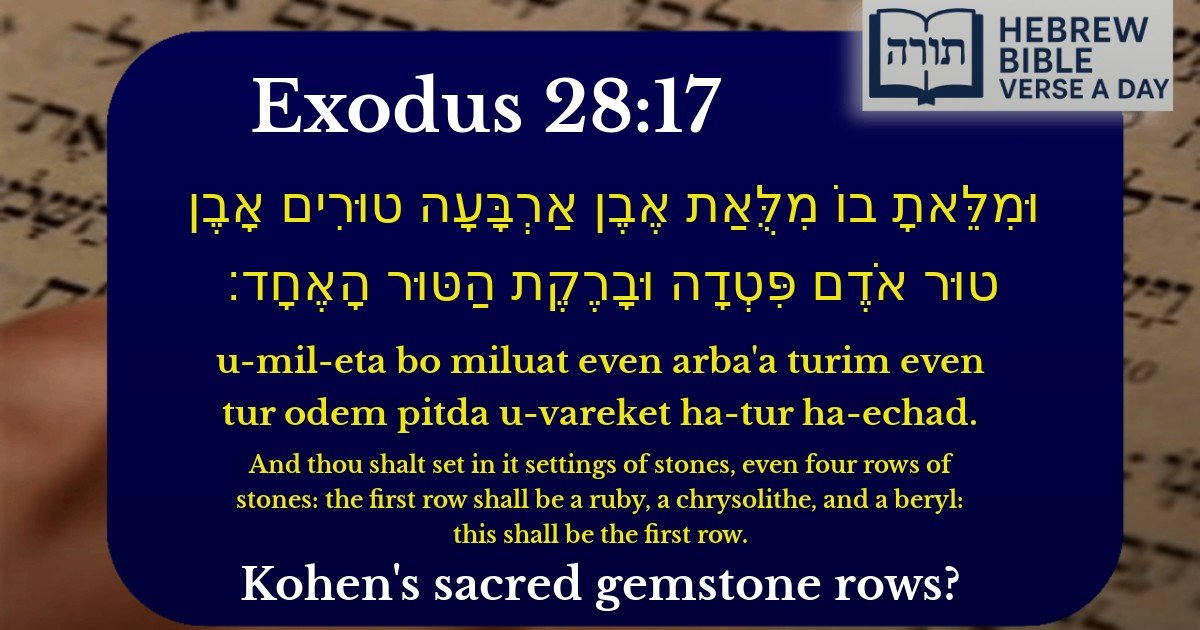

The Stones of the Choshen (Breastplate)
The verse describes the arrangement of precious stones in the Choshen Mishpat (Breastplate of Judgment), which was worn by the Kohen Gadol (High Priest). According to Rashi (Shemos 28:17), these stones were set in gold and engraved with the names of the twelve tribes of Israel, symbolizing their representation before Hashem.
The Four Rows and Their Significance
The Talmud (Yoma 73b) explains that the Choshen served as a means of divine communication, with the letters on the stones illuminating to convey answers from Hashem. The four rows correspond to the four matriarchs (Sarah, Rivka, Rachel, and Leah), as per Midrash Tanchuma (Pekudei 3), emphasizing their foundational role in the tribes of Israel.
Identification of the Stones
Rambam (Hilchos Klei HaMikdash 9:7) discusses the identity of the stones, though their exact translation is debated among commentators:
Spiritual Symbolism
The Midrash (Bamidbar Rabbah 2:7) teaches that each stone reflected the unique spiritual quality of its corresponding tribe. The Choshen thus unified the diversity of Klal Yisrael into a harmonious whole before Hashem. The Kli Yakar (Shemos 28:15) adds that the stones' brilliance represented the light of Torah and mitzvos shining through the Jewish people.