
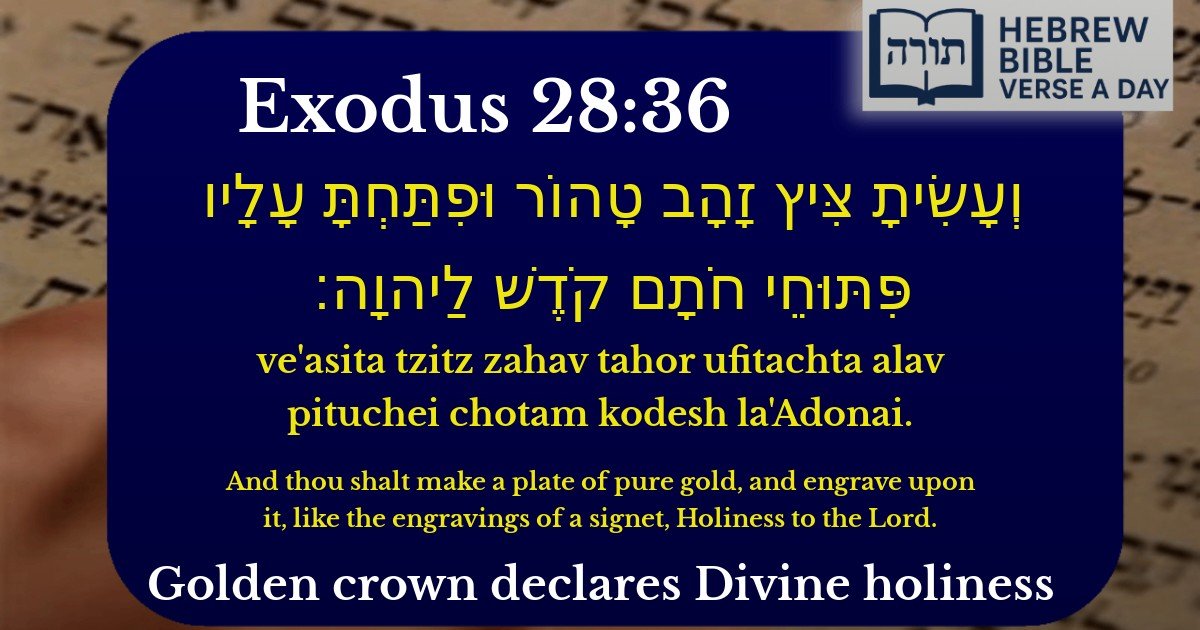

Exodus 28:36 - Golden crown declares Divine holiness

Exodus 28:36 - שמות 28:36

Hebrew Text

וְעָשִׂיתָ צִּיץ זָהָב טָהוֹר וּפִתַּחְתָּ עָלָיו פִּתּוּחֵי חֹתָם קֹדֶשׁ לַיהוָה׃

English Translation

And thou shalt make a plate of pure gold, and engrave upon it, like the engravings of a signet, Holiness to the Lord.

Transliteration

Ve'asita tzitz zahav tahor ufitachta alav pituchei chotam kodesh la'Adonai.

Hebrew Leining Text

וְעָשִׂ֥יתָ צִּ֖יץ זָהָ֣ב טָה֑וֹר וּפִתַּחְתָּ֤ עָלָיו֙ פִּתּוּחֵ֣י חֹתָ֔ם קֹ֖דֶשׁ לַֽיהֹוָֽה׃

🎵 Listen to leining

Parasha Commentary

The Tzitz (Golden Plate) and Its Significance

The verse (Shemot 28:36) commands the creation of the Tzitz, a golden plate worn on the forehead of the Kohen Gadol (High Priest). Rashi explains that it was a thin band of gold, two fingerbreadths wide, spanning from ear to ear, upon which the words "Kodesh LaHashem" (Holy to the Lord) were engraved.

Engraving "Kodesh LaHashem"

The phrase "Kodesh LaHashem" was inscribed in the same manner as a signet ring's engraving, meaning the letters were raised rather than sunken (Rambam, Hilchot Klei HaMikdash 9:1). The Talmud (Shabbat 63b) notes that this method ensured the words were clearly visible, symbolizing the constant awareness of holiness before Hashem.

Purpose and Symbolism

According to the Midrash (Shemot Rabbah 38:8), the Tzitz served as an atonement for arrogance, as it rested on the Kohen Gadol's forehead—the seat of pride. The Zohar (Terumah 179a) further teaches that the Tzitz channeled divine light, sanctifying the Kohen Gadol's service.

  • Atonement for Sacrilege: The Talmud (Zevachim 88b) states that the Tzitz atoned for improper intentions during sacrificial offerings.
  • Public Declaration: The raised letters proclaimed the sanctity of the divine service, reminding all who saw it of Hashem's holiness (Malbim on Shemot 28:36).
  • Connection to the Mishkan: The Tzitz paralleled the Ark's cover, both made of pure gold, symbolizing unity between the Kohen Gadol and the Mishkan's sanctity (Kli Yakar).

📚 Talmud Citations

This verse is quoted in the Talmud.

📖 Zevachim 19b
The verse is referenced in a discussion about the priestly garments, specifically the golden plate (tzitz) worn on the forehead of the High Priest.
📖 Arakhin 16a
The verse is cited in a discussion about the sanctity and the engravings on the golden plate.
📖 Menachot 28a
The verse is mentioned in the context of the making of the priestly garments and the specific requirements for the golden plate.

Frequently Asked Questions

Q: What is the 'tzitz' (plate of gold) mentioned in Exodus 28:36?
A: The 'tzitz' was a thin plate of pure gold worn on the forehead of the Kohen Gadol (High Priest). According to Rashi, it was engraved with the words 'Kodesh LaHashem' (Holy to the Lord) and was tied with a blue cord to the front of the turban. It served as a constant reminder of the sanctity of the service in the Mishkan (Tabernacle).
Q: Why was the phrase 'Holy to the Lord' engraved on the tzitz?
A: The Talmud (Zevachim 88b) explains that the inscription 'Holy to the Lord' on the tzitz atoned for any improper thoughts or arrogance during the Temple service. The Rambam (Hilchos Klei HaMikdash 9:1) adds that it symbolized the complete dedication of the Kohen Gadol's service to Hashem, representing purity and holiness in all actions.
Q: What can we learn from the tzitz in our daily lives today?
A: The Midrash (Shemos Rabbah 38:8) teaches that just as the tzitz was worn on the forehead—a prominent place—we should always keep holiness at the forefront of our thoughts and actions. Even though we no longer have the Temple, we can emulate this idea by dedicating our deeds to serving Hashem with purity and mindfulness.
Q: Was the tzitz worn by all Kohanim (priests) or only the Kohen Gadol?
A: According to the Mishnah (Yoma 7:5) and Rambam (Hilchos Klei HaMikdash 9:1), the tzitz was unique to the Kohen Gadol and was not worn by regular Kohanim. It was one of the eight special garments that only the High Priest wore while performing service in the Mishkan and later the Temple.
Q: How was the tzitz made, and what were its dimensions?
A: The Talmud (Shabbos 63b) states that the tzitz was a thin rectangular plate of pure gold, measuring '2 fingerbreadths in height and spanning the width of the forehead.' Rashi (on Exodus 28:36) explains that it was engraved with the words 'Kodesh LaHashem' in reverse (like a seal) so it would appear correctly when pressed or viewed.