
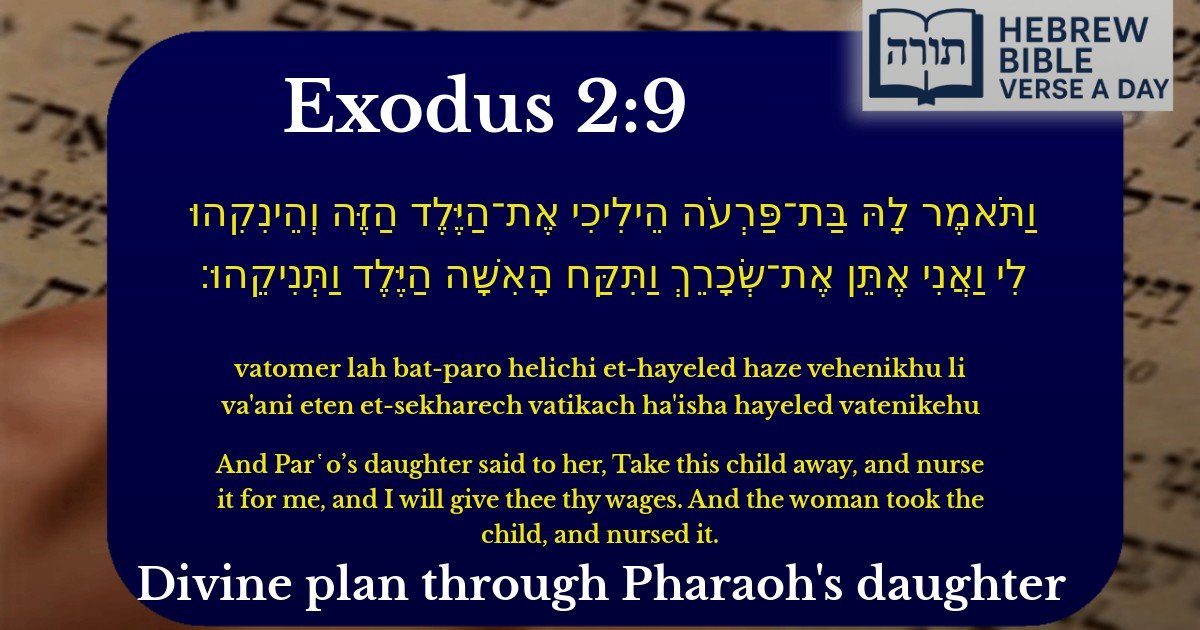

Exodus 2:9 - Divine plan through Pharaoh's daughter

Exodus 2:9 - שמות 2:9

Hebrew Text

וַתֹּאמֶר לָהּ בַּת־פַּרְעֹה הֵילִיכִי אֶת־הַיֶּלֶד הַזֶּה וְהֵינִקִהוּ לִי וַאֲנִי אֶתֵּן אֶת־שְׂכָרֵךְ וַתִּקַּח הָאִשָּׁה הַיֶּלֶד וַתְּנִיקֵהוּ׃

English Translation

And Par῾o’s daughter said to her, Take this child away, and nurse it for me, and I will give thee thy wages. And the woman took the child, and nursed it.

Transliteration

Vatomer lah bat-paro helichi et-hayeled haze vehenikhu li va'ani eten et-sekharech vatikach ha'isha hayeled vatenikehu

Hebrew Leining Text

וַתֹּ֧אמֶר לָ֣הּ בַּת־פַּרְעֹ֗ה הֵילִ֜יכִי אֶת־הַיֶּ֤לֶד הַזֶּה֙ וְהֵינִקִ֣הוּ לִ֔י וַאֲנִ֖י אֶתֵּ֣ן אֶת־שְׂכָרֵ֑ךְ וַתִּקַּ֧ח הָאִשָּׁ֛ה הַיֶּ֖לֶד וַתְּנִיקֵֽהוּ׃

🎵 Listen to leining

Parasha Commentary

Pharaoh's Daughter's Compassion and Divine Providence

The verse (Shemot 2:9) describes how Pharaoh's daughter, Batya, instructs Miriam to nurse Moshe and offers to pay her wages. Rashi explains that Batya recognized Moshe as a Hebrew child but chose to save him despite her father's decree. This act demonstrates her righteousness, and the Midrash (Shemot Rabbah 1:26) identifies her as one of the few righteous converts in Tanach, meriting to enter Gan Eden alive.

The Role of Miriam in Moshe's Upbringing

When Batya says, "Take this child away and nurse it for me," the phrase "for me" (לִי) is significant. The Talmud (Sotah 12b) explains that Batya intended to raise Moshe as her own son, yet allowed him to be nursed by his biological mother, Yocheved. This arrangement ensured Moshe would be raised with Jewish values despite growing up in Pharaoh's palace. Ramban notes that this was part of Hashem's plan to prepare Moshe for leadership.

The Divine Reward for Yocheved

The verse states that Batya promised to pay wages ("I will give thee thy wages"). The Midrash (Shemot Rabbah 1:26) teaches that this was not merely monetary compensation but a spiritual reward: Yocheved merited to nurse the future redeemer of Israel. Additionally, the Sforno highlights that this arrangement allowed Yocheved to instill faith and identity in Moshe during his formative years.

Symbolism of Nursing and Nurturing

  • Physical and Spiritual Sustenance: The Malbim explains that nursing represents both physical nourishment and the transmission of values. Yocheved provided Moshe with milk (physical sustenance) and Torah values (spiritual sustenance).
  • Hidden Divine Plan: The Kli Yakar emphasizes that Batya unknowingly fulfilled Hashem's plan by returning Moshe to his mother, ensuring he would grow up aware of his heritage.

📚 Talmud Citations

This verse is not quoted in the Talmud.

Frequently Asked Questions

Q: Who is speaking in Exodus 2:9 and who is she talking to?
A: In Exodus 2:9, Pharaoh's daughter is speaking to Yocheved, Moshe's (Moses') mother. After finding baby Moshe in the Nile, Pharaoh's daughter asks Yocheved to nurse him, not realizing she is his real mother (Rashi on Exodus 2:6).
Q: Why did Pharaoh's daughter pay Yocheved to nurse Moshe?
A: Pharaoh's daughter paid Yocheved to nurse Moshe because she wanted to raise him as her own son but needed a wet nurse. According to the Midrash (Shemot Rabbah 1:26), this was part of Hashem's plan to ensure Moshe would be raised with Jewish values by his own mother during his early years.
Q: What lesson can we learn from Yocheved nursing Moshe in Exodus 2:9?
A: We learn about hashgacha pratit (divine providence) - how Hashem orchestrates events for the good. Even in difficult situations (like Pharaoh's decree), Hashem made sure Moshe would be saved and raised by his own mother. The Talmud (Sotah 12b) also notes this shows the reward for kindness, as Yocheved was paid for nursing her own child.
Q: Why is it significant that Moshe was nursed by his biological mother?
A: It was crucial for Moshe's development to be nursed by Yocheved because, as Rashi explains (Exodus 2:9), a baby absorbs the mother's traits through nursing. Being with his real mother ensured Moshe would inherit Jewish values and identity despite growing up in Pharaoh's palace (Mechilta on Exodus 2:9).
Q: How does Exodus 2:9 show the importance of Jewish mothers?
A: This verse highlights the vital role of Jewish mothers in transmitting faith and identity. The Midrash (Shemot Rabbah 1:26) emphasizes that Yocheved's care during Moshe's early years laid the foundation for his future leadership. This teaches that a mother's influence in childhood shapes a person's entire character.