

Join Our Newsletter To Be Informed When New Videos Are Posted
Hebrew Text
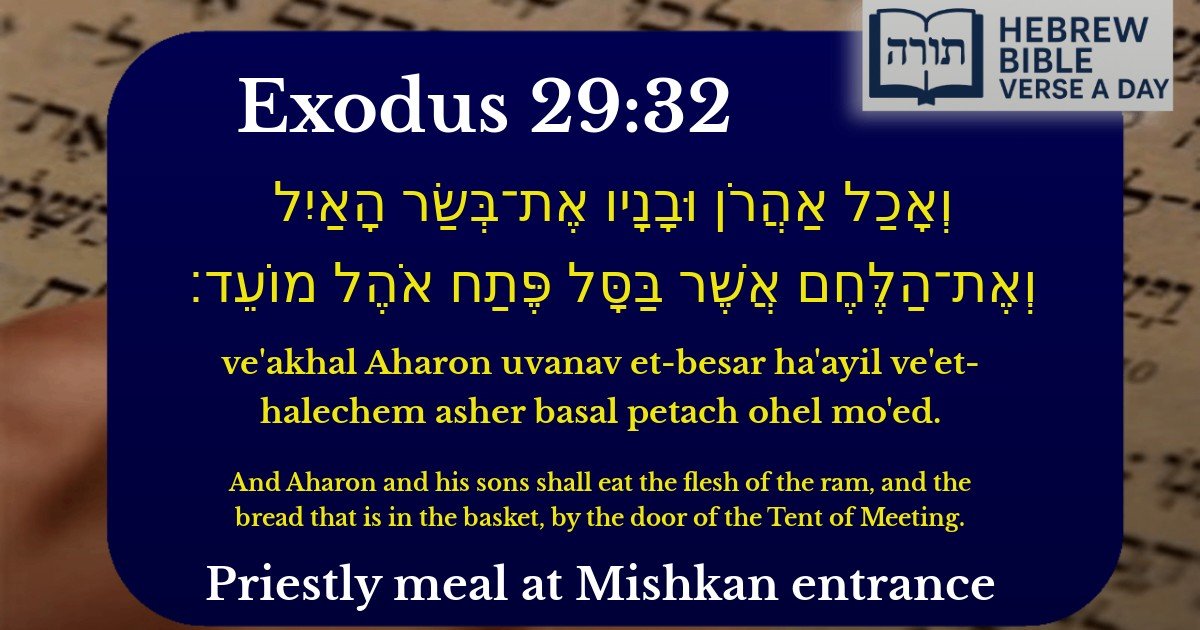
וְאָכַל אַהֲרֹן וּבָנָיו אֶת־בְּשַׂר הָאַיִל וְאֶת־הַלֶּחֶם אֲשֶׁר בַּסָּל פֶּתַח אֹהֶל מוֹעֵד׃
English Translation
And Aharon and his sons shall eat the flesh of the ram, and the bread that is in the basket, by the door of the Tent of Meeting.
Transliteration
Ve'akhal Aharon uvanav et-besar ha'ayil ve'et-halechem asher basal petach ohel mo'ed.
Hebrew Leining Text
וְאָכַ֨ל אַהֲרֹ֤ן וּבָנָיו֙ אֶת־בְּשַׂ֣ר הָאַ֔יִל וְאֶת־הַלֶּ֖חֶם אֲשֶׁ֣ר בַּסָּ֑ל פֶּ֖תַח אֹ֥הֶל מוֹעֵֽד׃
🎵 Listen to leining
Parasha Commentary
📚 Talmud Citations
This verse is quoted in the Talmud.
📖 Zevachim 101a
The verse is cited in a discussion about the laws of sacrifices and the consumption of sacrificial meat by the priests.
📖 Menachot 75b
Referenced in a discussion about the bread offerings and the proper place for eating sacrificial meals.
Context of the Verse
This verse (Shemot 29:32) is part of the Torah's description of the inauguration ceremony for Aharon and his sons as Kohanim (priests). The eating of the ram's flesh and the bread from the basket was a crucial part of their consecration process, symbolizing their acceptance of the priestly role and their connection to the Mishkan (Tabernacle).
Rashi's Explanation
Rashi (Rabbi Shlomo Yitzchaki) comments that this meal was to be eaten specifically at the entrance of the Ohel Moed (Tent of Meeting) to emphasize the sacred nature of the act. He notes that this was not an ordinary meal but part of the avodah (service), and thus had to be consumed in a holy place.
Rambam's Perspective
In Hilchot Klei HaMikdash (Laws of Temple Vessels), the Rambam (Maimonides) explains that eating these offerings was a mitzvah incumbent upon the Kohanim during their consecration. The location - at the entrance of the Ohel Moed - was chosen because it represented the threshold between the sacred and the mundane, appropriate for this transitional ritual.
Symbolism in the Meal
Talmudic Insights
The Talmud (Zevachim 88b) discusses how this meal established the precedent that certain priestly offerings must be eaten within the sacred precincts. The Sages derive from this verse that the Kohanim's eating was considered part of the sacrificial service itself, not merely consumption of food.
Midrashic Interpretation
The Midrash Tanchuma connects this act to the broader theme of priestly service, noting that just as the Kohanim were to be completely devoted to their sacred duties, their inaugural meal was to be eaten in complete focus on their new spiritual role, undistracted by worldly concerns.