Frequently Asked Questions
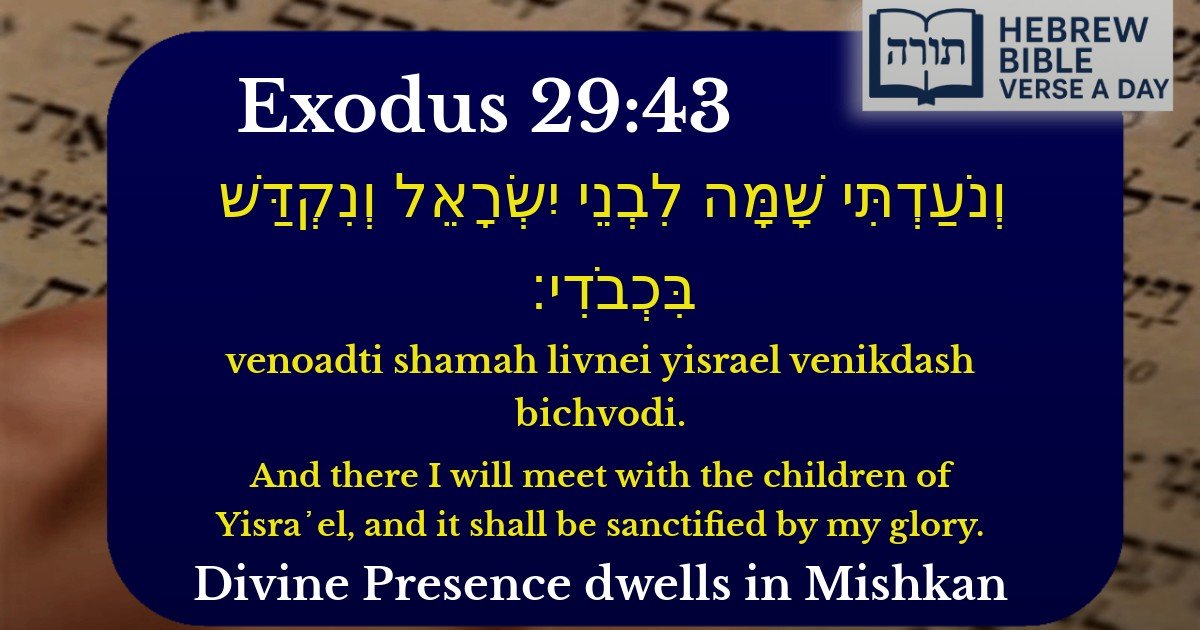
Q: What does 'And there I will meet with the children of Israel' mean in Exodus 29:43?
A: This verse refers to the Mishkan (Tabernacle), where Hashem's presence would dwell among the Jewish people. Rashi explains that this was a designated place for divine communication, where the Shechinah (Divine Presence) would rest and Moshe (Moses) would receive prophecy. It emphasizes the special relationship between Hashem and Bnei Yisrael (the children of Israel).
Q: Why is the Mishkan (Tabernacle) sanctified by Hashem's glory according to this verse?
A: The sanctification comes from the presence of the Shechinah (Divine Glory). The Ramban (Nachmanides) teaches that when Hashem's glory rests in a place, it becomes inherently holy. This verse highlights that the Mishkan was not holy by human effort alone but through Hashem's divine presence dwelling within it.
Q: How does this verse apply to Jewish life today?
A: While we no longer have the Mishkan, the concept remains relevant. The Beit HaMikdash (Temple) and later synagogues (as 'miniature sanctuaries') continue this idea of designated holy spaces where we connect with Hashem. The Talmud (Megillah 29a) compares synagogues to the Mishkan, teaching that they are places where the Shechinah rests when we gather for prayer and Torah study.
Q: What can we learn from Hashem meeting with Bnei Yisrael in the Mishkan?
A: This teaches the importance of creating a space—both physical and spiritual—where we can connect with Hashem. The Midrash (Shemot Rabbah 34:1) explains that the Mishkan symbolized a dwelling place for holiness in this world, showing that even in physical spaces, we can experience divine closeness through mitzvot (commandments) and kedushah (holiness).
Q: Why does the verse say 'children of Israel' and not just 'Israel'?
A: Rashi notes that referring to Bnei Yisrael (children of Israel) emphasizes their cherished status before Hashem—like beloved children. The Kli Yakar adds that this phrasing shows Hashem's mercy, as even when they err, they remain His children. The relationship is eternal, just as a parent's bond with a child is unbreakable.


Context in the Torah
The verse (Shemot 29:43) appears in the context of the inauguration of the Mishkan (Tabernacle), where Hashem instructs Moshe regarding the sanctification of the altar and the ongoing divine presence that will dwell among Bnei Yisrael.
Rashi's Explanation
Rashi comments on the phrase "וְנֹעַדְתִּי שָׁמָּה" ("And there I will meet"), explaining that this refers to the Ohel Moed (Tent of Meeting), where Hashem would communicate with Moshe. He emphasizes that this meeting is not arbitrary but occurs at a designated, sanctified place—the Mishkan.
Sanctification Through Divine Presence
The latter part of the verse, "וְנִקְדַּשׁ בִּכְבֹדִי" ("and it shall be sanctified by my glory"), is interpreted by the Ramban (Nachmanides) to mean that the Mishkan becomes holy not merely by human actions but through the indwelling of the Shechinah (Divine Presence). The Kedushah (sanctity) is a result of Hashem's glory manifesting in that space.
Midrashic Insights
Halachic Implications
The Rambam (Hilchot Beit HaBechirah 6:16) derives from this verse that the sanctity of the Mishkan (and later the Beit HaMikdash) is eternal, as it was established by Hashem's glory rather than human designation alone. This principle informs the laws regarding the holiness of the Temple Mount even after the Temple's destruction.