Frequently Asked Questions
Q: What is the 'mitre' mentioned in Exodus 29:6?
A: The 'mitre' (Hebrew: מִצְנֶפֶת, 'mitznefet') was a special turban worn by the Kohen Gadol (High Priest) as part of his sacred garments. According to Rashi, it was made of fine linen and wrapped around the head like a tall hat to signify honor and distinction in serving Hashem.
Q: What is the 'holy crown' in Exodus 29:6?
A: The 'holy crown' (Hebrew: נֵזֶר הַקֹּדֶשׁ, 'nezer hakodesh') refers to the golden headplate (tzitz) worn on the forehead of the Kohen Gadol. The Talmud (Zevachim 88b) explains that it had the words 'Kodesh LaHashem' (Holy to Hashem) engraved on it, symbolizing the sanctity of his service.
Q: Why was the mitre and crown important for the Kohen Gadol?
A: The mitre and crown were essential because they represented the Kohen Gadol's unique role as the spiritual leader of Israel. Rambam (Hilchos Klei HaMikdash 8:5) teaches that these garments brought atonement and sanctity, reminding both the Kohen and the people of the holiness required in divine service.
Q: Can we learn any lessons from Exodus 29:6 today?
A: Yes! The Midrash (Shemos Rabbah 38:8) explains that just as the Kohen Gadol wore special garments to honor his role, we too should approach mitzvos with dignity and respect. Even without the Temple, we can 'crown' our actions with holiness by performing them with proper intention and reverence.
Q: Is there any connection between the Kohen Gadol's crown and modern Jewish practice?
A: While we no longer have the Temple service, the Talmud (Berachos 28a) connects the concept of the 'crown' to Torah study. Just as the Kohen Gadol wore a physical crown, Torah scholars are said to wear a 'crown of Torah.' This teaches that spiritual greatness is now achieved through dedication to Torah wisdom.

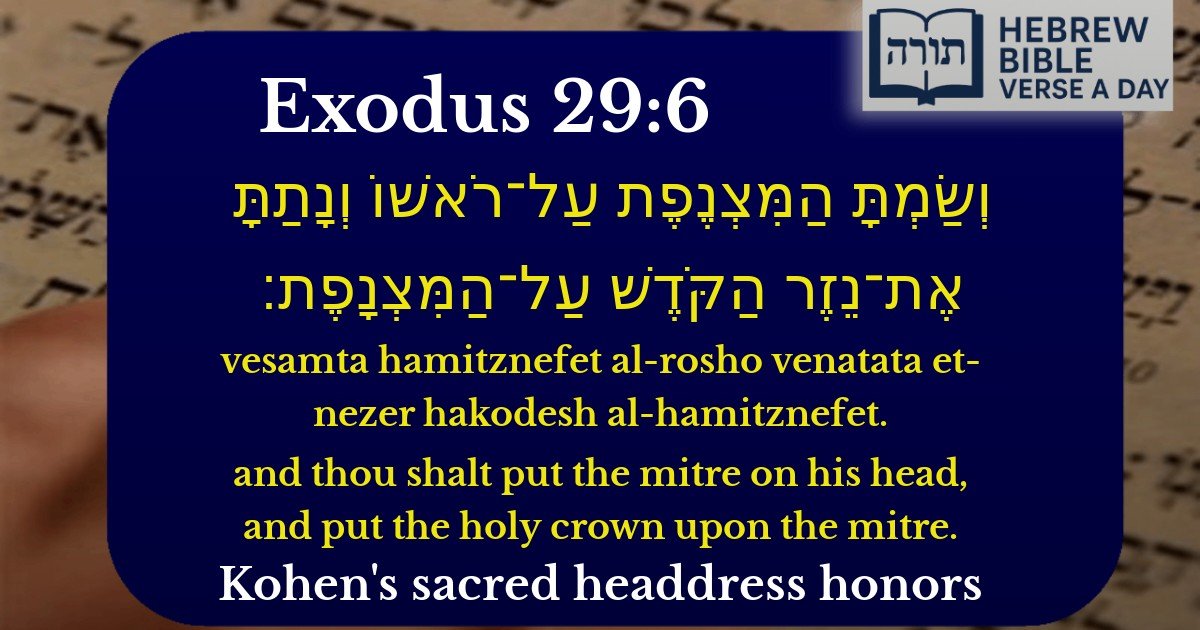

The Significance of the Mitre and Holy Crown
The verse describes the placement of the mitznefet (mitre) and the nezer hakodesh (holy crown) upon the head of the Kohen Gadol (High Priest). According to Rashi (Shemot 28:36), the mitznefet was a turban-like head covering made of fine linen, while the nezer hakodesh refers to the golden plate (tzitz) inscribed with the words "Kodesh LaHashem" (Holy to the Lord).
Symbolism of the Tzitz
The Rambam (Hilchos Klei HaMikdash 9:1) explains that the tzitz served as a constant reminder of the sanctity of the Kohen Gadol's service. The Talmud (Zevachim 88b) further elaborates that the tzitz atoned for arrogance, as it was placed on the forehead, the seat of pride. The Midrash (Shemos Rabbah 34:2) adds that the tzitz symbolized the crown of priesthood, distinguishing the Kohen Gadol as the representative of the Jewish people before Hashem.
Hierarchy of Holiness
The order of placement—first the mitznefet, then the tzitz—reflects a progression in sanctity. The Kli Yakar (Shemot 28:36) notes that the mitznefet represents the foundation of humility (as linen is a simple material), while the golden tzitz represents the pinnacle of spiritual elevation. This teaches that true holiness must be built upon humility.
Practical Halachic Implications