Frequently Asked Questions
Q: What is the purpose of the incense altar mentioned in Exodus 30:1?
A: The incense altar (Mizbeach HaKetoret) was used in the Mishkan (Tabernacle) and later in the Beit HaMikdash (Temple) to burn the special ketoret (incense) offering twice daily. According to Rashi and the Talmud (Keritot 6b), this service atoned for sins and brought spiritual elevation, symbolizing the prayers of Israel ascending to Hashem.
Q: Why was the incense altar made specifically from shittim (acacia) wood?
A: Shittim wood was chosen because it was durable and readily available in the wilderness (Rashi on Exodus 25:5). The Midrash (Tanchuma Terumah 9) also teaches that the shittim wood symbolizes the righteous, just as this wood doesn't rot, the righteous endure forever. The wood was overlaid with gold (Exodus 30:3), showing that even simple materials become holy when dedicated to divine service.
Q: What can we learn today from the commandment to build the incense altar?
A: Though we no longer have the Beit HaMikdash, the Rambam (Hilchot Tefillah 1:1) teaches that prayer replaces the sacrificial service. The incense altar reminds us that our prayers should be consistent (like the twice-daily incense) and offered with pure intention. The Talmud (Berachot 26b) compares the ketoret to prayer, as both ascend upward and create a 'pleasing fragrance' before Hashem.
Q: Why was the incense offering so important in Jewish tradition?
A: The Talmud (Yoma 44a) states that the ketoret atoned for lashon hara (evil speech), as incense's fine particles resemble words. The Midrash (Shemot Rabbah 43:7) also notes that the ketoret stopped plagues (as in Numbers 17:11-13). Its precise formula (detailed in Exodus 30:34-38) was considered so sacred that making it for personal use carried severe consequences (Keritot 6a).
Q: How big was the incense altar, and where was it placed?
A: According to Rashi (Exodus 30:2) and the Mishnah (Middot 3:1), the incense altar was 1 cubit (approx. 1.5-2 feet) square and 2 cubits tall. It stood in the Kodesh (Holy place), near the Parochet (curtain) before the Kodesh HaKodashim (Holy of Holies). Unlike the larger outer altar, this smaller altar emphasized the intimate nature of the incense service, representing the close relationship between Hashem and Israel.

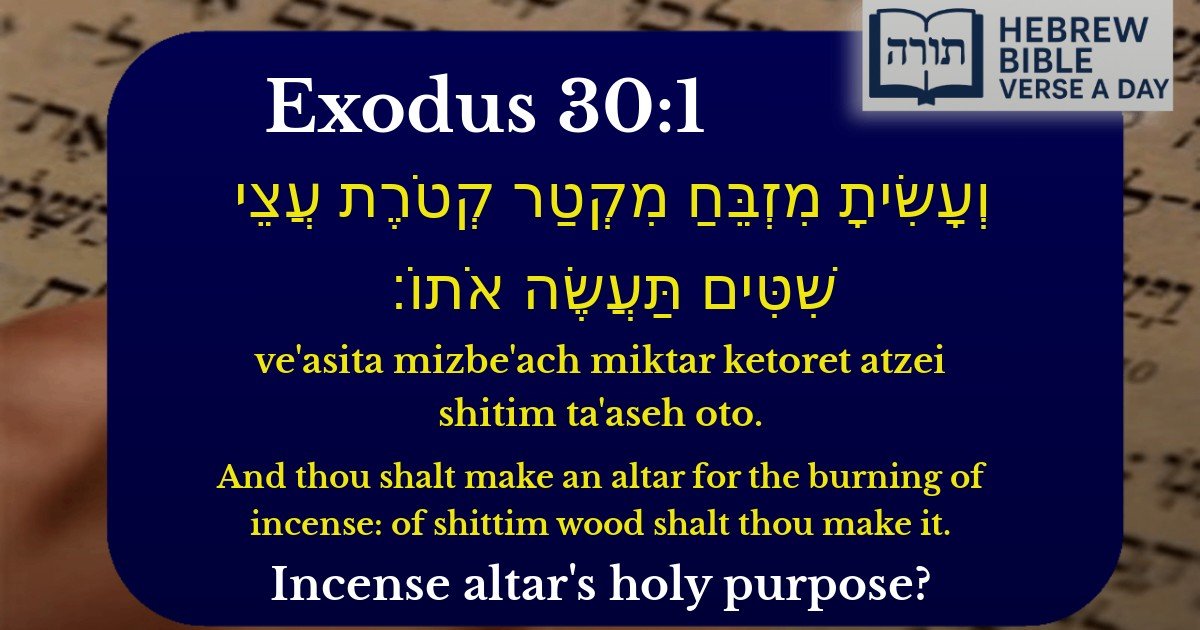

The Altar of Incense (Mizbeach HaKetoret)
The verse (Exodus 30:1) commands the construction of the golden altar used for burning incense in the Mishkan (Tabernacle). Rashi explains that this altar was distinct from the copper altar used for animal sacrifices, as its sole purpose was for the daily incense offering (Ketoret). The Ketoret had profound spiritual significance, representing the prayers of Israel (as referenced in Psalms 141:2).
Material: Shittim Wood (Atzei Shittim)
The Torah specifies that the altar must be made of shittim wood (acacia). The Ramban notes that this wood was chosen for its durability and resistance to decay, symbolizing the eternal nature of the service in the Mishkan. The Midrash Tanchuma (Terumah 9) teaches that the shittim wood was a legacy from Yaakov Avinu, who planted these trees in Egypt for his descendants to use in building the Mishkan.
Dimensions and Symbolism
The Incense Offering
The Talmud (Keritot 6b) elaborates on the precise formulation of the Ketoret, consisting of 11 spices. The Sages teach that the incense atoned for the sin of lashon hara (evil speech), as the smoke rises silently, in contrast to harmful words. The daily incense offering (Tamid service) was so cherished that, as the Mishnah (Yoma 3:5) records, lots were cast among Kohanim for the privilege of performing it.
Spiritual Lessons
The Or HaChaim highlights that the positioning of the incense altar near the Holy of Holies teaches that sincere prayer can bring one closest to the Divine Presence. The use of wood (a perishable material) overlaid with gold (a symbol of eternity) represents the synthesis of human effort and Divine grace in avodat Hashem (service of G-d).