Frequently Asked Questions
Q: Why does the Torah say 'And the Lord spoke to Moshe, saying' so many times?
A: The phrase 'And the Lord spoke to Moshe, saying' appears frequently in the Torah to emphasize that every commandment comes directly from Hashem. Rashi explains that this wording shows Moshe's humility—he didn't add or subtract anything from G-d's words (based on Deuteronomy 4:2). Each repetition teaches us that every mitzvah is equally important.
Q: What is the significance of the word 'saying' (לֵּאמֹר) in this verse?
A: The word 'laimor' (saying) indicates that Moshe was to transmit G-d's words exactly as he received them to the Jewish people. Rambam explains in the Mishneh Torah that this establishes the principle of faithful transmission of Torah from generation to generation. The Talmud (Eruvin 54b) derives from this that Torah teachers must convey the teachings precisely as they learned them.
Q: Why does the Torah specify that G-d spoke to Moshe rather than just stating the commandment?
A: By specifying that G-d spoke to Moshe, the Torah teaches us two important lessons: (1) The divine origin of all commandments, and (2) Moshe's unique role as the transmitter of Torah. The Midrash (Shemos Rabbah 28:6) explains that this phrasing comes to exclude any possibility that Moshe invented these laws himself—they all came directly from G-d.
Q: How does this verse connect to the commandments that follow it?
A: This introductory verse (Exodus 30:11) begins a new section about the half-shekel donation for the Mishkan (Tabernacle). The Sforno explains that by prefacing the commandment with 'And the Lord spoke to Moshe,' the Torah shows that even practical, seemingly mundane mitzvos like donations are divine commandments with deep spiritual significance.
Q: What can we learn today from how G-d spoke to Moshe?
A: We learn several important principles: (1) The Torah's divine origin, (2) The importance of faithfully transmitting Torah teachings (Mesorah), and (3) That leaders must be humble conduits of G-d's will. The Rambam (Hilchos Yesodei HaTorah 7:6) derives from such verses that a true prophet will never add to or subtract from Torah commandments.

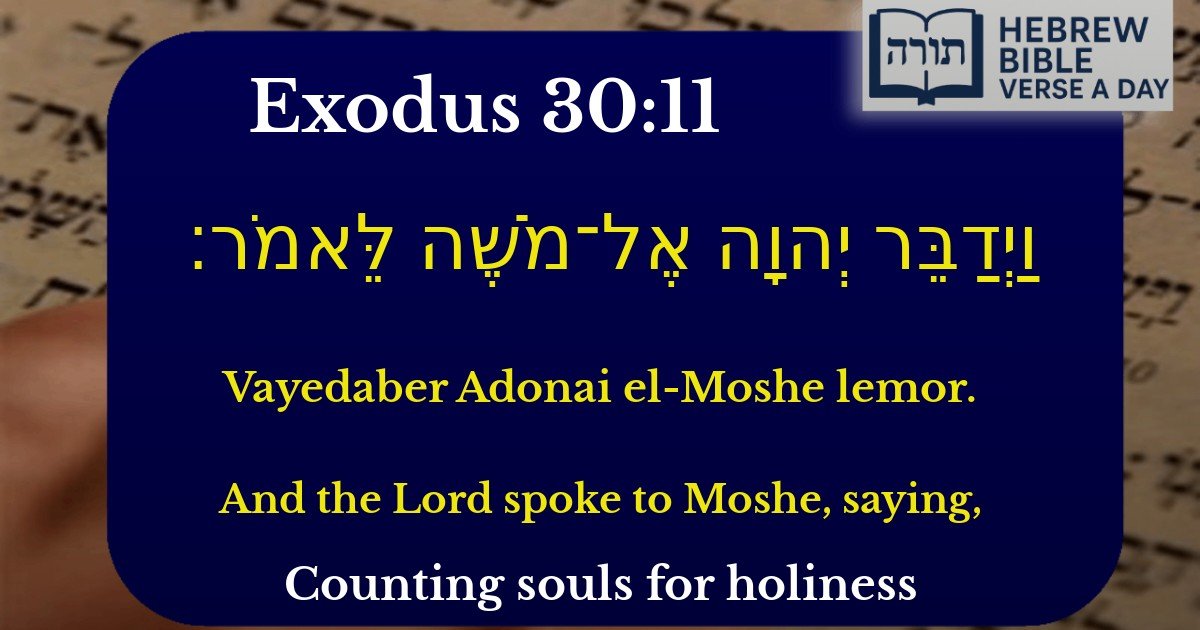

The Divine Communication to Moshe
The phrase "וַיְדַבֵּר יְהוָה אֶל־מֹשֶׁה לֵּאמֹר" ("And the Lord spoke to Moshe, saying") appears frequently in the Torah, introducing direct communication from Hashem to Moshe Rabbeinu. Rashi (Shemot 6:2) notes that this expression signifies a clear and direct revelation, distinguishing it from other forms of prophecy, such as visions or dreams. The term "וַיְדַבֵּר" (spoke) implies a forceful and intentional transmission of divine will.
The Significance of "לֵּאמֹר" (Saying)
The word "לֵּאמֹר" indicates that Moshe was commanded to relay the message to Bnei Yisrael or to Aharon. Rambam (Hilchos Yesodei HaTorah 7:6) explains that Moshe's prophecy was unique in that he served as the intermediary to convey Hashem's words to the people. The Sforno (Bamidbar 30:2) adds that this term emphasizes the precision required in transmitting divine commandments without alteration.
Moshe's Unique Prophetic Status
The Talmud (Yevamos 49b) teaches that Moshe's prophecy was unparalleled—he received divine communication "פֶּה אֶל פֶּה" ("mouth to mouth"), in a state of complete clarity and wakefulness. The Ramban (Shemot 19:9) elaborates that this direct speech reflects Moshe's unique role as the greatest of all prophets, chosen to receive and transmit the Torah to Klal Yisrael.
Lessons for Torah Transmission