

Join Our Newsletter To Be Informed When New Videos Are Posted
Hebrew Text
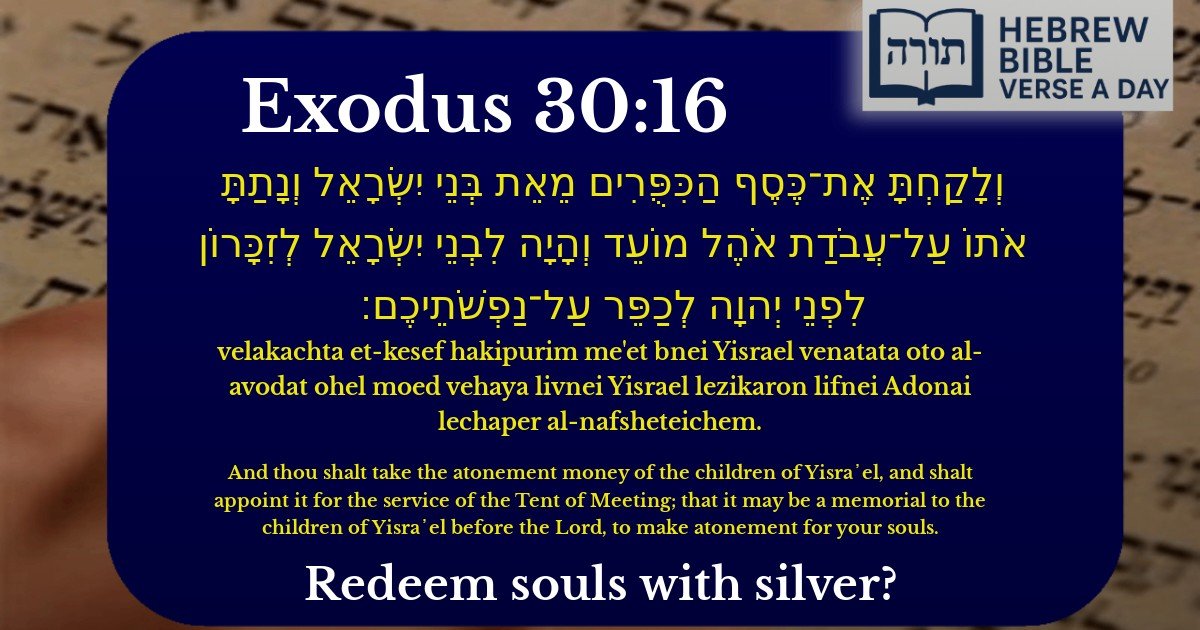
וְלָקַחְתָּ אֶת־כֶּסֶף הַכִּפֻּרִים מֵאֵת בְּנֵי יִשְׂרָאֵל וְנָתַתָּ אֹתוֹ עַל־עֲבֹדַת אֹהֶל מוֹעֵד וְהָיָה לִבְנֵי יִשְׂרָאֵל לְזִכָּרוֹן לִפְנֵי יְהוָה לְכַפֵּר עַל־נַפְשֹׁתֵיכֶם׃
English Translation
And thou shalt take the atonement money of the children of Yisra᾽el, and shalt appoint it for the service of the Tent of Meeting; that it may be a memorial to the children of Yisra᾽el before the Lord, to make atonement for your souls.
Transliteration
Velakachta et-kesef hakipurim me'et bnei Yisrael venatata oto al-avodat ohel moed vehaya livnei Yisrael lezikaron lifnei Adonai lechaper al-nafsheteichem.
Hebrew Leining Text
וְלָקַחְתָּ֞ אֶת־כֶּ֣סֶף הַכִּפֻּרִ֗ים מֵאֵת֙ בְּנֵ֣י יִשְׂרָאֵ֔ל וְנָתַתָּ֣ אֹת֔וֹ עַל־עֲבֹדַ֖ת אֹ֣הֶל מוֹעֵ֑ד וְהָיָה֩ לִבְנֵ֨י יִשְׂרָאֵ֤ל לְזִכָּרוֹן֙ לִפְנֵ֣י יְהֹוָ֔ה לְכַפֵּ֖ר עַל־נַפְשֹׁתֵיכֶֽם׃ {פ}
🎵 Listen to leining
Parasha Commentary
📚 Talmud Citations
This verse is quoted in the Talmud.
📖 Shekalim 2a
The verse is discussed in the context of the collection and use of the half-shekel for the Temple service, emphasizing its role as atonement and memorial.
📖 Megillah 29b
Referenced in a discussion about the sanctity and purpose of communal offerings and their role in atonement.
Context of the Verse
This verse (Shemot 30:16) appears in the context of the mitzvah of machatzit hashekel (the half-shekel contribution), which was given by every Israelite above the age of twenty for the maintenance of the Mishkan (Tabernacle) and later the Beit HaMikdash (Temple). The funds were used for communal offerings and the upkeep of the sanctuary.
Rashi's Explanation
Rashi (Shemot 30:16) explains that the term "כֶּסֶף הַכִּפֻּרִים" (atonement money) refers to the half-shekel given as an atonement for the sin of the Golden Calf. The act of contributing this money served as a rectification for their souls. Rashi further notes that the phrase "לְזִכָּרוֹן" (as a memorial) means that Hashem would recall the merit of Bnei Yisrael’s contribution when judging them.
Rambam's Perspective
The Rambam (Hilchot Shekalim 1:1-2) elaborates that this mitzvah was an annual obligation during the times of the Beit HaMikdash. The funds were used for purchasing communal sacrifices, ensuring the continuous service in the Temple. The Rambam emphasizes that this contribution was a fixed amount—neither more nor less than a half-shekel—to symbolize equality before Hashem.
Midrashic Insight
The Midrash (Shemot Rabbah 35:4) teaches that the half-shekel serves as a reminder that no individual is complete on their own. Each person must unite with others to form a whole, reflecting the communal responsibility in avodat Hashem (divine service). The Midrash also connects this mitzvah to the future redemption, suggesting that the merit of the half-shekel will protect Israel in the days of Mashiach.
Symbolism of the Half-Shekel
Practical Halachic Implications
The Shulchan Aruch (Orach Chaim 694) discusses the custom of giving machatzit hashekel before Purim, commemorating this mitzvah. While the Beit HaMikdash is not standing, the practice serves as a remembrance and a prayer for its rebuilding. The money is typically donated to tzedakah (charity), continuing the theme of communal support.