

Join Our Newsletter To Be Informed When New Videos Are Posted
Hebrew Text
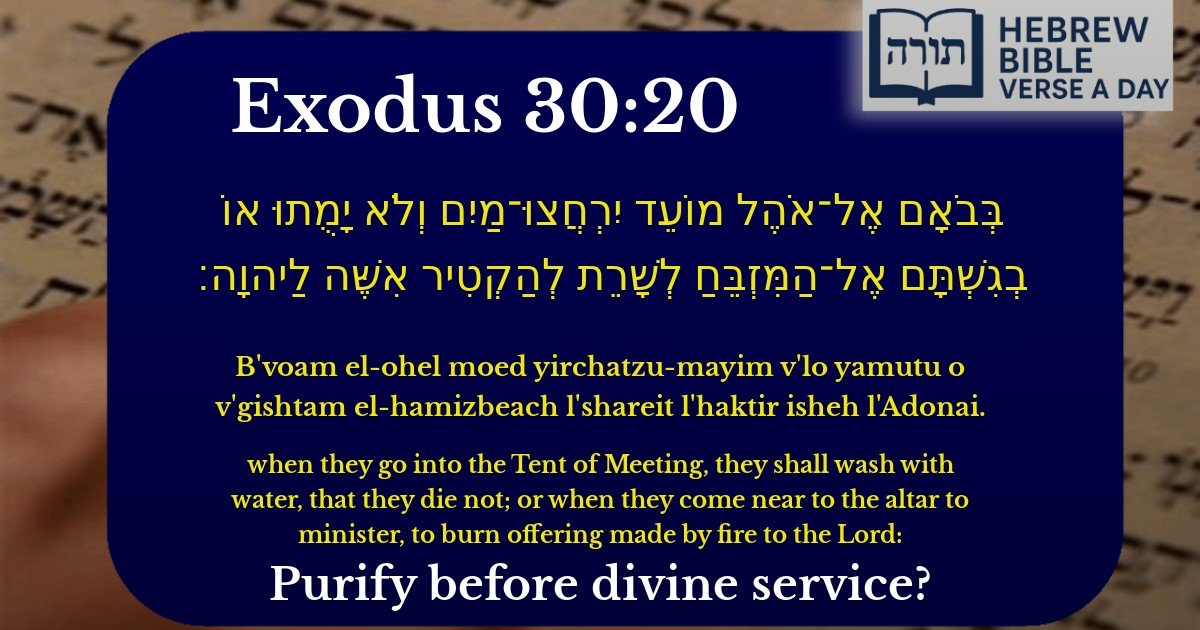
בְּבֹאָם אֶל־אֹהֶל מוֹעֵד יִרְחֲצוּ־מַיִם וְלֹא יָמֻתוּ אוֹ בְגִשְׁתָּם אֶל־הַמִּזְבֵּחַ לְשָׁרֵת לְהַקְטִיר אִשֶּׁה לַיהוָה׃
English Translation
when they go into the Tent of Meeting, they shall wash with water, that they die not; or when they come near to the altar to minister, to burn offering made by fire to the Lord:
Transliteration
B'voam el-ohel moed yirchatzu-mayim v'lo yamutu o v'gishtam el-hamizbeach l'shareit l'haktir isheh l'Adonai.
Hebrew Leining Text
בְּבֹאָ֞ם אֶל־אֹ֧הֶל מוֹעֵ֛ד יִרְחֲצוּ־מַ֖יִם וְלֹ֣א יָמֻ֑תוּ א֣וֹ בְגִשְׁתָּ֤ם אֶל־הַמִּזְבֵּ֙חַ֙ לְשָׁרֵ֔ת לְהַקְטִ֥יר אִשֶּׁ֖ה לַֽיהֹוָֽה׃
🎵 Listen to leining
Parasha Commentary
📚 Talmud Citations
This verse is quoted in the Talmud.
📖 Yoma 30a
The verse is discussed in the context of the priestly service and the requirement for priests to wash their hands and feet before entering the Tent of Meeting or approaching the altar to avoid death.
📖 Zevachim 19b
The verse is referenced in a discussion about the sanctity of the priestly service and the consequences of neglecting the washing ritual before performing sacred duties.
Context and Overview
The verse (Shemot 30:20) appears in the context of the commandment to construct the Kiyor (laver), a copper basin used by the Kohanim (priests) for ritual washing before performing service in the Mishkan (Tabernacle). This mitzvah underscores the importance of ritual purity and sanctity when approaching sacred duties.
Rashi's Explanation
Rashi (Shemot 30:20) explains that the phrase "when they go into the Tent of Meeting" refers to the priests entering the Mishkan to perform services such as arranging the Lechem HaPanim (Showbread) or lighting the Menorah. The washing is mandatory to avoid the severe consequence of death, as the verse states: "that they die not." Rashi further clarifies that the washing applies not only before entering the Mishkan but also before approaching the altar to offer sacrifices.
Rambam's Halachic Perspective
In Hilchot Bi'at HaMikdash (5:1-3), the Rambam codifies this law, stating that a Kohen who fails to wash his hands and feet before service is liable for Karet (divine excision). The washing must be done from the Kiyor specifically, as it was sanctified for this purpose. The Rambam emphasizes that this mitzvah applies even if the Kohen is already ritually pure, demonstrating that the act is not merely about cleanliness but about spiritual preparation for divine service.
Midrashic Insights
The Midrash Tanchuma (Tetzaveh 10) connects this mitzvah to the idea of kedushah (holiness). Just as Moshe was commanded to wash before receiving the Torah (Shemot 19:10), the Kohanim must wash before serving in the Mishkan. This parallel teaches that approaching the divine requires both external and internal purification.
Symbolism of the Kiyor
Practical Implications
The Gemara (Zevachim 19b) discusses the precise manner of washing: the Kohen must wash his hands and feet up to the wrist and ankle, respectively. This detail highlights the Torah's emphasis on exactness in divine service. The Sforno adds that neglecting this mitzvah demonstrates a lack of reverence for the sanctity of the Mishkan, hence the severe penalty.