Frequently Asked Questions
Q: What does it mean when the verse says 'The Lord spoke to Moshe'?
A: This phrase appears frequently in the Torah and signifies divine communication. According to Rashi, when the Torah says 'The Lord spoke to Moshe,' it emphasizes that Moshe received direct prophecy from Hashem, unlike other prophets who received messages through visions or dreams (Bamidbar 12:6-8). This shows Moshe's unique level of prophecy.
Q: Why does the Torah repeat 'saying' after 'The Lord spoke to Moshe'?
A: The word 'saying' (לֵאמֹר) teaches us that Moshe was commanded to relay these words to the Jewish people. The Talmud (Yoma 4b) explains that this term indicates Moshe wasn't just receiving private instruction - he was being given a message to transmit to others.
Q: How is this introduction different from other times the Torah says 'God spoke to Moshe'?
A: While the phrase appears often, our sages note subtle differences. Here in Exodus 30:22, it begins with 'Moreover' (וַיְדַבֵּר), which the Midrash (Shemos Rabbah 36:1) explains connects this new commandment about the anointing oil to the previous instructions about the Mishkan (Tabernacle), showing continuity in the divine instructions.
Q: What can we learn from how God communicated with Moshe?
A: The Rambam (Yesodei HaTorah 7:6) teaches that Moshe's prophecy was the most direct form of divine communication. The precise language 'The Lord spoke to Moshe' teaches us about the clarity and reliability of Torah transmission - every word comes directly from Hashem to Moshe to the Jewish people.
Q: Why does the Torah mention Moshe's name when God speaks to him?
A: Rashi (on Shemos 6:2) explains that mentioning Moshe by name shows God's affection and closeness to him, like friends who call each other by name. The Talmud (Berachos 7a) also teaches that this demonstrates Moshe's humility - though he reached the highest spiritual levels, the Torah always refers to him simply as 'Moshe.'


Introduction to Divine Communication
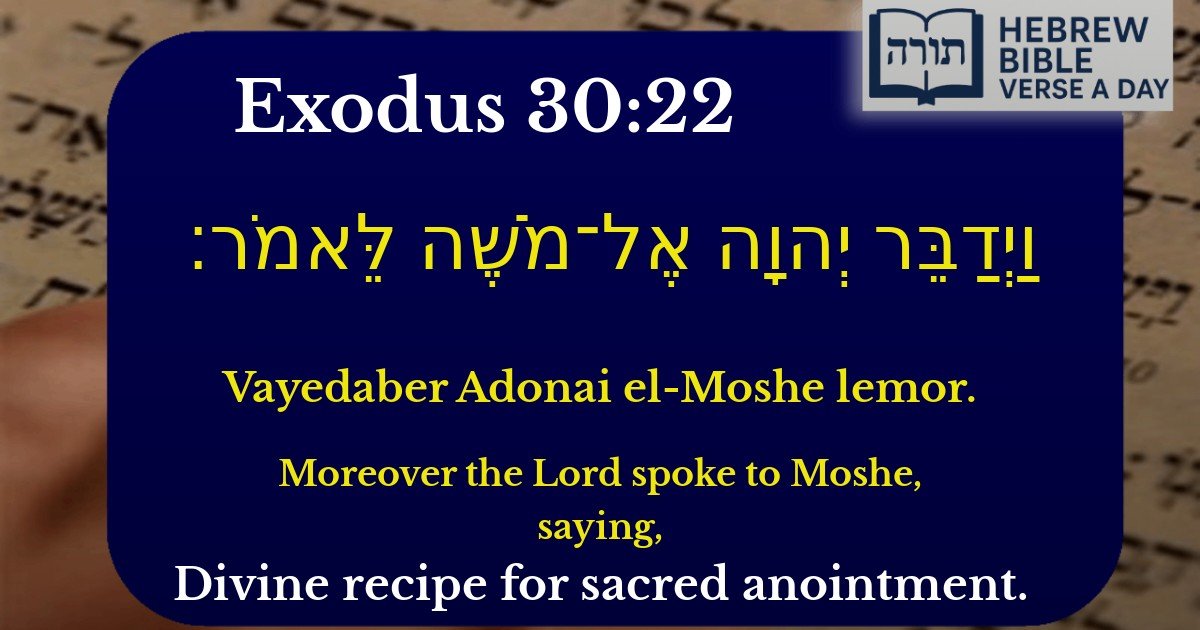
The verse "וַיְדַבֵּר יְהוָה אֶל־מֹשֶׁה לֵּאמֹר" ("Moreover the Lord spoke to Moshe, saying") appears frequently in the Torah as a prelude to Hashem's commandments or revelations to Moshe Rabbeinu. This phrase underscores the unique prophetic relationship between Hashem and Moshe, as explained by Rambam (Maimonides) in Hilchos Yesodei HaTorah, where he describes Moshe's prophecy as the highest level, with direct and clear communication from Hashem.
The Significance of "וַיְדַבֵּר"
The term "וַיְדַבֵּר" ("spoke") implies a forceful and direct form of communication, as noted by Rashi in his commentary on Shemos 6:2. Unlike softer terms like "וַיֹּאמֶר" ("said"), "דיבור" often conveys a tone of authority and clarity, fitting for the transmission of mitzvos and divine instruction.
Moshe's Unique Role
The phrase emphasizes Moshe's singular role as the intermediary between Hashem and Bnei Yisrael. The Midrash Tanchuma (Va'eira 3) explains that Moshe was chosen because of his humility and willingness to serve as Hashem's faithful messenger. The Ramban (Nachmanides) further elaborates that this introductory formula highlights the authenticity and divine origin of the commandments that follow.
The Structure of Divine Command
Broader Implications
The Sforno notes that this phrasing appears at key moments in the Torah, signaling the transmission of essential laws or pivotal events. The repetition of this formula throughout the Torah serves as a constant reminder of the divine origin of the mitzvos and the unchanging nature of Torah law.