Frequently Asked Questions
Q: What does Exodus 30:33 mean?
A: Exodus 30:33 warns against copying the sacred anointing oil (used in the Mishkan/Tabernacle) or applying it to an unauthorized person ('stranger'). Doing so carries the severe penalty of being 'cut off from one's people' (karet), meaning spiritual separation or divine punishment. Rashi explains this refers to someone who is not a kohen (priest) or who misuses the oil.
Q: Why is the anointing oil in Exodus 30:33 so special?
A: The anointing oil described in Exodus 30:22-33 was uniquely prepared with specific spices for sanctifying the Mishkan, its vessels, and the kohanim (priests). The Rambam (Hilchot Kelei HaMikdash 1:3) emphasizes that its precise formula was a divine commandment, making it holy and forbidden for common use. Replicating it or misusing it showed disrespect for its sanctity.
Q: What does 'cut off from his people' (karet) mean in Exodus 30:33?
A: The term 'karet' (cut off) is a severe spiritual penalty mentioned in the Torah for certain sins. According to the Talmud (Makkot 23b), it can mean premature death or being spiritually severed from one's people in the afterlife. The Mishnah (Keritot 1:1) lists intentional misuse of the anointing oil as one of the sins punishable by karet.
Q: Does Exodus 30:33 apply today without the Temple?
A: Since the anointing oil was specifically for the Mishkan and later the Beit HaMikdash (Temple), its laws are not practically applicable today. However, the Rambam (Hilchot Klei HaMikdash 1:10) notes that the prohibition remains in principle, teaching us to respect holy objects and not replicate them for personal use.
Q: What lesson can we learn from Exodus 30:33?
A: This verse teaches the importance of respecting sacred items and roles. Just as the anointing oil was reserved for holy purposes, we learn (based on Midrash Tanchuma, Tetzaveh 5) that certain things in life—like Torah, mitzvot, and leadership—require reverence and should not be treated casually or misused.

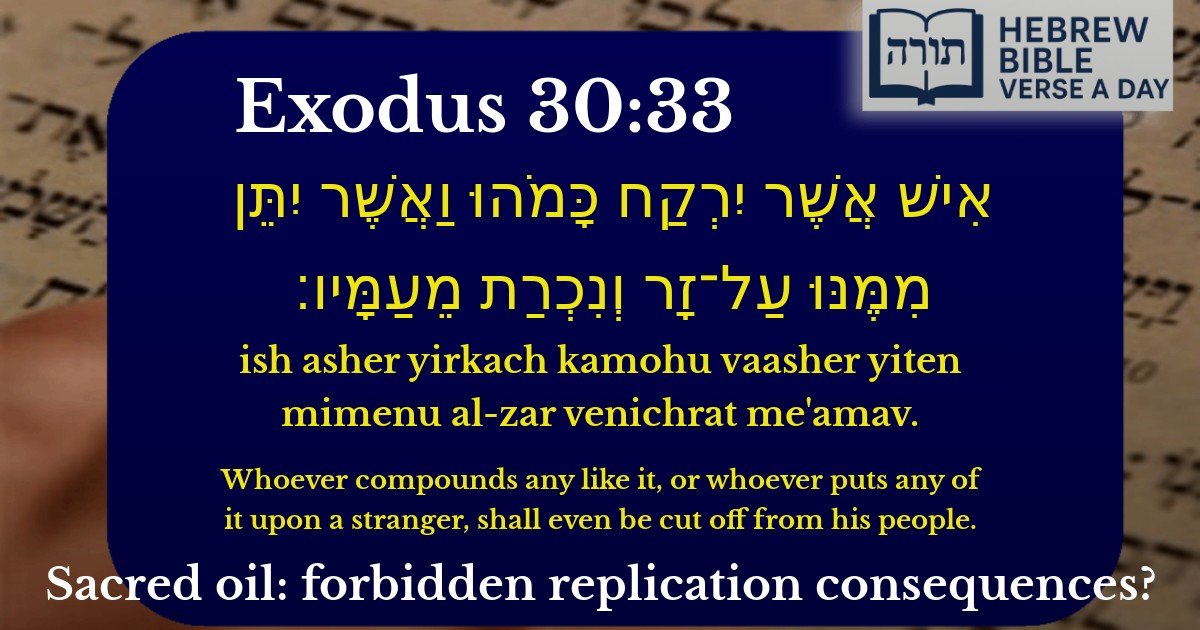

Context of the Verse
This verse (Shemot 30:33) appears in the context of the preparation of the sacred anointing oil (shemen hamishcha) used in the Mishkan (Tabernacle) and later in the Beit HaMikdash (Temple). The Torah strictly prohibits replicating this oil for personal use or applying it to an unauthorized person ("zar" – stranger/non-priest).
Prohibition Against Replication
Rashi explains that the phrase "אִישׁ אֲשֶׁר יִרְקַח כָּמֹהוּ" ("whoever compounds any like it") refers to the prohibition against preparing an oil with the same formula as the sacred anointing oil. The Torah specifies the exact ingredients (Shemot 30:22-25), and duplicating this mixture for mundane purposes is forbidden.
Prohibition Against Misuse
The second part of the verse "וַאֲשֶׁר יִתֵּן מִמֶּנּוּ עַל־זָר" ("or whoever puts any of it upon a stranger") prohibits applying the sacred oil to someone not authorized to receive it. Rambam (Hilchot Kelei HaMikdash 1:10) clarifies that "zar" here refers to anyone who is not a kohen (priest) or king anointed for service.
Punishment of "Karet"
The severe penalty of "וְנִכְרַת מֵעַמָּיו" ("shall be cut off from his people") indicates the gravity of this transgression. The Talmud (Keritot 7a) discusses that "karet" can refer to premature death or being spiritually severed from the Jewish people in the World to Come.
Philosophical Significance
The Kli Yakar offers a deeper insight: The anointing oil represents kedusha (holiness), which must be treated with reverence. By prohibiting its replication or misuse, the Torah teaches that holiness cannot be manufactured artificially or applied indiscriminately – it must remain in its designated sacred framework.
Practical Halachic Implications