Frequently Asked Questions
Q: What is the significance of the spices mentioned in Exodus 30:34?
A: The spices listed in Exodus 30:34 (storax, onycha, galbanum, and pure frankincense) were ingredients for the Ketoret (incense) used in the Mishkan (Tabernacle) and later in the Beit HaMikdash (Holy Temple). According to Rashi and the Talmud (Keritot 6a), each spice had a unique purpose, symbolizing different types of people—even those who may seem less virtuous (like galbanum, which had a strong smell) were included, teaching that every Jew has a role in serving Hashem.
Q: Why were the spices in the Ketoret required to be of equal weight?
A: The Torah specifies that the spices must be 'of each a like weight' to teach precision and balance in serving Hashem. The Rambam (Hilchot Klei HaMikdash 2:4) explains that exact measurements were crucial for the Ketoret’s sanctity. The equal weight also symbolizes unity—just as all spices were needed, every Jew contributes equally to the spiritual wholeness of Klal Yisrael (the Jewish people).
Q: What lesson can we learn from the inclusion of galbanum in the Ketoret?
A: Galbanum had a pungent smell, unlike the other sweet spices. The Midrash (Shemot Rabbah 43:7) teaches that this represents Jews who may not seem righteous outwardly but are still essential to the community. Just as the Ketoret required galbanum to be complete, we must value every Jew, recognizing that collective unity—not individual perfection—brings divine favor.
Q: How does the Ketoret relate to Jewish prayer today?
A: The Talmud (Berachot 6b) compares the Ketoret to prayer, as both ascend to heaven. Just as the incense was offered daily in the Beit HaMikdash, we pray three times a day. The spices’ blend reminds us that prayer should include all aspects of life—joy (sweet spices) and challenges (galbanum)—and that sincerity, like the 'pure frankincense,' is key to connecting with Hashem.
Q: Was the Ketoret recipe a secret?
A: Yes, the Talmud (Yoma 38a) states that the exact preparation of the Ketoret was a closely guarded tradition passed down through righteous families. The Mishnah (Keritot 6a) warns that altering the recipe was punishable by heavenly decree, emphasizing its holiness. This teaches the importance of preserving Torah traditions with precision and reverence.

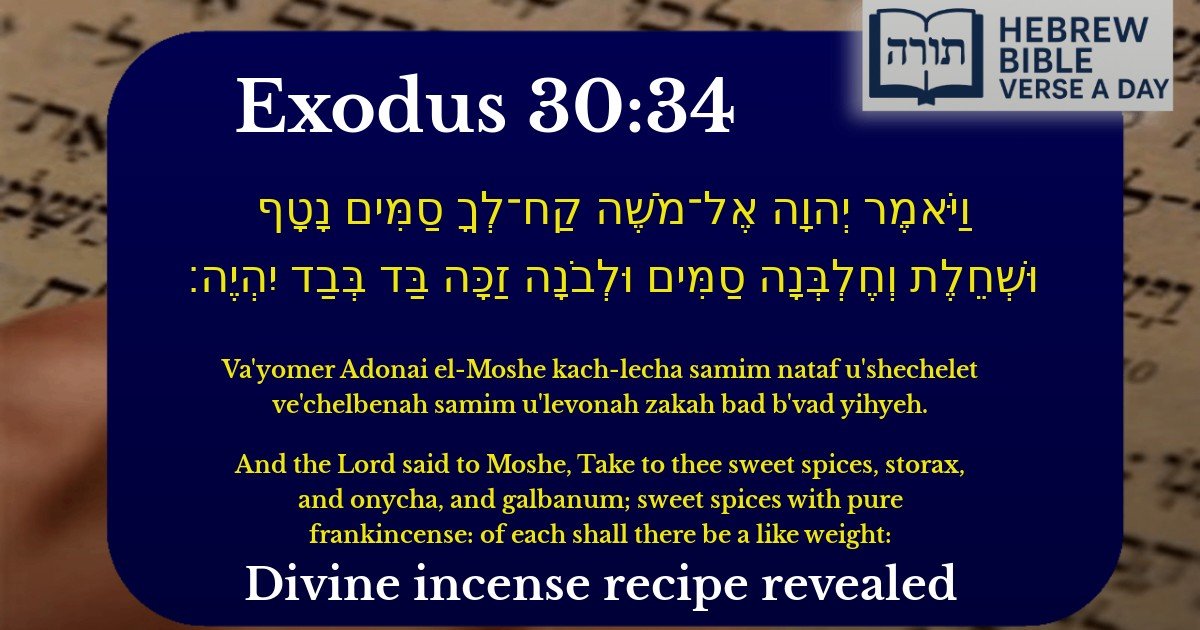

The Ingredients of the Ketoret (Incense)
The verse (Shemot 30:34) lists the components of the Ketoret, the sacred incense offered in the Mishkan (Tabernacle) and later in the Beit HaMikdash (Temple). According to Rashi, these ingredients were:
Equal Measures and Symbolism
The phrase "בַּד בְּבַד יִהְיֶה" ("of each shall there be a like weight") teaches that all ingredients were measured in equal portions. The Rambam (Hilchot Klei HaMikdash 2:4) emphasizes that precise measurements were crucial for the sanctity of the Ketoret.
The Midrash (Shemot Rabbah 43:7) highlights the inclusion of Chelbanah, despite its bitterness, as a lesson in communal unity—just as the incense required all components, so too must the Jewish people include all individuals, even those who may seem flawed.
The Spiritual Significance of the Ketoret
The Ketoret was unique in its ability to atone for sins, as stated in the Talmud (Yoma 44a). Unlike other offerings, it was burned entirely for Hashem’s sake, symbolizing complete devotion. The Zohar (Vayikra 15a) further explains that the incense’s ascent represents the elevation of prayers to Heaven.