Frequently Asked Questions
Q: What does it mean that Aharon burns incense every morning in Exodus 30:7?
A: In Exodus 30:7, the verse describes the daily ritual in the Mishkan (Tabernacle), where the Kohen Gadol (High Priest), Aharon, was commanded to burn ketoret (incense) every morning while preparing the menorah. According to Rashi, this was a sacred duty performed alongside the daily cleaning and lighting of the menorah, symbolizing devotion and purity in serving Hashem.
Q: Why was the incense burned specifically in the morning?
A: The incense was burned in the morning to coincide with the 'hatavat hanerot'—the cleaning and relighting of the menorah (Exodus 30:7). The Talmud (Yoma 33a) explains that this timing reflects order and consistency in avodah (Temple service), showing that divine service requires daily renewal and dedication.
Q: What was the significance of the ketoret (incense) in the Mishkan?
A: The ketoret had deep spiritual meaning. The Midrash (Shemot Rabbah 43:7) teaches that its sweet fragrance symbolized the unity of the Jewish people and their prayers ascending to Hashem. The Rambam (Hilchot Temidin uMusafin 3:3) also notes that it was a unique offering, separate from other sacrifices, highlighting its special role in divine service.
Q: How does the incense offering apply to Jewish practice today?
A: Although we no longer have the Beit HaMikdash (Temple), the ketoret teaches us about the power of prayer and consistency in serving Hashem. Many Jews recite the 'Pitum HaKetoret' (incense formula) during daily prayers (Shacharit) as a remembrance of this mitzvah, as mentioned in the Siddur and Mishnah Berurah (Orach Chaim 132:5).
Q: Who was allowed to burn the ketoret in the Mishkan?
A: Only the Kohanim (priests), specifically Aharon and his descendants, were permitted to burn the ketoret, as stated in Exodus 30:7. The Talmud (Keritot 6a) emphasizes that this was an exclusive duty, and unauthorized individuals who offered incense were severely punished, underscoring the sanctity of the service.

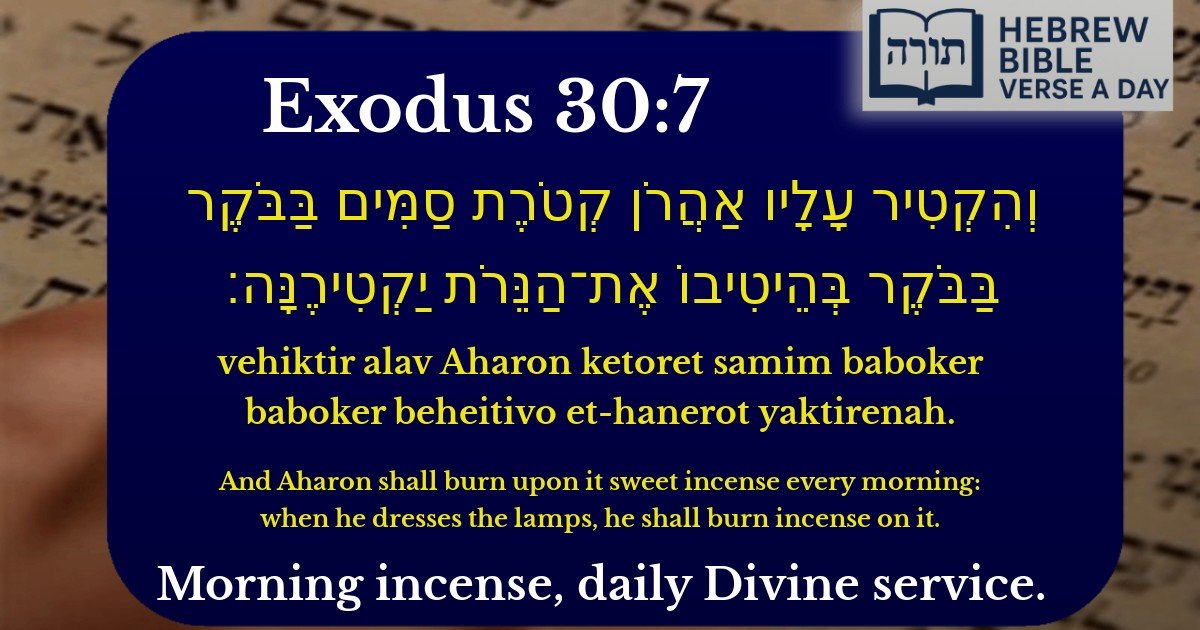

The Incense Offering in the Morning
The verse (Shemot 30:7) describes the daily incense offering (קְטֹרֶת סַמִּים) that Aharon the Kohen Gadol was commanded to bring each morning alongside the tending of the Menorah. According to Rashi, this was one of the primary avodot (services) performed in the Mishkan and later the Beit HaMikdash. The timing—"בַּבֹּקֶר בַּבֹּקֶר" (every morning)—emphasizes its regularity and importance.
Connection Between the Incense and the Menorah
The verse links the burning of incense to the dressing of the lamps (הַנֵּרֹת), indicating a synchronized service. Rambam (Hilchot Temidin uMusafin 3:3) explains that the Kohen would first prepare the Menorah, ensuring its lights were properly arranged, and then proceed to offer the incense. The Talmud (Yoma 33a) teaches that this sequence reflects the divine service's precision, where each mitzvah has its designated time and order.
Symbolism of the Incense
Halachic Details
The Shulchan Aruch (Orach Chaim 132:5, based on Zevachim 59a) notes that the incense was offered on the inner golden altar (מִזְבַּח הַזָּהָב), distinct from the outer altar for sacrifices. This highlights its unique role as an intimate service, performed closer to the Kodesh HaKodashim (Holy of Holies). The meticulous preparation of the Ketoret, as detailed in the Mishnah (Keritot 1:1), underscores the care required in divine service.