Frequently Asked Questions
Q: What does the verse mean when it says Aharon should light the lamps 'between the evenings'?
A: The phrase 'between the evenings' (בֵּין הָעֲרְבַּיִם) refers to the time period in the late afternoon before sunset. According to Rashi, this is when the Kohen Gadol (High Priest) would light the Menorah in the Mishkan (Tabernacle) and offer the daily incense. This was done once in the morning and once in the evening as part of the continuous service in the Mishkan and later the Beit HaMikdash (Temple).
Q: Why was the incense offering so important in this verse?
A: The incense (קְטֹרֶת) was a special blend of spices offered twice daily in the Mishkan and Beit HaMikdash. The Rambam explains that it symbolized the spiritual elevation of the Jewish people. The Talmud (Keritot 6b) also teaches that the incense had the power to atone for certain sins, particularly lashon hara (evil speech), showing its deep spiritual significance.
Q: What can we learn from the phrase 'a perpetual incense before the Lord throughout your generations'?
A: This teaches us the importance of consistency in serving Hashem. The Midrash (Shemot Rabbah 36:1) explains that the perpetual nature of the incense service represents the eternal bond between Hashem and the Jewish people. Even though we no longer have the Beit HaMikdash, we maintain this connection through daily prayer (tefillah), which our Sages say corresponds to the incense offering.
Q: How does this verse apply to us today without the Beit HaMikdash?
A: Although we cannot bring the incense offering today, the Talmud (Berachot 26b) teaches that our daily prayers (Shacharit and Mincha) correspond to the morning and afternoon offerings in the Beit HaMikdash. Additionally, the Chofetz Chaim explains that we can internalize the lesson of the incense by being mindful of our speech (avoiding lashon hara) and creating a 'pleasant fragrance' through good deeds and Torah study.
Q: Why does the verse specify that Aharon should perform this service?
A: Aharon and his descendants, the Kohanim (priests), were given the special role of performing the service in the Mishkan. Rashi explains that this emphasizes the importance of proper leadership in spiritual matters. The Kohanim were chosen to represent the people in divine service, teaching us the value of having dedicated individuals who help connect the community to Hashem through Torah and mitzvot.


Context and Overview
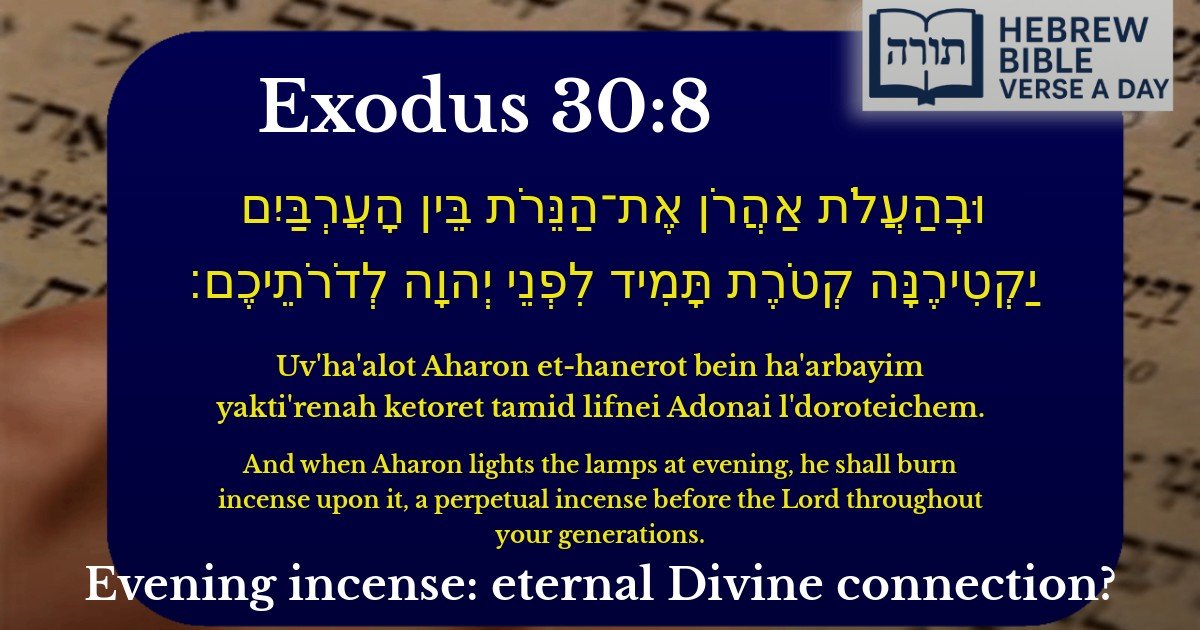
The verse (Shemot 30:8) describes Aharon's duty to light the menorah in the Mishkan (Tabernacle) and offer the ketoret (incense) every evening. This mitzvah is designated as a "perpetual incense before Hashem throughout your generations," emphasizing its enduring significance in Jewish worship.
Rashi's Explanation
Rashi clarifies that the phrase "בֵּין הָעֲרְבַּיִם" ("at evening") refers to the time when the sun begins to set, known as bein ha'arbayim. He notes that Aharon was to light the menorah first and then offer the incense, as derived from the sequence of the verse. Rashi also explains that the term "תָּמִיד" ("perpetual") indicates that this mitzvah applies every day without interruption.
Rambam's Halachic Perspective
In Hilchot Temidin u'Musafin (3:12), the Rambam codifies this mitzvah, stating that the incense offering was an integral part of the daily service in the Beit HaMikdash. He emphasizes that the ketoret was offered twice daily—once in the morning and once in the evening—reinforcing its perpetual nature as commanded in the verse.
Midrashic Insights
Symbolism of the Incense
The ketoret consisted of eleven spices (Keritot 6a), each representing different aspects of divine service. The Talmud (Yoma 44a) teaches that the incense brought blessing and atonement, and its omission was considered a severe transgression (as seen in the episode of Nadav and Avihu).
Practical Halachic Implications
Though the Beit HaMikdash is not standing today, the verse remains a reminder of the ideal service of Hashem. The Shulchan Aruch (Orach Chaim 132) references this verse when discussing the lighting of Shabbat candles, drawing a parallel between the menorah's light and the spiritual illumination brought into Jewish homes.