

Join Our Newsletter To Be Informed When New Videos Are Posted
Hebrew Text
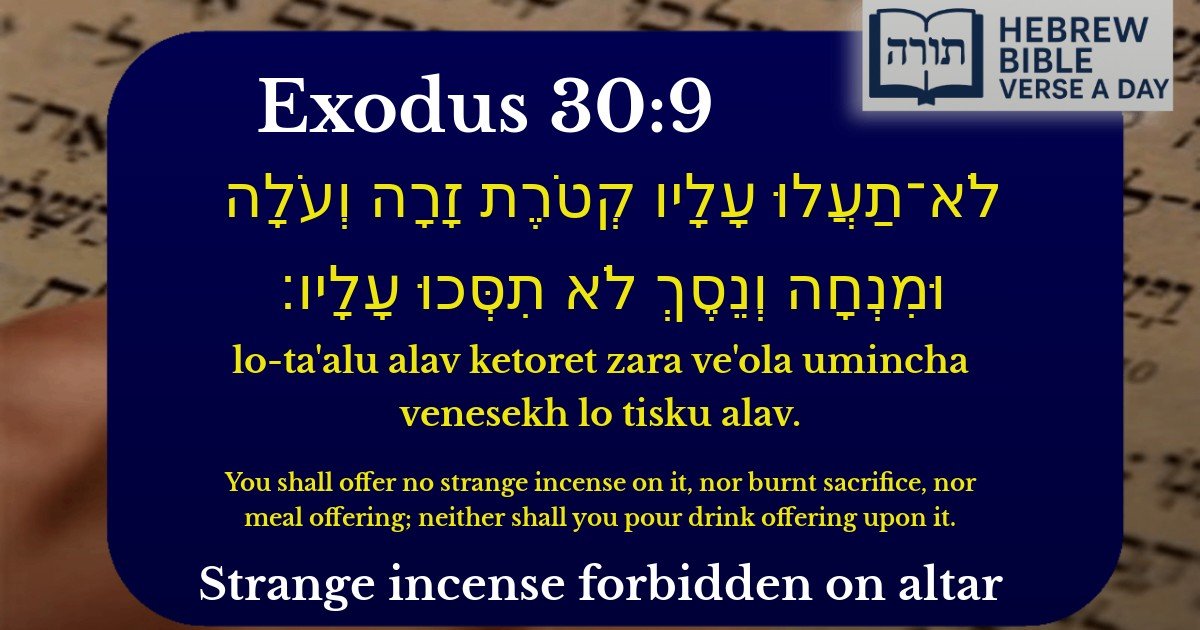
לֹא־תַעֲלוּ עָלָיו קְטֹרֶת זָרָה וְעֹלָה וּמִנְחָה וְנֵסֶךְ לֹא תִסְּכוּ עָלָיו׃
English Translation
You shall offer no strange incense on it, nor burnt sacrifice, nor meal offering; neither shall you pour drink offering upon it.
Transliteration
Lo-ta'alu alav ketoret zara ve'ola umincha venesekh lo tisku alav.
Hebrew Leining Text
לֹא־תַעֲל֥וּ עָלָ֛יו קְטֹ֥רֶת זָרָ֖ה וְעֹלָ֣ה וּמִנְחָ֑ה וְנֵ֕סֶךְ לֹ֥א תִסְּכ֖וּ עָלָֽיו׃
🎵 Listen to leining
Parasha Commentary
📚 Talmud Citations
This verse is quoted in the Talmud.
📖 Keritot 6a
The verse is discussed in the context of the prohibition against offering strange incense on the altar, emphasizing the severity of such an act.
📖 Zevachim 46b
The verse is referenced in a discussion about the proper offerings and the prohibition of unauthorized sacrifices.
Context and Source
The verse (Exodus 30:9) pertains to the Mizbe'ach HaKetoret (Altar of Incense) in the Mishkan (Tabernacle). It prohibits offering unauthorized incense, sacrifices, meal offerings, or libations on this altar. The prohibition underscores the sanctity and designated purpose of the Mizbe'ach HaKetoret, which was exclusively for the daily Ketoret (incense) offering.
Rashi's Commentary
Rashi (Exodus 30:9) explains that "strange incense" (ketoret zara) refers to any incense not prepared according to the specific formula of the Ketoret HaSammim (Holy Incense) described in Exodus 30:34-38. He emphasizes that even if one offers the correct incense at an improper time (e.g., not during the daily service), it is considered "strange" and forbidden.
Rambam's Legal Perspective
Rambam (Hilchot Temidin uMusafin 3:2-3) elaborates on the prohibition, stating that the Mizbe'ach HaKetoret was never intended for animal sacrifices or meal offerings. Its sole function was for the burning of the Ketoret. Offering unauthorized items on it violates the Torah's command and incurs severe consequences.
Midrashic Insights
Halachic Implications
The Sefer HaChinuch (Mitzvah 103) derives from this verse the prohibition against altering any aspect of the Avodah (Temple service). Just as the Ketoret must adhere to its precise formula, all korbanot (offerings) and rituals must follow Torah-mandated procedures without deviation.
Symbolic Meaning
Rabbeinu Bachya notes that the Ketoret represents the silent, inward devotion of the heart, distinct from the outward physicality of animal sacrifices. The prohibition against mixing offerings teaches that each form of worship has its designated place and purpose in serving Hashem.