Frequently Asked Questions
Q: What is the 'altar of burnt offering' mentioned in Exodus 31:9?
A: The 'altar of burnt offering' (מִזְבַּח הָעֹלָה) was the large copper altar in the Tabernacle courtyard where animal sacrifices were offered. According to Rashi, it was called the 'altar of burnt offering' because it was primarily used for the daily burnt offerings (עוֹלוֹת) and other sacrifices.
Q: What was the purpose of the 'laver' (כִּיּוֹר) in Exodus 31:9?
A: The laver was a copper basin filled with water, used by the Kohanim (priests) to wash their hands and feet before performing service in the Tabernacle, as explained in Exodus 30:19-21. The Rambam (Hilchot Bi'at HaMikdash 5:1) teaches that this washing was essential for ritual purity before sacred service.
Q: Why does the Torah list all these Tabernacle vessels in Exodus 31:9?
A: The Torah lists these sacred vessels to emphasize their importance in the Tabernacle service. The Midrash (Tanchuma Terumah 11) explains that each vessel had a specific spiritual purpose, and their construction was commanded directly by Hashem to enable proper worship and connection between the Jewish people and the Divine.
Q: Do we still use these vessels today?
A: No, since we currently lack the Holy Temple in Jerusalem, we do not use these vessels. However, the Talmud (Megillah 29a) teaches that our synagogues and study halls are considered 'miniature sanctuaries,' and we await the future rebuilding of the Temple when these vessels will again be used as prescribed in the Torah.
Q: What can we learn today from the vessels mentioned in Exodus 31:9?
A: The Sages teach that each vessel represents important spiritual lessons. For example, the laver teaches the importance of purification before serving Hashem (symbolized today by netilat yadayim, ritual handwashing). The altar reminds us of complete devotion to Hashem, as burnt offerings were entirely consumed on the altar (Vayikra Rabbah 7:3).

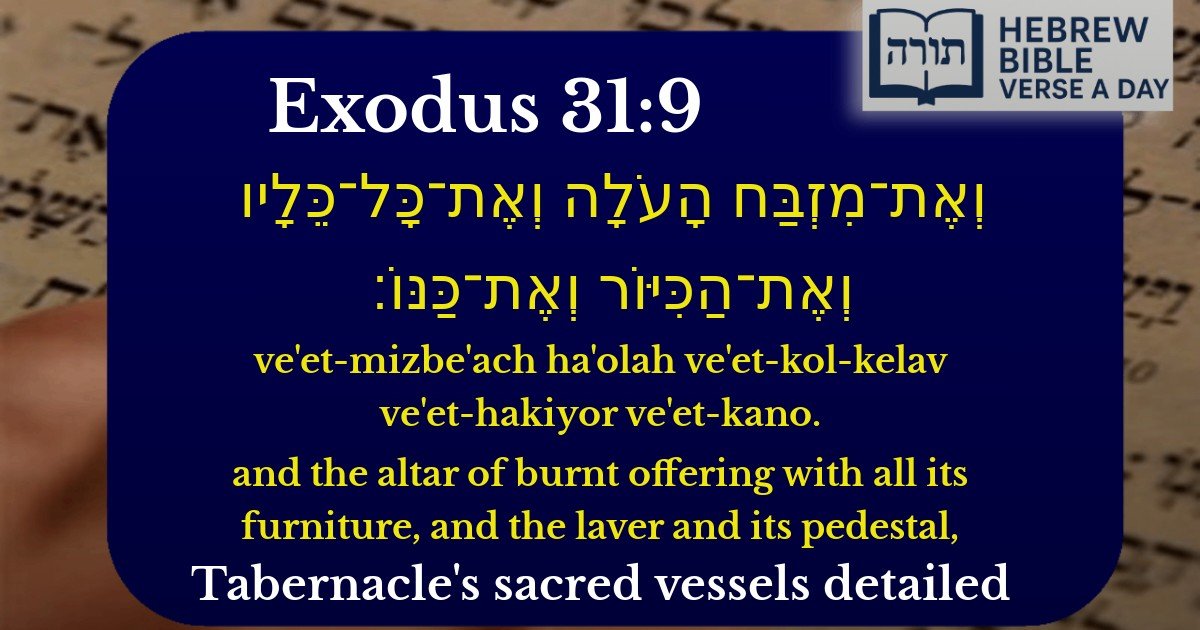

Commentary on Exodus 30:28 – The Altar of Burnt Offering and the Laver
The verse lists key components of the Mishkan (Tabernacle) service: the altar of burnt offering (מִזְבַּח הָעֹלָה), its utensils, the laver (כִּיּוֹר), and its pedestal (כַּנּוֹ). These items were sanctified as part of the consecration process, as detailed in Parashat Tetzaveh and Parashat Ki Tisa.
1. The Altar of Burnt Offering (מִזְבַּח הָעֹלָה)
Rashi (Exodus 27:1) explains that this altar, made of acacia wood and overlaid with copper, was designated specifically for korbanot olah (burnt offerings), which were entirely consumed by fire. The Rambam (Hilchot Temidin uMusafin 1:1) emphasizes that the daily Tamid offering was brought on this altar, symbolizing the perpetual connection between Bnei Yisrael and Hashem.
2. The Laver (כִּיּוֹר) and Its Pedestal (כַּן)
The kior, made from the copper mirrors of the women (Exodus 38:8), was used by the Kohanim to wash their hands and feet before service. Rashi (Exodus 30:18) highlights that this purification was obligatory, teaching that one must approach divine service with physical and spiritual cleanliness.
3. Unity of the Vessels
The Or HaChaim (Exodus 30:28) observes that these items are listed together to emphasize their interdependence—the altar’s service could not proceed without the purifying function of the laver. This teaches that holiness requires both active service (korbanot) and preparatory sanctity (taharah).