Frequently Asked Questions
Q: What does 'I will stretch out my hand' mean in Exodus 3:20?
A: In Exodus 3:20, when Hashem says 'I will stretch out My hand,' it refers to His divine power and intervention. Rashi explains that this phrase signifies the mighty plagues that Hashem would bring upon Egypt to demonstrate His supremacy and compel Pharaoh to free the Jewish people.
Q: Why did Hashem say He would smite Egypt with 'all My wonders'?
A: The term 'all My wonders' refers to the Ten Plagues that Hashem brought upon Egypt. According to the Midrash, each plague was a miraculous act that targeted Egypt's false beliefs and demonstrated Hashem's absolute control over nature. These wonders were meant to punish Egypt for enslaving the Jewish people and to prove that Hashem alone is the true G-d.
Q: What is the significance of 'after that he will let you go' in this verse?
A: The phrase 'after that he will let you go' teaches that Pharaoh would only release the Jewish people after witnessing Hashem's overwhelming power through the plagues. The Rambam explains that this shows how human stubbornness (like Pharaoh's) cannot withstand divine will, and ultimately, Hashem's plan for redemption will prevail.
Q: How does Exodus 3:20 relate to the broader story of Yetziat Mitzrayim (the Exodus)?
A: Exodus 3:20 is a key verse in the promise of the Exodus. It foreshadows the Ten Plagues and the eventual liberation of the Jewish people. The Talmud (Berachot 9a) teaches that this verse emphasizes that the Exodus was not just about physical freedom but also about revealing Hashem's greatness to the world, a foundational event in Jewish history.
Q: What lesson can we learn today from Exodus 3:20?
A: This verse teaches us about Hashem's faithfulness in keeping His promises and His power to redeem His people. The Sages explain that just as Hashem intervened in Egypt, He continues to guide Jewish history. It reminds us to trust in Hashem's deliverance, especially in times of difficulty, as He has shown His ability to bring salvation in the past.


Understanding the Verse in Context
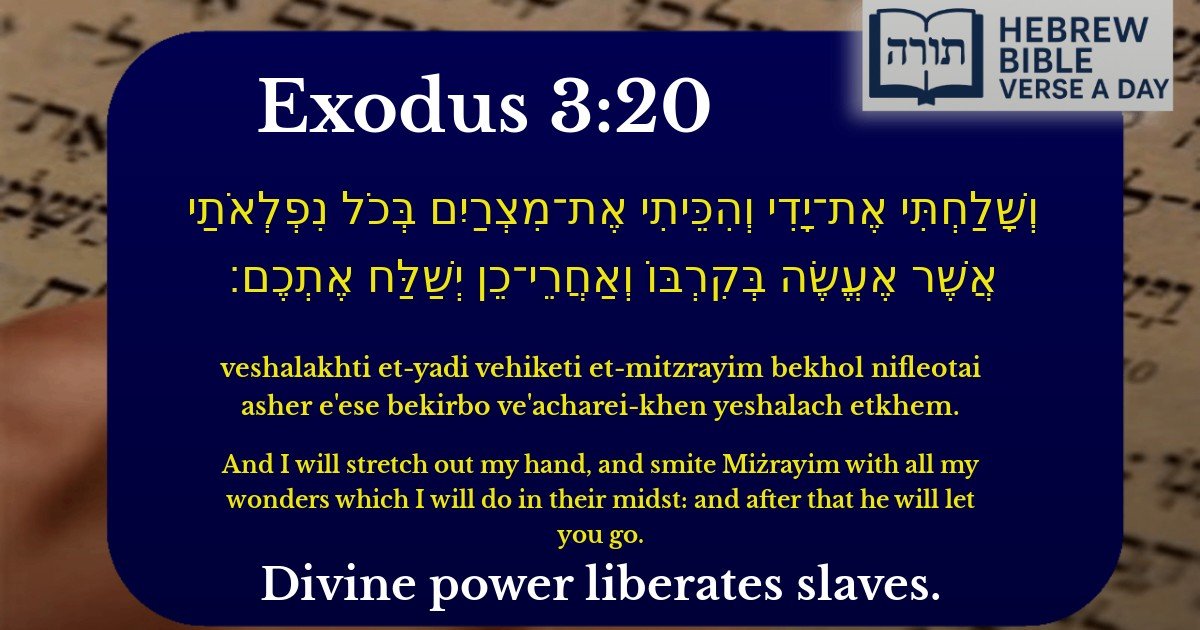
The verse (Shemot 3:20) is part of Hashem's revelation to Moshe at the burning bush, where He outlines His plan to redeem Bnei Yisrael from Egyptian bondage. The phrase "וְשָׁלַחְתִּי אֶת־יָדִי" ("I will stretch out My hand") signifies divine intervention through miraculous plagues, demonstrating Hashem's absolute power over nature and human rulers.
Rashi's Commentary
Rashi explains that the "wonders" (נִפְלְאֹתַי) refer to the Ten Plagues, which were supernatural acts beyond the ordinary laws of nature. He emphasizes that these miracles would occur "בְּקִרְבּוֹ" ("in their midst")—within Egypt itself—to prove that Hashem's presence was directly confronting Pharaoh's arrogance and Egypt's false deities.
Rambam's Perspective
In Moreh Nevuchim (3:36), Rambam discusses how the plagues served a dual purpose: to punish Egypt for their oppression and to educate Bnei Yisrael about Hashem's unity and providence. The phrase "יְשַׁלַּח אֶתְכֶם" ("he will let you go") implies that Pharaoh's eventual submission would be compelled, not voluntary, reinforcing that true freedom comes only through divine will.
Midrashic Insights
Theological Implications
The verse underscores the principle of middah k'neged middah (measure for measure): just as Egypt "stretched out their hand" to oppress Bnei Yisrael (Shemot 1:13-14), Hashem would "stretch out His hand" to exact justice. The plagues were not merely punitive but also revelatory, affirming Hashem as the ultimate Redeemer (Go'el Yisrael).