

Join Our Newsletter To Be Informed When New Videos Are Posted
Hebrew Text
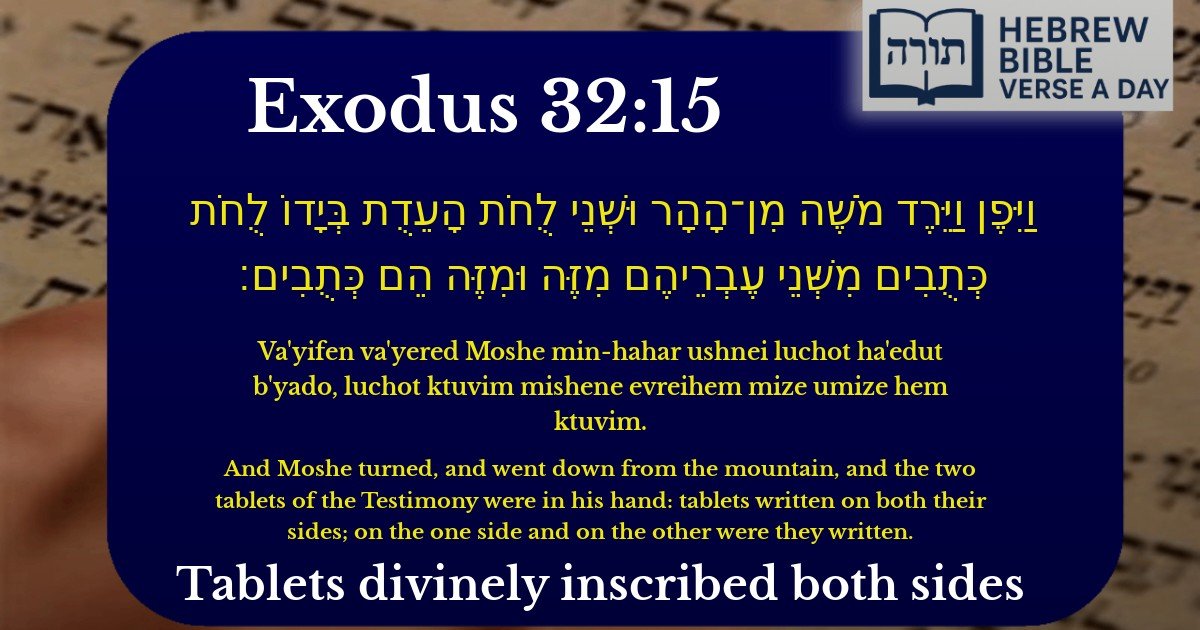
וַיִּפֶן וַיֵּרֶד מֹשֶׁה מִן־הָהָר וּשְׁנֵי לֻחֹת הָעֵדֻת בְּיָדוֹ לֻחֹת כְּתֻבִים מִשְּׁנֵי עֶבְרֵיהֶם מִזֶּה וּמִזֶּה הֵם כְּתֻבִים׃
English Translation
And Moshe turned, and went down from the mountain, and the two tablets of the Testimony were in his hand: tablets written on both their sides; on the one side and on the other were they written.
Transliteration
Va'yifen va'yered Moshe min-hahar ushnei luchot ha'edut b'yado, luchot ktuvim mishene evreihem mize umize hem ktuvim.
Hebrew Leining Text
וַיִּ֜פֶן וַיֵּ֤רֶד מֹשֶׁה֙ מִן־הָהָ֔ר וּשְׁנֵ֛י לֻחֹ֥ת הָעֵדֻ֖ת בְּיָד֑וֹ לֻחֹ֗ת כְּתֻבִים֙ מִשְּׁנֵ֣י עֶבְרֵיהֶ֔ם מִזֶּ֥ה וּמִזֶּ֖ה הֵ֥ם כְּתֻבִֽים׃
🎵 Listen to leining
Parasha Commentary
📚 Talmud Citations
This verse is quoted in the Talmud.
📖 Shabbat 104a
The verse is referenced in a discussion about the writing on the tablets, specifically how the letters were miraculously legible from both sides.
📖 Nedarim 38a
The verse is mentioned in the context of discussing the unique qualities of Moses and the divine nature of the tablets.
The Dual-Sided Writing on the Luchot
The verse describes the Luchot HaBrit (Tablets of the Covenant) as being written "מִשְּׁנֵי עֶבְרֵיהֶם"—"on both their sides." Rashi (Exodus 32:15) explains that this means the writing was miraculously engraved through the entire thickness of the tablets, so that it could be read identically from both sides. This was a divine miracle, as the letters מ"ם and ס"ף (which are closed shapes in Hebrew) were suspended in place without natural support.
The Significance of the Writing
The Talmud (Shabbat 104a) teaches that the words were not merely inscribed on the surface but were carved through the stone, demonstrating that the Torah is not bound by physical limitations. Rambam (Hilchot Yesodei HaTorah 1:8) emphasizes that this miracle affirmed the divine origin of the Torah, as human engraving could not produce such a phenomenon.
The Two Tablets as a Symbol
Midrash Tanchuma (Ki Tisa 30) notes that the two tablets correspond to two categories of mitzvot:
The fact that both sides were equally legible symbolizes that these two aspects of Torah are inseparable and equally essential.
Moshe's Descent from Har Sinai
The Mechilta (Beshalach 3) highlights that Moshe descended with the Luchot "בְּיָדוֹ"—"in his hand," indicating his personal role as the transmitter of Torah to Israel. The Kli Yakar (Exodus 32:15) adds that this emphasizes Moshe's humility, as he carried the heavy tablets himself rather than delegating the task.