Frequently Asked Questions
Q: What was the noise that Yehoshua heard in the camp?
A: Yehoshua heard the people shouting loudly while celebrating around the Golden Calf (Exodus 32:17). Rashi explains that Yehoshua initially thought it was the sound of war, but Moshe corrected him, recognizing it as sinful revelry (Rashi on Exodus 32:17).
Q: Why did Yehoshua mistake the noise for war?
A: The Midrash (Shemot Rabbah 42:5) teaches that Yehoshua, as a righteous leader, could not imagine the Jewish people sinning with idolatry. Therefore, he assumed the loud noise must have been from an external threat like war, rather than internal wrongdoing.
Q: What lesson can we learn from Yehoshua's reaction?
A: The Talmud (Sanhedrin 93a) derives from this incident that a person should always judge others favorably ('dan l'kaf zechut'). Even when hearing something that sounds negative, we should first consider innocent explanations before assuming wrongdoing.
Q: How does this verse connect to the sin of the Golden Calf?
A: This verse shows the immediate aftermath of the Golden Calf incident. Rambam (Mishneh Torah, Hilchot Avodah Zarah 1) explains that the people's wild celebration demonstrated how quickly they fell into idolatrous behavior, despite having recently witnessed the revelation at Sinai.
Q: Why is this moment significant in Yehoshua's development as a leader?
A: The Sforno notes that this was a test for Yehoshua, preparing him for future leadership. His concern for the people's welfare (even when mistaken about the nature of the noise) demonstrated the qualities that would later make him Moshe's worthy successor (Sforno on Exodus 32:17).

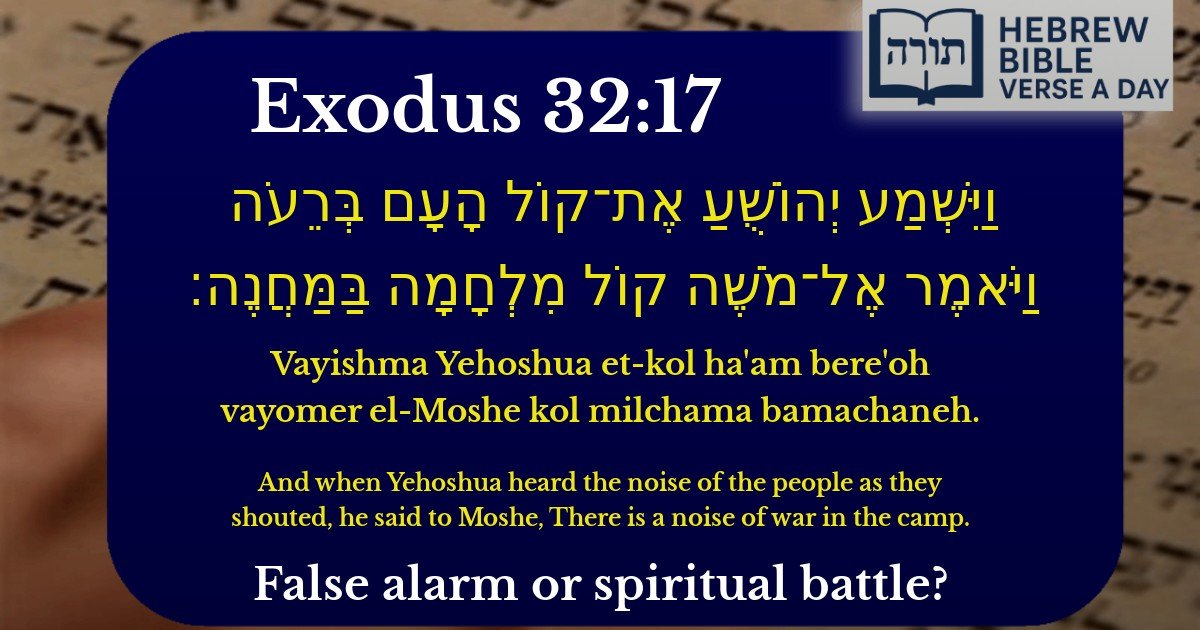

Context of the Verse
The verse (Shemot 32:17) describes Yehoshua's reaction upon hearing the noise from the camp of Bnei Yisrael while descending Har Sinai with Moshe. This occurs during the episode of the Golden Calf (Cheit Ha'Egel). Yehoshua misinterprets the sounds as war cries, unaware that the people were engaged in idolatrous revelry.
Yehoshua's Misinterpretation
Rashi explains that Yehoshua, being younger and less experienced than Moshe, heard the noise but did not discern its true nature. Unlike Moshe, who recognized it as sinful revelry (based on the deeper understanding granted to him), Yehoshua assumed it was the sound of battle. This teaches that spiritual perception varies according to a person's level of closeness to Hashem.
The Nature of the Noise
The Midrash (Shemot Rabbah 41:7) elaborates that the noise was a mixture of:
Spiritual Implications
Rambam (Moreh Nevuchim 1:5) uses this episode to demonstrate how even great leaders like Yehoshua can err in perception when not fully attuned to spiritual realities. The Maharal (Gur Aryeh) adds that Yehoshua's mistake stemmed from his pure nature—he could not fathom that Bnei Yisrael would commit such a grave sin after witnessing Matan Torah.
Contrast with Moshe's Understanding
The Kli Yakar notes that Moshe immediately recognized the sounds as those of sin (based on the word "רֵעֹה" - implying moral corruption), while Yehoshua heard only "קוֹל" - simple noise. This highlights the difference between Moshe's prophetic clarity and Yehoshua's more limited perception at that time.