Frequently Asked Questions
Q: What is happening in Exodus 32:18?
A: In Exodus 32:18, Moshe (Moses) is descending from Har Sinai (Mount Sinai) with the Luchot (Tablets of the Covenant). He hears noise from the Israelite camp and describes it to Yehoshua (Joshua). Rashi explains that Moshe distinguishes between sounds of war ('voice of those who shout for mastery' or 'cry for being overcome') and the sound of singing, which he actually hears. This refers to the sinful celebration around the Golden Calf (Egel HaZahav).
Q: Why does Moshe describe the sounds he hears in this way?
A: Moshe uses this poetic language to convey that the Israelites were not in distress or battle (which would warrant intervention), but rather engaged in improper revelry. The Midrash Tanchuma notes that Moshe, with his prophetic insight, perceived the spiritual downfall behind their singing—indicating their involvement in idolatry with the Golden Calf.
Q: What lesson can we learn from Exodus 32:18?
A: This verse teaches us to be discerning about the nature of celebrations. Not all joyous noise is positive—sometimes it can mask spiritual wrongdoing. The Rambam (Hilchot Avodah Zarah 1) derives from this episode the importance of distancing oneself from even the atmosphere of sin, as the Israelites' singing reflected their moral decline.
Q: How does this verse connect to the sin of the Golden Calf?
A: This verse introduces the scene where Moshe discovers the Golden Calf worship. The singing he hears is the Israelites celebrating around the idol. The Talmud (Sanhedrin 63b) explains that their 'voice of singing' demonstrated how quickly they turned from the sublime experience of Matan Torah (receiving the Torah) to base idolatry, showing the fragility of human commitment without constant spiritual vigilance.
Q: Why is the distinction between types of 'voices' important in this verse?
A: Moshe's precise description shows his leadership wisdom. As Rashi notes, had it been sounds of war, Yehoshua (a military leader) would have responded differently. But since it was singing, Moshe understood it was a spiritual crisis requiring his intervention. This teaches that leaders must discern between different types of communal challenges to respond appropriately.

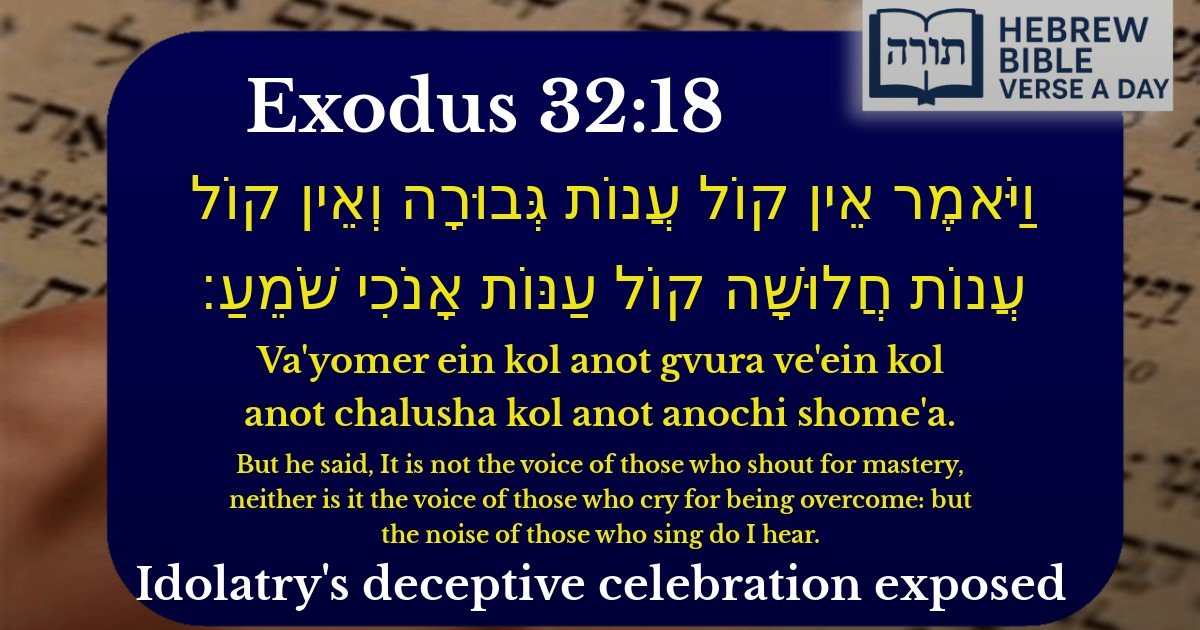

Context of the Verse
This verse (Exodus 32:18) is part of the narrative describing Moshe's descent from Har Sinai, where he hears the sounds of the Jewish people celebrating around the Golden Calf. Yehoshua, accompanying Moshe, mistakes the noise for the sounds of battle, but Moshe corrects him, identifying it as the sound of singing.
Rashi's Explanation
Rashi (Exodus 32:18) explains that Moshe discerned three distinct sounds:
Rashi emphasizes that Moshe, through divine insight (רוח הקודש), recognized this as the sound of idolatrous singing, not war.
Ibn Ezra's Insight
Ibn Ezra (Exodus 32:18) notes that the term "עַנּוֹת" is related to "ענה" (to answer or respond), suggesting a call-and-response style of singing. This implies a coordinated, communal celebration rather than the chaos of battle.
Midrashic Interpretation
The Midrash (Shemot Rabbah 42:7) elaborates that Moshe's ability to discern the nature of the sounds demonstrated his prophetic clarity. While Yehoshua heard only indistinct noise, Moshe perceived the spiritual corruption underlying the revelry.
Rambam's Perspective
Rambam (Moreh Nevuchim 2:45) discusses how prophets could distinguish subtle spiritual realities. Moshe's perception here exemplifies his unique prophetic capacity to interpret auditory signs with precision, reflecting his closeness to Hashem.
Halachic Implication
The Kli Yakar (Exodus 32:18) connects this episode to the broader theme of עבודה זרה (idolatry). He explains that the sounds of celebration without sanctity—mere "noise"—symbolize the emptiness of idol worship, contrasting with the meaningful sounds of Torah and tefillah.