

Join Our Newsletter To Be Informed When New Videos Are Posted
Hebrew Text
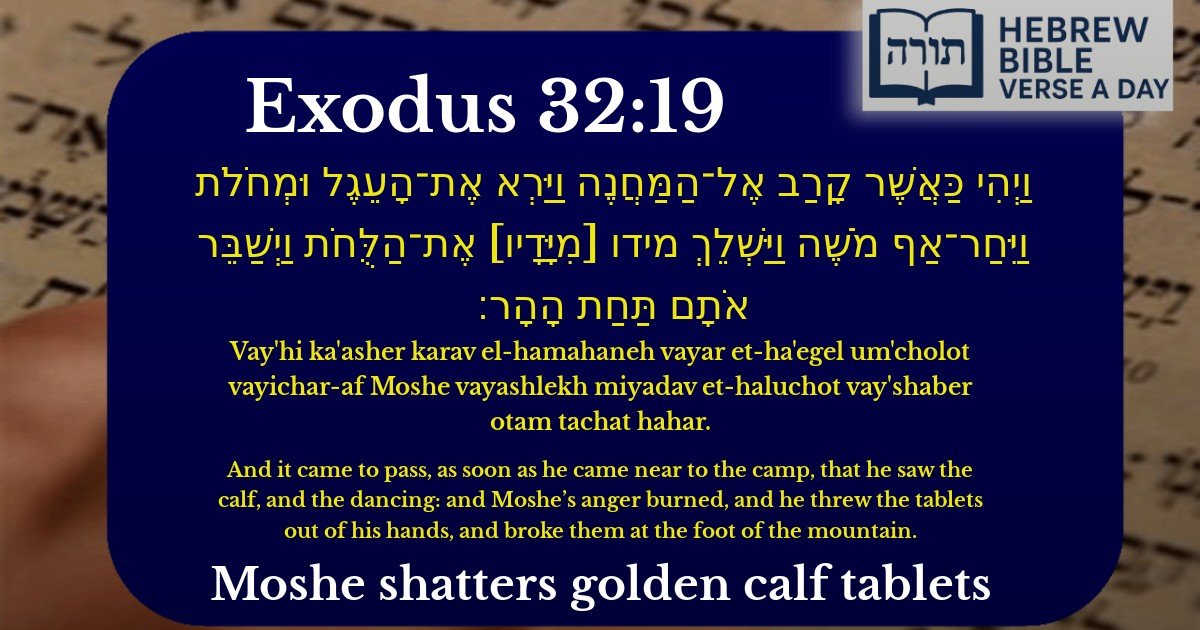
וַיְהִי כַּאֲשֶׁר קָרַב אֶל־הַמַּחֲנֶה וַיַּרְא אֶת־הָעֵגֶל וּמְחֹלֹת וַיִּחַר־אַף מֹשֶׁה וַיַּשְׁלֵךְ מידו [מִיָּדָיו] אֶת־הַלֻּחֹת וַיְשַׁבֵּר אֹתָם תַּחַת הָהָר׃
English Translation
And it came to pass, as soon as he came near to the camp, that he saw the calf, and the dancing: and Moshe’s anger burned, and he threw the tablets out of his hands, and broke them at the foot of the mountain.
Transliteration
Vay'hi ka'asher karav el-hamahaneh vayar et-ha'egel um'cholot vayichar-af Moshe vayashlekh miyadav et-haluchot vay'shaber otam tachat hahar.
Hebrew Leining Text
וַֽיְהִ֗י כַּאֲשֶׁ֤ר קָרַב֙ אֶל־הַֽמַּחֲנֶ֔ה וַיַּ֥רְא אֶת־הָעֵ֖גֶל וּמְחֹלֹ֑ת וַיִּֽחַר־אַ֣ף מֹשֶׁ֗ה וַיַּשְׁלֵ֤ךְ מִיָּדָו֙ אֶת־הַלֻּחֹ֔ת וַיְשַׁבֵּ֥ר אֹתָ֖ם תַּ֥חַת הָהָֽר׃
🎵 Listen to leining
Parasha Commentary
📚 Talmud Citations
This verse is quoted in the Talmud.
📖 Shabbat 87a
The verse is discussed in the context of Moses breaking the tablets, with the Talmud exploring the timing and justification for his actions.
📖 Yoma 66b
The breaking of the tablets is mentioned in relation to the concept of acting out of righteous anger and zeal for God's honor.
Moshe's Anger and the Breaking of the Tablets
The verse describes Moshe's reaction upon witnessing the Golden Calf and the accompanying revelry. According to Rashi (Shemot 32:19), Moshe's anger burned when he saw the idolatry, leading him to shatter the Luchot HaBrit (Tablets of the Covenant). Rashi explains that Moshe reasoned: If the Torah states that a korban Pesach (Passover offering) may not be brought by an idolater (Shemot 12:43), how much more so must the entire Torah—embodied in the Tablets—be withheld from those engaged in idol worship.
The Timing of Moshe's Action
The Talmud (Shabbat 87a) discusses why Moshe broke the Tablets specifically tachat hahar (at the foot of the mountain). Rabbi Yehuda explains that Moshe acted deliberately to parallel the giving of the Torah at Har Sinai—just as the covenant was established at the mountain, its rupture also occurred there. The Midrash Tanchuma (Ki Tisa 30) adds that Moshe sought to protect Bnei Yisrael from greater punishment by demonstrating the severity of their sin through this symbolic act.
The Nature of Moshe's Anger
Rambam (Hilchos Dei'os 2:3) cites this episode as an example of justified anger when confronting grave transgressions. However, the Talmud (Pesachim 66b) notes that Moshe's anger caused him to momentarily forget halachic rulings, teaching that anger can impair one's judgment—even for a leader of Moshe's stature.
The Symbolism of the Broken Tablets