
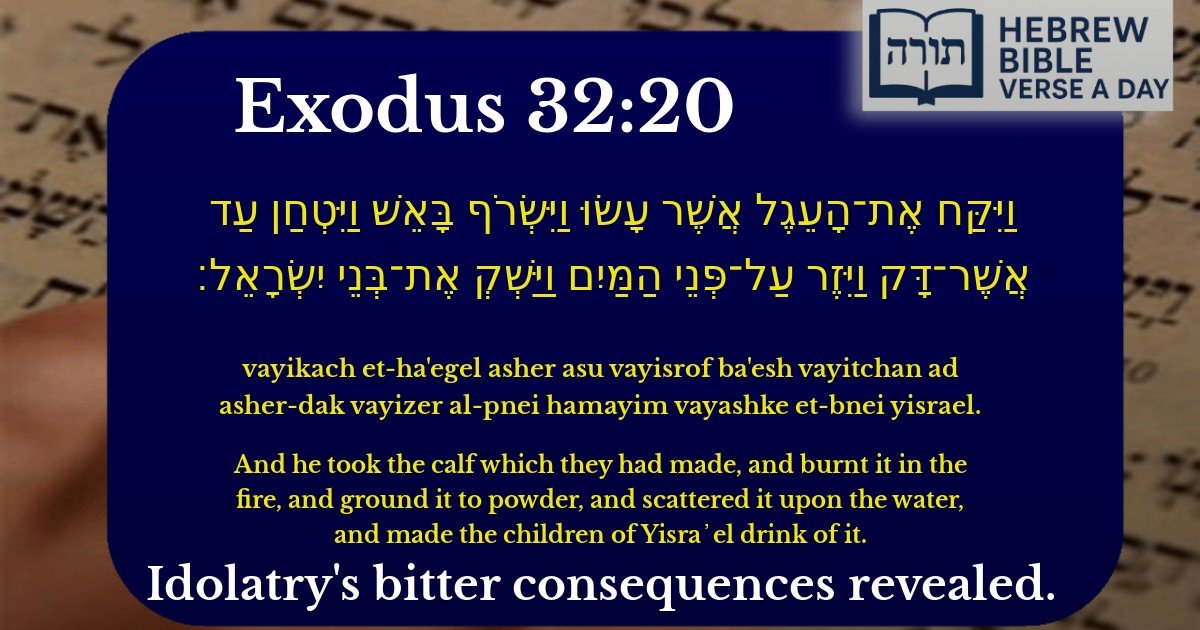

Exodus 32:20 - Idolatry's bitter consequences revealed.

Exodus 32:20 - שמות 32:20

Hebrew Text

וַיִּקַּח אֶת־הָעֵגֶל אֲשֶׁר עָשׂוּ וַיִּשְׂרֹף בָּאֵשׁ וַיִּטְחַן עַד אֲשֶׁר־דָּק וַיִּזֶר עַל־פְּנֵי הַמַּיִם וַיַּשְׁקְ אֶת־בְּנֵי יִשְׂרָאֵל׃

English Translation

And he took the calf which they had made, and burnt it in the fire, and ground it to powder, and scattered it upon the water, and made the children of Yisra᾽el drink of it.

Transliteration

Vayikach et-ha'egel asher asu vayisrof ba'esh vayitchan ad asher-dak vayizer al-pnei hamayim vayashke et-bnei yisrael.

Hebrew Leining Text

וַיִּקַּ֞ח אֶת־הָעֵ֨גֶל אֲשֶׁ֤ר עָשׂוּ֙ וַיִּשְׂרֹ֣ף בָּאֵ֔שׁ וַיִּטְחַ֖ן עַ֣ד אֲשֶׁר־דָּ֑ק וַיִּ֙זֶר֙ עַל־פְּנֵ֣י הַמַּ֔יִם וַיַּ֖שְׁקְ אֶת־בְּנֵ֥י יִשְׂרָאֵֽל׃

🎵 Listen to leining

Parasha Commentary

Destruction of the Golden Calf (Shemot 32:20)

The verse describes Moshe's actions in response to the sin of the Golden Calf. According to Rashi, Moshe's thorough destruction of the calf—burning, grinding, and scattering it—served multiple purposes:

  • Public Demonstration: By burning the calf, Moshe demonstrated that it was not a divine being, as a true deity would not be consumed by fire (Rashi on Shemot 32:20).
  • Complete Nullification: Grinding it into powder ensured that no remnant of idolatry remained, fulfilling the mitzvah of bitul avodah zarah (nullifying idolatry).
  • Spiritual Purification: Making Bnei Yisrael drink the mixture served as a test—those truly guilty of idolatry would suffer consequences, while the innocent would be unharmed (Midrash Tanchuma, Ki Tisa 26).

Symbolism of the Water

The Ramban (Nachmanides) explains that scattering the powder on the water alludes to the Sotah ritual (Bamidbar 5:11-31), where a suspected adulteress drinks water to prove her innocence. Here, the nation was tested for their loyalty to Hashem.

Halachic Implications

The Rambam (Hilchot Avodah Zarah 7:8) derives from this episode that the proper way to nullify idolatry is through destruction, ensuring no possibility of future worship. The severity of Moshe's actions underscores the gravity of the sin and the need for complete repentance.

📚 Talmud Citations

This verse is quoted in the Talmud.

📖 Avodah Zarah 44a
The verse is referenced in the discussion about the prohibition of idolatry and the treatment of idolatrous objects, illustrating how Moses dealt with the golden calf.

Frequently Asked Questions

Q: What did Moshe do with the golden calf in Exodus 32:20?
A: Moshe destroyed the golden calf by burning it, grinding it into powder, scattering it on water, and making Bnei Yisrael drink it. This was to demonstrate the complete rejection of idolatry and to show that the calf had no power (Rashi on Exodus 32:20).
Q: Why did Moshe make Bnei Yisrael drink the powdered golden calf?
A: According to the Midrash (Shemot Rabbah 41:7), Moshe made them drink it as a test—those who truly repented would be unharmed, while those still attached to idolatry would suffer consequences. It was a way to purify the nation from sin.
Q: What lesson can we learn from Exodus 32:20 about idolatry?
A: The verse teaches that idolatry must be utterly destroyed and rejected. Just as Moshe didn’t merely discard the calf but obliterated it, we must completely remove any form of avodah zarah (foreign worship) from our lives (Rambam, Hilchot Avodah Zarah 7:1-2).
Q: How does the punishment in Exodus 32:20 relate to justice?
A: The Talmud (Avodah Zarah 44a) explains that the punishment was measure-for-measure: since they used gold (a precious material) for sin, they had to 'consume' its consequences. This teaches that wrongdoing carries accountability.
Q: Is there a deeper meaning to scattering the powder on water?
A: Rashi (Exodus 32:20) suggests the water symbolizes Torah—just as water is essential for life, Torah purifies and sustains the soul. By mixing the calf’s remains with water, Moshe showed that true repentance requires returning to Torah values.