Frequently Asked Questions
Q: What does it mean that Hashem will 'blot out' someone from His book?
A: According to Rashi, this refers to being erased from the 'Book of Life' - meaning losing one's share in the World to Come (Olam Haba). The Rambam explains in Hilchot Teshuvah that this is a warning about the serious consequences of unrepentant sin, but also teaches that sincere repentance can restore one's place.
Q: Why does Hashem say this specifically to Moshe?
A: The Midrash explains this was said after the sin of the Golden Calf when Moshe pleaded for mercy for the Jewish people. Hashem was teaching that while Moshe could intercede, ultimately each person is accountable for their own actions before G-d.
Q: Does this mean G-d actually has a physical 'book'?
A: No, this is a metaphor. The Talmud (Rosh Hashanah 32b) explains that 'book' refers to G-d's knowledge and judgment of each person's deeds. Just as a king records his subjects in a book, G-d 'records' the righteous for life and blessing.
Q: How can we apply this verse to our lives today?
A: The verse teaches us the gravity of sin but also the power of teshuvah (repentance). The Seforno notes that the verse implies one can avoid being 'blotted out' by correcting their ways. During the High Holidays especially, we focus on being inscribed in the Book of Life through repentance, prayer and charity.
Q: What is the 'book' referred to in this verse?
A: Traditional sources identify three 'books' opened on Rosh Hashanah (Talmud Rosh Hashanah 16b): The completely righteous are immediately inscribed in the Book of Life, the completely wicked in the Book of Death, and intermediates have until Yom Kippur to repent. This verse refers to that divine accounting.

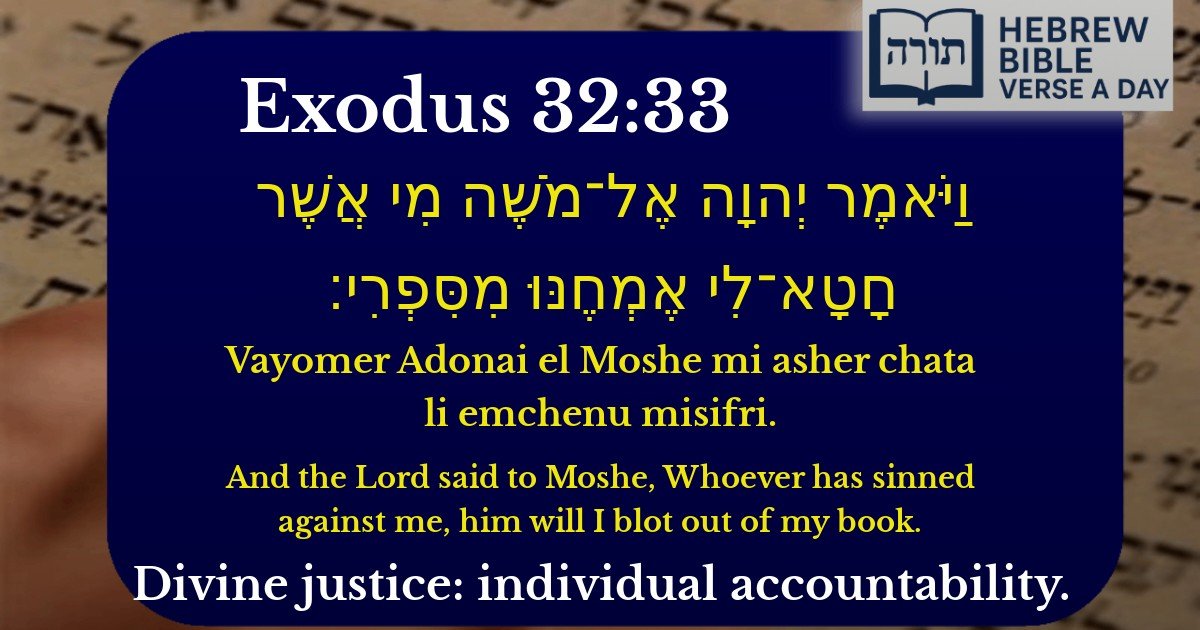

Context of the Verse
The verse (Shemot 32:33) appears in the aftermath of the sin of the Golden Calf, where Hashem responds to Moshe's plea for mercy on behalf of Bnei Yisrael. The phrase "him will I blot out of My book" is a powerful statement about accountability for sin.
Rashi's Explanation
Rashi interprets "My book" as referring to the "Book of the Living" (Sefer HaChayim), which records the righteous. He explains that those who sin intentionally and without repentance will be erased from this book, signifying their exclusion from eternal life (Olam Haba). Rashi emphasizes that this applies specifically to those who persist in their rebellion against Hashem.
Rambam's Perspective
Rambam (Hilchos Teshuvah 3:5-6) connects this verse to the concept of divine justice and free will. He teaches that while Hashem decrees consequences for sin, teshuvah (repentance) can overturn the decree. Thus, the erasure from the book is not absolute—it depends on whether the sinner repents or continues in wrongdoing.
Talmudic and Midrashic Insights
Practical Implications
This verse serves as a reminder of the gravity of sin and the importance of teshuvah. Orthodox Jewish tradition teaches that while sin creates distance from Hashem, sincere repentance can restore one's place in the "Book of the Living." The verse also underscores the principle of individual accountability—each person is judged based on their own actions, not collectively.