Frequently Asked Questions
Q: What does Moses mean when he asks to see G-d's glory in Exodus 33:18?
A: Moses is asking for a deeper understanding and revelation of G-d's presence and essence. According to Rashi, Moses wanted to comprehend G-d's ways in governing the world, especially after the sin of the Golden Calf. G-d responds by showing His attributes of mercy (Exodus 34:6-7), teaching that while we cannot perceive G-d's full essence, we can understand His actions in the world.
Q: Why couldn't Moses see G-d's face in Exodus 33:18?
A: The Talmud (Berachot 7a) explains that no human can fully perceive G-d's essence and live, as G-d's true nature is beyond human comprehension. G-d tells Moses, 'You cannot see My face, for no man can see Me and live' (Exodus 33:20). Instead, G-d allows Moses to see a glimpse of His 'back'—meaning a partial understanding of His ways after they have occurred in the world.
Q: What can we learn from Moses' request to see G-d's glory?
A: Moses teaches us the importance of seeking a closer relationship with G-d and striving to understand His ways. The Midrash (Shemot Rabbah 45:6) highlights Moses' humility and deep desire for divine connection. While we cannot see G-d directly, we can perceive His presence through studying Torah, performing mitzvot, and observing His hand in creation and history.
Q: How does Exodus 33:18 relate to prayer today?
A: Just as Moses sought to experience G-d's presence, prayer (tefillah) is our way of connecting with G-d's glory. The Rambam (Hilchot Tefillah 1:1) explains that prayer is a mitzvah where we stand before G-d, expressing our needs and yearning for closeness. While we don't see G-d physically, we can feel His presence through sincere devotion and Torah study.
Q: What is the 'glory of G-d' in Jewish thought?
A: In Jewish tradition, G-d's glory (kavod) refers to the manifestation of His presence in the world, such as the Shechinah (Divine Presence) in the Mishkan (Tabernacle). The Ramban (Nachmanides) on Exodus 33:18 explains that G-d's glory represents His revealed attributes—kindness, justice, and mercy—which guide the world. We perceive His glory through Torah, prophecy, and divine providence.

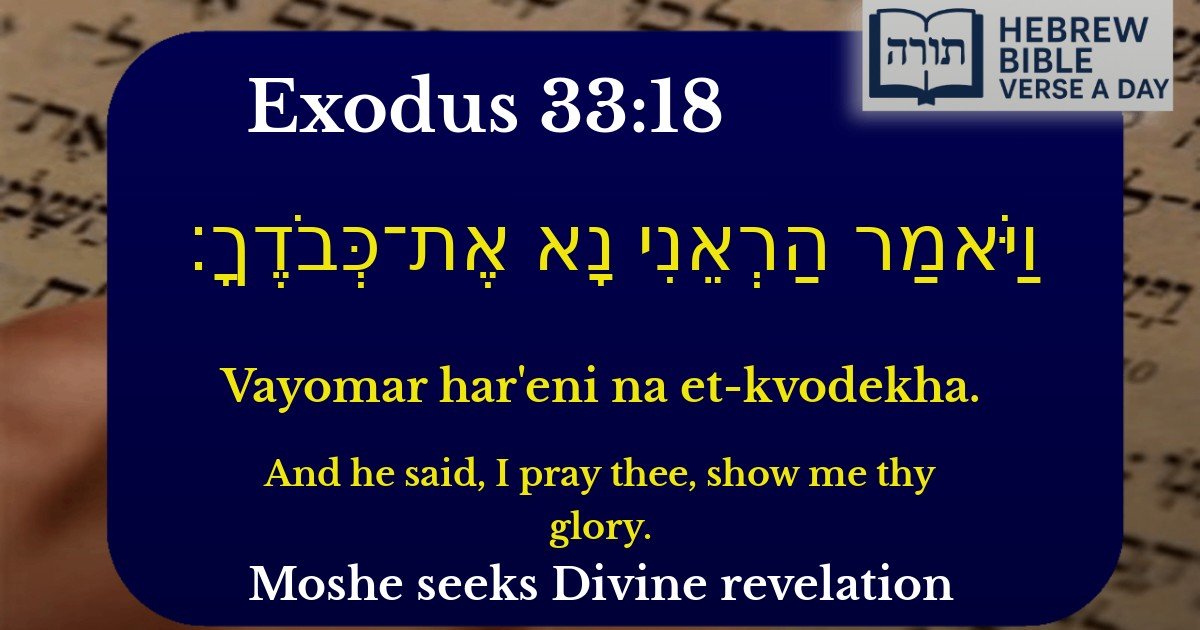

Context of the Verse
The verse (Shemot 33:18) occurs after the sin of the Golden Calf, when Moshe Rabbeinu pleads with Hashem to continue guiding Bnei Yisrael. Following Hashem's assurance of His presence, Moshe makes this profound request to behold the Divine Glory.
Rashi's Explanation
Rashi explains that Moshe was asking to understand the ways of Divine Providence—why the righteous sometimes suffer while the wicked prosper. Hashem responds (in the following verses) by showing Moshe only His "back," not His "face," meaning that humans can only comprehend Hashem's ways in retrospect, not in the moment.
Rambam's Perspective
In Moreh Nevuchim (1:54), Rambam interprets this as Moshe seeking to grasp the essence of Hashem's existence. However, Hashem explains that no mortal can perceive His true essence (as stated in Shemot 33:20), only His actions and attributes manifested in the world.
Talmudic Insight
Berachos 7a relates that Moshe asked to see the "knot of Hashem's tefillin," a metaphor for understanding the depth of Divine judgment. The Talmud explains that Hashem showed Moshe only after covering him with His hand (symbolizing limited revelation), teaching that complete comprehension of the Divine is beyond human capacity.
Midrashic Interpretation
Kabbalistic Dimension
The Zohar (2:229a) explains that Moshe sought to perceive the sefirah of Tiferet (representing balance of Divine attributes), but was shown only Malchut (Divine immanence in creation), as complete perception of the Divine is impossible for physical beings.
Practical Lesson
This episode teaches the boundaries of human understanding of the Divine. While we yearn to comprehend Hashem's ways, we must accept that some aspects of Divine Providence remain beyond our grasp, requiring emunah (faith) even when we cannot understand.