Frequently Asked Questions
Q: What does Exodus 33:20 mean when it says 'no man shall see Me and live'?
A: This verse means that human beings in their physical form cannot perceive Hashem's full essence and survive, as His infinite holiness is beyond human comprehension. Rashi explains that this refers to seeing Hashem's 'face'—His full revealed presence—which would overwhelm mortal existence. However, we can perceive Hashem's 'back' (Exodus 33:23), meaning we can recognize His actions and influence in the world after they occur.
Q: Why is it important that humans cannot see Hashem's face?
A: This teaches us about the infinite difference between the Creator and creation. The Rambam (Hilchos Yesodei HaTorah 1:10) explains that Hashem's true essence is beyond human perception. This limitation humbles us and reinforces that we connect to Hashem through faith, mitzvos, and studying His Torah—not through physical perception. The Midrash (Shemos Rabbah 45:5) compares this to the sun: just as we cannot stare directly at the sun, we cannot perceive Hashem's full glory.
Q: How does Exodus 33:20 apply to our lives today?
A: This verse reminds us that while we cannot physically see Hashem, we experience His presence through Torah study, tefillah (prayer), and observing mitzvos. The Talmud (Berachos 7a) teaches that Moshe Rabbeinu's request to 'see Hashem's glory' represents our deep desire for closeness to the Divine. In our daily lives, we cultivate this connection by recognizing Hashem's hand in nature, history, and personal experiences—seeing His 'back' through the results of His actions in the world.
Q: What does it mean that Moshe couldn't see Hashem's face?
A: Even Moshe Rabbeinu—the greatest prophet who spoke to Hashem 'face to face' (Devarim 34:10)—could not perceive Hashem's full essence. The Ibn Ezra explains that 'face' represents complete understanding. This shows that while Moshe achieved the highest level of prophecy possible for a human (Rambam, Yesodei HaTorah 7:6), there are still limits to human perception of the Divine. Our relationship with Hashem is built on faith within these boundaries.

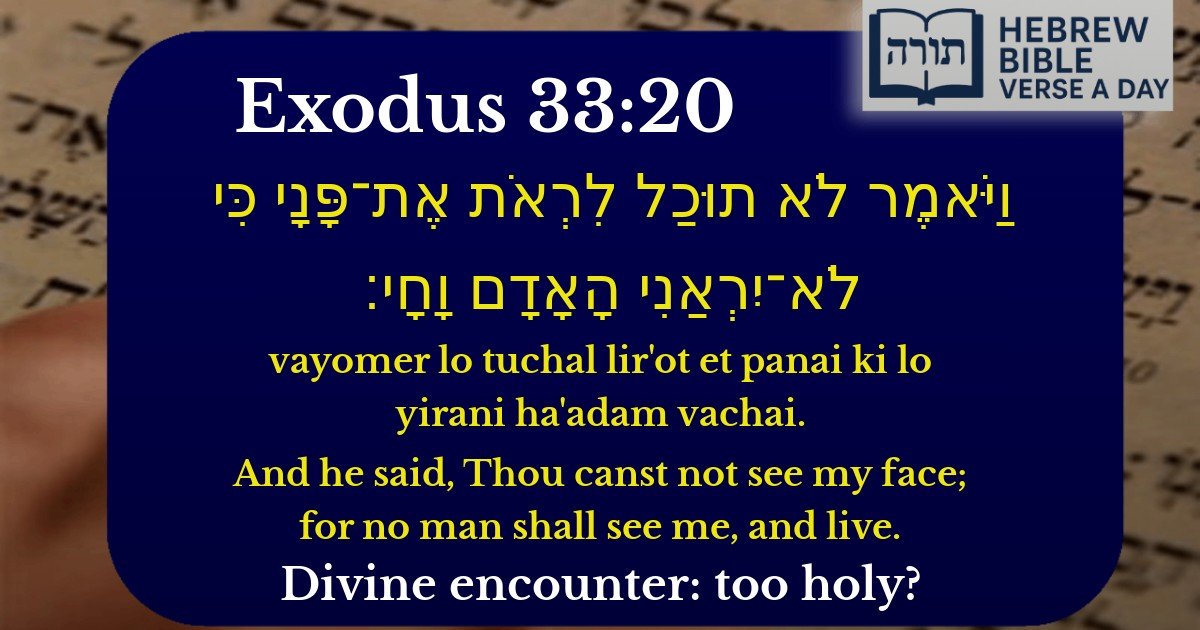

The Divine Revelation and Human Limitation
The verse (Shemot 33:20) states: "וַיֹּאמֶר לֹא תוּכַל לִרְאֹת אֶת־פָּנָי כִּי לֹא־יִרְאַנִי הָאָדָם וָחָי" ("And He said, 'You cannot see My face, for no man shall see Me and live'"). This profound statement reflects the fundamental difference between the infinite nature of the Divine and the finite capacity of human beings.
Rashi's Explanation
Rashi comments on this verse, explaining that Hashem was telling Moshe that no mortal can perceive the full essence of the Divine Presence (כבוד השם) while alive in this physical world. Rashi emphasizes that even Moshe Rabbeinu, the greatest of prophets, was limited in his ability to comprehend Hashem's true essence.
Rambam's Philosophical Perspective
The Rambam (Moreh Nevuchim 1:37) elaborates that human intellect is incapable of grasping the true nature of Hashem, as He transcends all physical and conceptual limitations. The phrase "לא יראני האדם וחי" teaches that complete comprehension of the Divine would overwhelm human existence, as our finite minds cannot contain the infinite.
Talmudic and Midrashic Insights
Kabbalistic Interpretation
The Zohar (2:99a) teaches that the inability to see Hashem's "face" refers to the inaccessibility of the ספירת חכמה (sefira of Chochmah/Wisdom) in its purest form. What humans can perceive are only the "traces" (רשמים) of Divine interaction with the world.
Practical Implication
This verse establishes a foundational principle in Jewish thought: while we strive for closeness to Hashem through Torah and mitzvot, we must recognize our inherent limitations in comprehending the Infinite. As the Rambam writes (Yesodei HaTorah 1:10), our highest perception of the Divine is through recognizing what we cannot know about Him.