Frequently Asked Questions
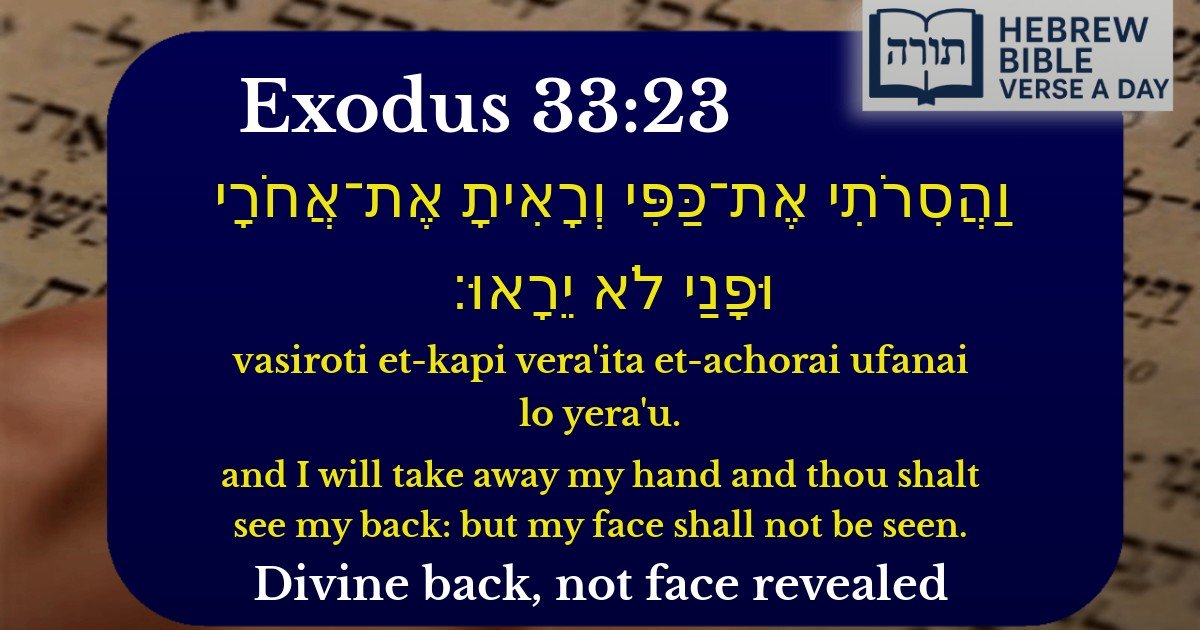
Q: What does it mean that Moshe saw Hashem's 'back' but not His 'face' in Exodus 33:23?
A: Rashi explains that 'seeing Hashem's back' refers to understanding Divine actions after they occur (like seeing someone's back as they walk away), while 'not seeing His face' means we cannot comprehend Hashem's full intentions beforehand. This teaches that humans can only perceive Hashem's ways in hindsight, not in advance.
Q: Why did Hashem show Moshe only a partial revelation in this verse?
A: The Rambam (Moreh Nevuchim 1:54) teaches that no human can fully comprehend Hashem's essence. This partial revelation was the maximum spiritual perception a human could handle, emphasizing that while we can recognize Hashem's influence in the world, His true nature remains beyond human understanding.
Q: What practical lesson can we learn from Exodus 33:23 about understanding Hashem?
A: The Talmud (Berachos 7a) derives from this verse that we can recognize Hashem's kindness and justice through historical events and personal experiences, but we must accept that some matters remain beyond our understanding. This teaches humility in our spiritual seeking.
Q: How does the concept of seeing 'Hashem's back' apply to our lives today?
A: The Midrash (Shemos Rabbah 45:6) explains this teaches us to have faith even when we don't understand events as they happen. Like Moshe, we may only recognize Hashem's hand in our lives when looking back at past events, strengthening our emunah during challenging times.
Q: Why is this revelation to Moshe important in Jewish thought?
A: This moment establishes a fundamental Jewish principle about prophecy. As Rambam explains (Yesodei HaTorah 7:2), even Moshe - the greatest prophet - couldn't perceive Hashem directly. This sets boundaries for authentic prophecy and prevents exaggerated claims of divine revelation.


Understanding the Verse in Context
The verse (Shemot 33:23) appears in the aftermath of the sin of the Golden Calf, where Moshe Rabbeinu requests to behold the Divine Presence. Hashem responds that Moshe cannot see His "face" (i.e., His full essence), but only His "back" (i.e., a limited revelation). This distinction is central to Jewish theology regarding the unknowable nature of Hashem's essence.
Rashi's Explanation
Rashi (ad loc.) explains that "אֲחֹרָי" ("My back") refers to seeing Hashem's actions after they occur—understanding Divine providence in hindsight. This aligns with the principle that humans cannot grasp Hashem's full intent in real-time but may perceive His justice and mercy retrospectively. "פָנַי" ("My face") symbolizes direct, unobscured Divine knowledge, which is beyond human comprehension.
Rambam's Philosophical Perspective
In Moreh Nevuchim (1:21, 1:38), the Rambam interprets this verse as a metaphor for the limits of human understanding. "Seeing Hashem's back" represents apprehending the effects of Divine wisdom in creation (e.g., natural order), while "His face" refers to the essence of the Divine, which remains eternally hidden. This reflects the principle of negative theology—defining Hashem by what He is not, as His true nature is ineffable.
Midrashic Insights
Kabbalistic Interpretation
The Zohar (2:99a) associates "אֲחֹרָי" with the sefirah of Malchut (Divine immanence), the lowest level of revelation accessible to humans. "פָנַי" corresponds to the higher, concealed sefirot, which are beyond mortal perception. This reinforces the idea that humans interact only with Hashem's "shadow," not His essence.
Halachic Implications
The Rambam (Hilchot Yesodei HaTorah 1:10) derives from this verse that it is forbidden to attempt to visualize Hashem's form, as His true "face" is unknowable. This underpins the prohibition against physical representations of the Divine and the emphasis on abstract, intellectual worship.