Frequently Asked Questions
Q: What does 'All that opens the womb is mine' mean in Exodus 34:19?
A: This verse teaches that the firstborn of both humans and animals belong to Hashem. For animals like oxen and sheep, the firstborn males must be given to the Kohen (priest) or, in the case of kosher animals, brought as a sacrifice in the Temple (Rambam, Hilchot Bikkurim 1:1-2). For human firstborns, there is a mitzvah of Pidyon HaBen (redemption of the firstborn son) as explained in Exodus 13:13.
Q: Why are firstborn animals special in Judaism?
A: Firstborn animals are considered holy (kodesh) because they represent the initial and choicest produce. The Torah emphasizes this sanctity to remind us that everything ultimately belongs to Hashem, and we must dedicate our 'first fruits'—whether animals, crops, or even our time—to divine service (Rashi on Exodus 13:2; Talmud, Bekhorot 4b).
Q: Does this law about firstborns still apply today?
A: While the Temple stands, firstborn kosher animals (like oxen and sheep) are brought as sacrifices. Today, without the Temple, these laws are suspended, but the sanctity remains. For firstborn donkeys (a non-kosher animal), the mitzvah of redeeming it with a lamb (or breaking its neck if unredeemed) still applies (Shulchan Aruch, Yoreh De'ah 321).
Q: What is the deeper lesson behind dedicating firstborns to Hashem?
A: This mitzvah teaches us the principle of 'hakarat hatov' (gratitude). Just as Hashem spared the Jewish firstborns during the Plague of the Firstborn in Egypt (Exodus 12:29-30), we acknowledge His kindness by sanctifying what is first and dear to us (Midrash Tanchuma, Bo 8). It also trains us to prioritize spirituality over materialism.


Source and Context
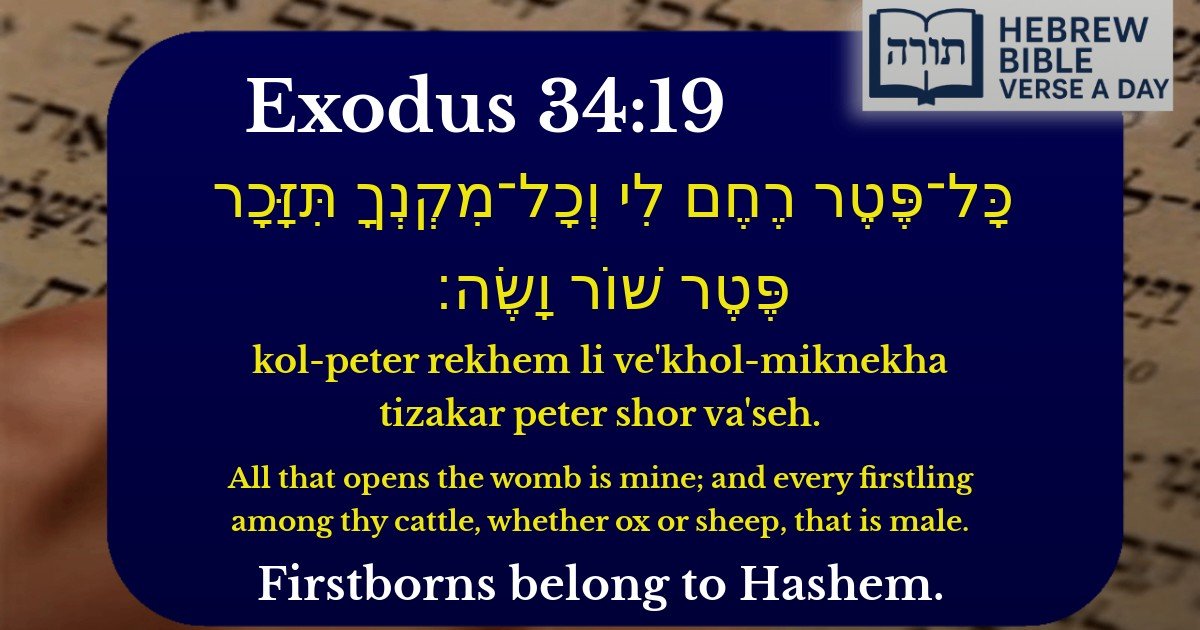
The verse "כָּל־פֶּטֶר רֶחֶם לִי וְכָל־מִקְנְךָ תִּזָּכָר פֶּטֶר שׁוֹר וָשֶׂה" (Shemot 34:19) appears in the context of the renewal of the covenant after the sin of the Golden Calf. It reiterates the mitzvah of consecrating firstborn animals to Hashem, originally commanded in Shemot 13:2. This mitzvah is part of a broader framework of kedushah (holiness) in Jewish life.
Explanation of the Verse
The verse establishes two key halachic principles:
Halachic Implications
According to Orthodox Jewish tradition, this mitzvah has practical ramifications:
Spiritual Significance
The Midrash (Shemot Rabbah 32:5) explains that this mitzvah commemorates the Exodus, when Hashem spared the Jewish firstborns during the Plague of the Firstborn. By dedicating firstborns to Hashem, we acknowledge His sovereignty and our gratitude for redemption.
Rashi’s Commentary
Rashi (on Shemot 13:2) clarifies that the mitzvah applies only to males, as the verse specifies "שׁוֹר וָשֶׂה" (ox and sheep), which are male terms. He also notes that the mitzvah applies only to kosher animals, excluding non-kosher species (except for the donkey, which has a separate halacha).