Frequently Asked Questions
Q: What does it mean to 'redeem a firstborn donkey with a lamb' in Exodus 34:20?
A: According to Jewish law (Halacha), a firstborn donkey (petter chamor) is considered sacred because it is the first offspring of its mother. Since donkeys are not kosher animals, they cannot be offered as sacrifices. Instead, the Torah commands us to redeem it by giving a lamb to a Kohen (priest). If not redeemed, the donkey's neck must be broken (Rambam, Hilchot Bikkurim 12:1).
Q: Why does the Torah mention redeeming firstborn sons in the same verse as firstborn donkeys?
A: The Torah connects these two mitzvot to teach that just as firstborn animals have sanctity, so too do firstborn sons (Bechorim). After the Exodus from Egypt, Hashem sanctified all firstborns. Later, the Levites replaced them for service in the Mishkan, but firstborn sons are still redeemed from a Kohen through the Pidyon HaBen ceremony (Rashi on Exodus 13:2, Talmud Bavli Bechorot 4b).
Q: What does 'do not appear before Me empty-handed' mean in this verse?
A: This teaches that when coming to the Beit HaMikdash (Temple) for the pilgrimage festivals (Pesach, Shavuot, Sukkot), one must bring an offering - either an animal sacrifice or at least a minimal offering if poor. Appearing empty-handed shows disrespect (Rashi on Exodus 23:15). Today, when we cannot bring sacrifices, some have the custom to give charity before festivals.
Q: Is the law about redeeming firstborn donkeys still applicable today?
A: Yes, according to Halacha, the mitzvah of redeeming a firstborn donkey (Petter Chamor) still applies today when certain conditions are met (Shulchan Aruch, Yoreh De'ah 321). However, since most people don't own donkeys nowadays, this mitzvah is rare. When it does occur, one must give a sheep or its monetary value to a Kohen.
Q: What is the deeper meaning behind redeeming firstborns in Judaism?
A: The redemption of firstborns reminds us that everything ultimately belongs to Hashem. By redeeming what is 'first' - whether children, animals, or crops (Bikkurim) - we acknowledge that our possessions are really His, and we merit to keep and use them (Sefer HaChinuch, Mitzvah 18). This cultivates gratitude and proper priorities in life.

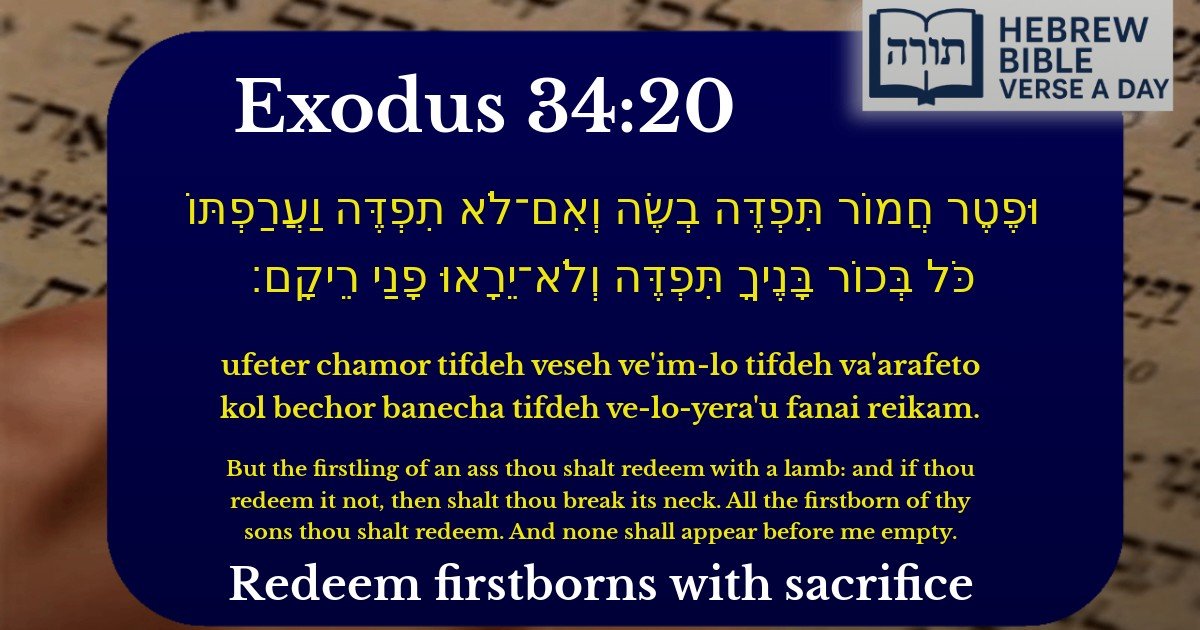

Redemption of the Firstborn Donkey
The verse commands the redemption of a firstborn donkey (peter chamor) with a lamb (seh), or if not redeemed, its neck must be broken (arifah). Rashi (Exodus 13:13) explains that this mitzvah is unique because the donkey is an impure animal, yet its firstborn requires redemption, unlike other impure animals. The lamb serves as a substitute, transferring its sanctity to the kohen. The Rambam (Hilchot Bikkurim 12:1) elaborates that this mitzvah applies only in Eretz Yisrael when the majority of Jews reside there.
Symbolism of the Donkey and Lamb
The Midrash (Shemot Rabbah 16:2) connects this mitzvah to the Exodus, noting that the donkeys carried the spoils of Egypt, and the lambs were used for the Korban Pesach. The juxtaposition of these animals highlights gratitude for Hashem's miracles. The donkey, a beast of burden, represents material wealth, while the lamb symbolizes spiritual sacrifice. Redeeming the donkey with a lamb teaches that material blessings must be sanctified for higher purposes.
Redemption of Human Firstborns
The verse also commands the redemption of firstborn sons (pidyon haben). The Talmud (Bechorot 47a) states this applies to a firstborn male from the mother’s side, provided the father is not a kohen or levi. The Rambam (Hilchot Bikkurim 11:1) specifies that five silver coins (equivalent to the biblical shekel) are given to a kohen. This mitzvah commemorates the sparing of Jewish firstborns during the Plague of the Firstborn in Egypt.
Prohibition of Appearing Empty-Handed
The phrase "lo yera'u panai reikam" (none shall appear before Me empty) is interpreted by Rashi (Exodus 23:15) as a requirement to bring offerings during the Three Pilgrimage Festivals. The Mechilta adds that this teaches the importance of expressing gratitude when standing before Hashem, whether through korbanot, tefillah, or acts of kindness. The Rambam (Hilchot Chagigah 1:1) rules that this obligation applies even if one cannot afford an elaborate offering.