Frequently Asked Questions
Q: What is the 'feast of weeks' mentioned in Exodus 34:22?
A: The 'feast of weeks' (Chag Shavuot in Hebrew) is one of the three pilgrimage festivals (Shalosh Regalim) when Jews would travel to the Temple in Jerusalem. It occurs seven weeks after Passover (hence the name 'Shavuot,' meaning 'weeks') and celebrates the wheat harvest and the giving of the Torah at Mount Sinai. The Talmud (Pesachim 68b) discusses its significance as both an agricultural and spiritual holiday.
Q: Why does the verse mention 'firstfruits of wheat harvest' for Shavuot?
A: The 'firstfruits of wheat harvest' (bikkurei ketzir chitim) refer to the special offering brought in the Temple from the new wheat crop. This reflects the agricultural aspect of Shavuot, as the Torah connects it to the harvest season in Israel. Rashi (on Exodus 34:22) explains that this offering was a way to express gratitude to Hashem for the bounty of the land.
Q: What is the 'feast of ingathering' in Exodus 34:22?
A: The 'feast of ingathering' (Chag Ha'asif) refers to Sukkot, which takes place in the autumn after the harvest season. It is called 'ingathering' because it marks the time when farmers gathered their crops (fruits, grains, etc.) before winter. The Talmud (Sukkah 11b) discusses how Sukkot also commemorates the protection Hashem provided for the Israelites in the wilderness with the Clouds of Glory.
Q: Why does the Torah connect Shavuot and Sukkot to agricultural cycles?
A: The Torah emphasizes the connection between the festivals and agriculture to teach that our spiritual lives are intertwined with the physical world. By celebrating the harvests, we acknowledge Hashem as the source of all sustenance. Rambam (Hilchot Temidin u'Musafin 7:1) explains that these holidays remind us to be grateful for both material blessings and divine revelation.
Q: How do we observe Shavuot today without the Temple offerings?
A: Today, without the Temple, we observe Shavuot by studying Torah all night (Tikkun Leil Shavuot), reading the Book of Ruth, and eating dairy foods (a custom with various explanations in Midrash and later authorities). The Shulchan Aruch (Orach Chaim 494) outlines the holiday prayers and customs, maintaining its spiritual focus on receiving the Torah.

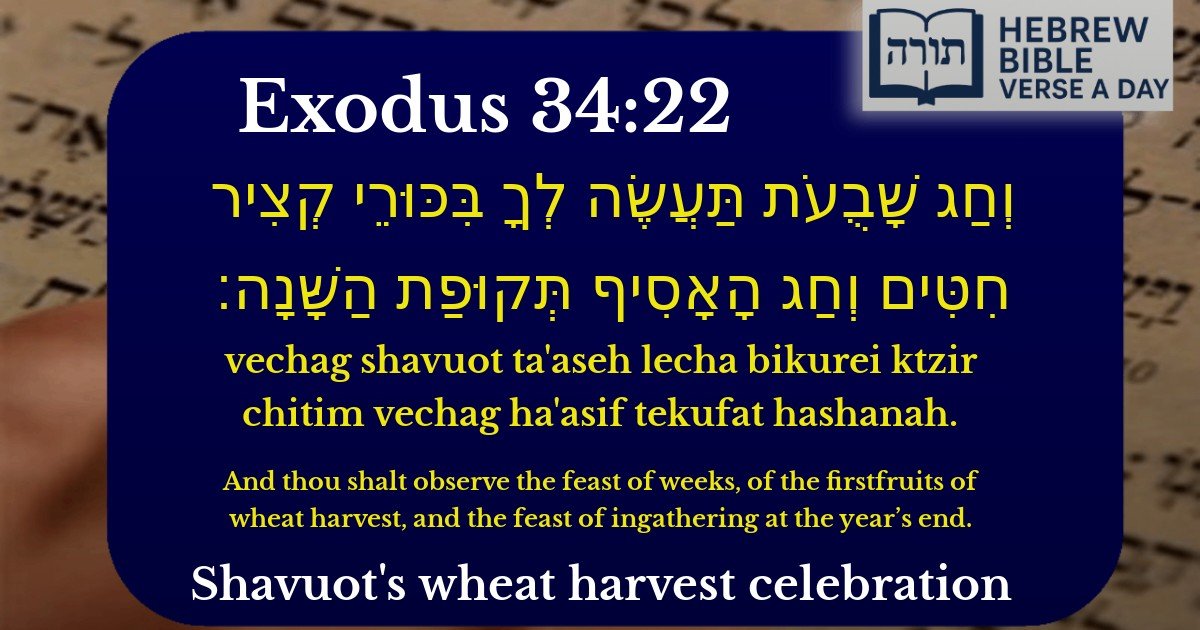

The Festival of Shavuot
The verse commands the observance of Chag Shavuot (the Festival of Weeks), which is tied to the offering of the bikkurim (firstfruits) of the wheat harvest. According to Rashi (Shemot 34:22), this festival is called Shavuot because it follows the counting of seven weeks from Pesach (as commanded in Vayikra 23:15-16). The Talmud (Menachot 65a) explains that the wheat harvest mentioned here refers to the minchat ha'omer (the Omer offering) brought on the second day of Pesach, which initiates the count toward Shavuot.
The Significance of Bikkurim
The bikkurim (firstfruits) of wheat highlight the agricultural aspect of Shavuot, but the Rambam (Hilchot Temidin u'Musafin 8:1) emphasizes that the festival also commemorates Matan Torah (the Giving of the Torah) at Har Sinai. The Midrash (Shemot Rabbah 31:3) connects the wheat offering to the Torah, as bread (made from wheat) sustains the body, while Torah sustains the soul.
Chag Ha'Asif (Sukkot)
The verse also mentions Chag Ha'Asif (the Festival of Ingathering), which our tradition identifies as Sukkot (see Rashi on Shemot 23:16). The Rambam (Moreh Nevuchim 3:43) explains that this festival marks the end of the agricultural cycle, when all produce is gathered before winter. The Talmud (Sukkah 11b) teaches that the sukkah symbolizes the Ananei HaKavod (Clouds of Glory) that protected Bnei Yisrael in the wilderness.
Tekufat HaShanah (The Cycle of the Year)
The phrase "tekufat hashanah" (the year’s end) is interpreted by Rashi as referring to the change of seasons, specifically the transition from summer to autumn. The Ibn Ezra (Shemot 34:22) notes that this term emphasizes the cyclical nature of time, reinforcing the idea that the festivals are not only historical commemorations but also recurring opportunities for spiritual renewal.