
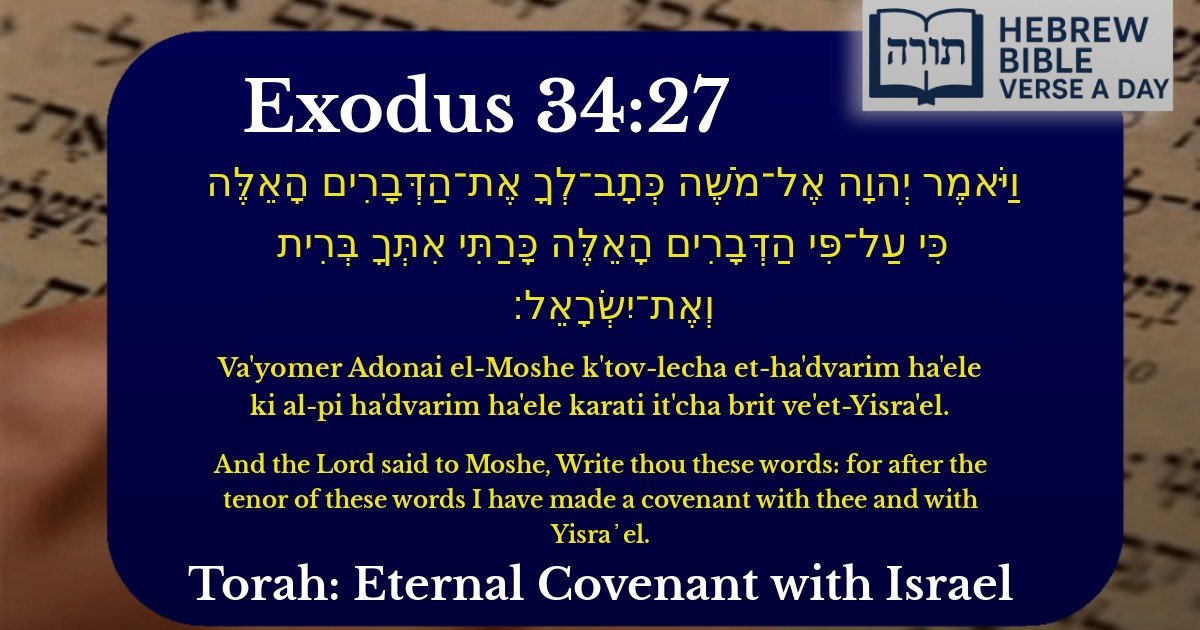

Exodus 34:27 - Torah: Eternal Covenant with Israel

Exodus 34:27 - שמות 34:27

Hebrew Text

וַיֹּאמֶר יְהוָה אֶל־מֹשֶׁה כְּתָב־לְךָ אֶת־הַדְּבָרִים הָאֵלֶּה כִּי עַל־פִּי הַדְּבָרִים הָאֵלֶּה כָּרַתִּי אִתְּךָ בְּרִית וְאֶת־יִשְׂרָאֵל׃

English Translation

And the Lord said to Moshe, Write thou these words: for after the tenor of these words I have made a covenant with thee and with Yisra᾽el.

Transliteration

Va'yomer Adonai el-Moshe k'tov-lecha et-ha'dvarim ha'ele ki al-pi ha'dvarim ha'ele karati it'cha brit ve'et-Yisra'el.

Hebrew Leining Text

וַיֹּ֤אמֶר יְהֹוָה֙ אֶל־מֹשֶׁ֔ה כְּתׇב־לְךָ֖ אֶת־הַדְּבָרִ֣ים הָאֵ֑לֶּה כִּ֞י עַל־פִּ֣י&thinsp

🎵 Listen to leining

Parasha Commentary

The Command to Write the Torah

The verse (Shemot 34:27) states: "וַיֹּאמֶר יְהוָה אֶל־מֹשֶׁה כְּתָב־לְךָ אֶת־הַדְּבָרִים הָאֵלֶּה" ("And the Lord said to Moshe, Write thou these words"). Rashi explains that this refers to the entire Torah, not just the immediate context. The commandment to write the Torah is foundational, as it ensures the preservation and transmission of Hashem's covenant with Israel for all generations.

The Covenant Based on the Written and Oral Torah

The verse continues: "כִּי עַל־פִּי הַדְּבָרִים הָאֵלֶּה כָּרַתִּי אִתְּךָ בְּרִית וְאֶת־יִשְׂרָאֵל" ("for after the tenor of these words I have made a covenant with thee and with Yisra᾽el"). The Ramban (Nachmanides) emphasizes that the covenant is established not only through the written text but also through the Oral Torah (Torah she'ba'al peh), as the phrase "עַל־פִּי" ("after the tenor of," literally "by the mouth of") alludes to the oral tradition.

Key Teachings from the Talmud and Midrash

  • Gittin 60b: The Talmud derives from this verse that the Torah must be written down, as oral transmission alone is insufficient to preserve its integrity.
  • Midrash Tanchuma (Ki Tisa 34): Explains that the covenant is eternal and binding because it is rooted in both the written and oral dimensions of Torah.
  • Rambam (Hilchot Yesodei HaTorah 9:1): States that the mitzvah to write a Sefer Torah applies to every Jew, reinforcing the personal connection to the covenant.

The Dual Nature of the Covenant

The Sforno teaches that the covenant is twofold: it binds the Jewish people collectively ("אֶת־יִשְׂרָאֵל") and Moshe individually ("אִתְּךָ"), symbolizing that leadership and nationhood are intertwined in upholding the Torah. The Kli Yakar adds that writing the Torah ensures that its teachings remain accessible and unchanging, unlike oral traditions that may be forgotten or altered.

📚 Talmud Citations

This verse is quoted in the Talmud.

📖 Gittin 60b
The verse is cited in the context of discussing the importance of writing down the Torah and the oral traditions, emphasizing the divine commandment to Moses to record the words of the covenant.
📖 Sanhedrin 21b
The verse is referenced in a discussion about the written Torah and its transmission, highlighting the commandment to Moses as foundational for the written law.

Frequently Asked Questions

Q: What does Exodus 34:27 mean when it says 'Write thou these words'?
A: This verse commands Moshe (Moses) to write down the words of the Torah, specifically the laws given at Sinai. Rashi explains that this refers to writing the entire Torah from Bereishit (Genesis) until this point, ensuring the covenant is preserved for future generations. The written Torah becomes the foundation of our relationship with Hashem.
Q: Why is the covenant mentioned in Exodus 34:27 important?
A: The covenant is central to Judaism because it establishes the eternal bond between Hashem and the Jewish people. The Rambam (Maimonides) teaches that this covenant includes all mitzvot (commandments) given at Sinai. It obligates us to follow Torah law and affirms our unique role as Hashem's chosen nation.
Q: What can we learn from Hashem telling Moshe to write these words?
A: We learn the importance of preserving Torah exactly as given. The Talmud (Gittin 60b) derives from this verse that Torah must be written with a scribe's precision. It also teaches that Torah study should be both oral (explained by teachers) and written (learned from texts), as the verse says 'after the tenor of these words' - implying both written and spoken aspects.
Q: How does Exodus 34:27 apply to Jews today?
A: This verse establishes our daily obligation to study and uphold the Torah. Just as Moshe was commanded to write it for all generations, today every Jew participates in this covenant through Torah learning and mitzvah observance. The Midrash (Shemot Rabbah 47:9) explains that each Jew should view the Torah as if it was given personally to them at Sinai.
Q: What 'words' is Exodus 34:27 referring to?
A: According to traditional commentators, this primarily refers to the laws just given in the preceding verses (including the second set of tablets), but also encompasses the entire Torah. Ibn Ezra explains that 'these words' include both the specific commandments and the general principles of our covenant with Hashem - the entire Torah system given at Sinai.