Frequently Asked Questions
Q: What materials were donated for the Mishkan (Tabernacle) in Exodus 35:23?
A: The verse lists several materials donated for building the Mishkan: blue wool (techelet), purple wool (argaman), scarlet wool (tola'at shani), fine linen (shesh), goats' hair, red-dyed ram skins, and tachash skins (a special type of animal hide). These were used for the Mishkan's curtains, coverings, and holy garments.
Q: Why were these specific materials used for the Mishkan?
A: Each material had symbolic and practical significance. The colorful wools (blue, purple, scarlet) represented royalty and holiness (Rashi on Exodus 25:3). Fine linen signified purity, while the durable skins provided protection. The Midrash (Shemot Rabbah 35:1) teaches that these materials paralleled the heavens and elements of creation, making the Mishkan a microcosm of the universe.
Q: What is the 'tachash' skin mentioned in Exodus 35:23?
A: The tachash was a rare, colorful animal (possibly a type of desert mammal or sea creature) that appeared temporarily for the Mishkan's construction (Talmud, Shabbat 28b). Its skin was used as the Mishkan's outermost covering (Rashi on Exodus 26:14). The Talmud explains it was a miraculous provision from Hashem specifically for this purpose.
Q: How does this verse teach about giving to holy causes?
A: The verse emphasizes voluntary giving ('every man... brought them'). The Rambam (Hilchot Matnot Aniyim 8:10) learns from this that donations to holy causes should be given willingly and joyfully. The materials were also of personal value—people gave what they cherished, not just leftovers (Midrash Tanchuma, Terumah 5).
Q: Why is the color blue (techelet) significant in this verse?
A: Techelet (blue dye) represents the sea and sky, reminding us of Hashem's presence (Talmud, Menachot 43b). It was used in the Mishkan's curtains and later in tzitzit (fringes). The Sages teach (Chullin 89a) that techelet humbles us, as its color resembles the heavenly throne, putting earthly life in perspective.

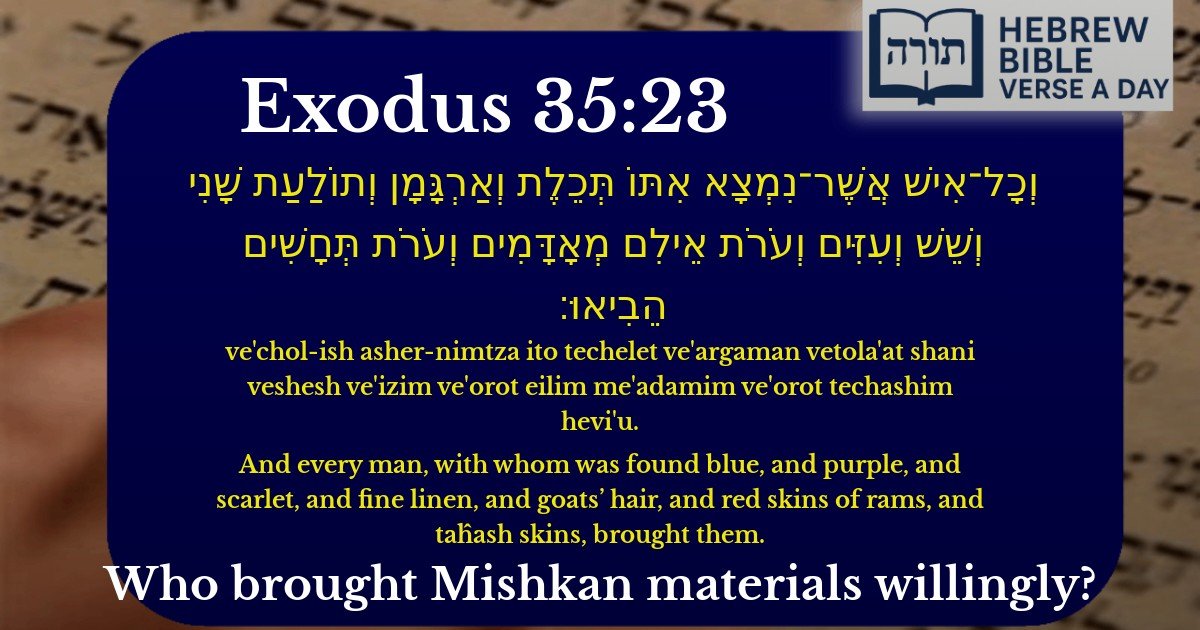

Materials for the Mishkan
The verse (Shemot 35:23) describes the voluntary contributions brought by the Israelites for the construction of the Mishkan (Tabernacle). Each material listed held symbolic significance in the service of Hashem, as explained by our Sages.
Significance of the Materials
The Animal Materials
Collective Contribution
The Sforno emphasizes that the phrase "every man... brought them" shows how all Israelites participated according to their means. The Midrash Tanchuma (Pekudei 3) teaches that this collective effort created unity among the people in serving Hashem, with each material contributing to the sanctity of the Mishkan.