Frequently Asked Questions
Q: What does the verse 'You shall kindle no fire throughout your habitations on the sabbath day' mean?
A: This verse (Exodus 35:3) is one of the 39 categories of prohibited work (melachot) on Shabbat. It teaches that lighting or extinguishing a fire is forbidden on Shabbat. Rashi explains that this prohibition includes not only creating a fire but also causing a fire to burn (such as stoking it). The Torah emphasizes this separately to highlight its importance.
Q: Why is the prohibition of fire on Shabbat important?
A: Fire represents human creativity and control over nature. By refraining from kindling fire on Shabbat, we acknowledge that Hashem is the ultimate Creator and sustainer of the world. The Talmud (Shabbat 70a) lists this as one of the 39 primary categories of forbidden labor, showing its significance in observing Shabbat properly.
Q: Does this verse mean we cannot use electricity on Shabbat?
A: According to Orthodox Jewish halacha (law), most authorities consider using electricity to be included in this prohibition because it involves completing an electrical circuit, which is similar to creating a fire (both involve generating energy). The Mishna Berura and contemporary poskim (halachic decisors) rule that turning lights or appliances on or off violates this biblical prohibition.
Q: How do we keep warm or have light on Shabbat if we can't light a fire?
A: The Torah permits benefiting from a fire lit before Shabbat. Thus, we leave lights on before Shabbat (or use timers) and may keep food warm on a pre-lit flame (like a blech). The Shulchan Aruch (Orach Chaim 257) discusses these practical applications, showing how we can observe the prohibition while still having light and warmth.
Q: What is the spiritual lesson behind not kindling fire on Shabbat?
A: The Midrash teaches that refraining from creative acts like lighting fires on Shabbat helps us focus on spiritual 'light'—Torah study, prayer, and family connection. Rambam (Hilchot Shabbat 21:1) explains that Shabbat is a day of menuchah (rest), reminding us that our achievements come from Hashem, not just our own efforts.

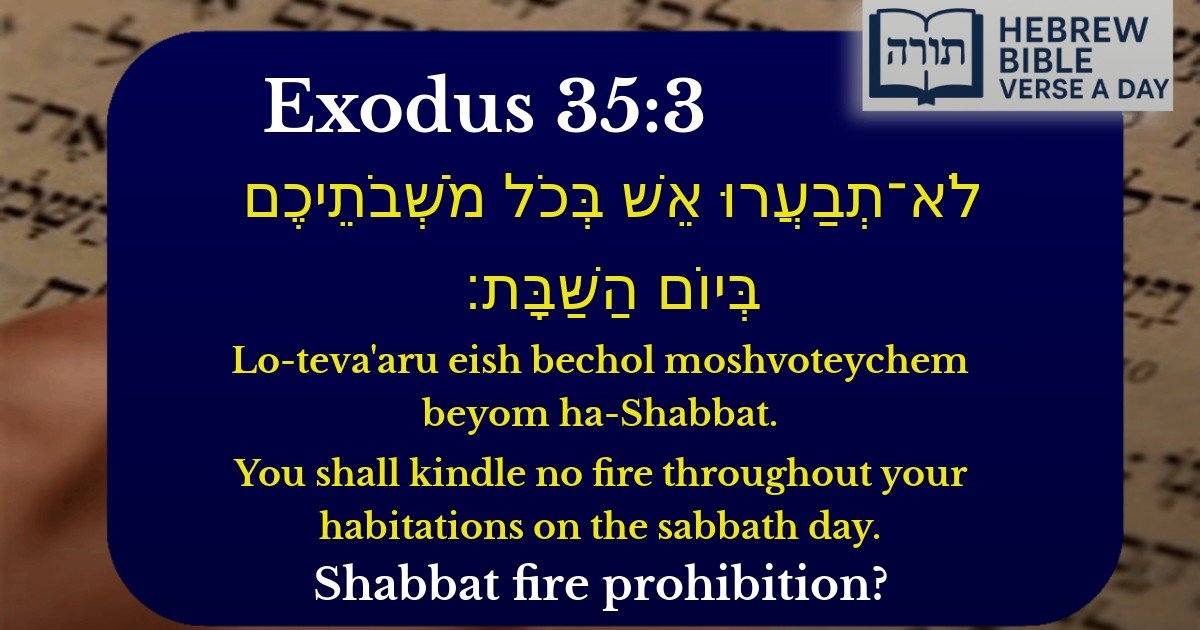

Prohibition of Fire on Shabbat
The verse (Shemot 35:3) states: "לֹא־תְבַעֲרוּ אֵשׁ בְּכֹל מֹשְׁבֹתֵיכֶם בְּיוֹם הַשַּׁבָּת" ("You shall kindle no fire throughout your habitations on the sabbath day"). This prohibition is one of the 39 melachot (forbidden labors) on Shabbat, specifically the act of mav'ir (kindling).
Rashi's Explanation
Rashi (on Shemot 35:3) explains that this prohibition is stated separately from the general prohibition of work on Shabbat to emphasize that even though lighting a fire may seem like a minor labor compared to other melachot, it is nevertheless forbidden. This teaches that all melachot are equally significant in their prohibition.
Rambam's Classification
Rambam (Hilchot Shabbat 12:1) categorizes kindling a fire under the melacha of mav'ir, which is derived from the kindling of the Menorah in the Mishkan. He further clarifies that extinguishing a fire is also prohibited as the inverse of this melacha.
Talmudic Discussion
The Gemara (Shabbat 70a) discusses whether kindling is a primary melacha or a derivative (toladah). The conclusion is that it is a primary melacha, as it was necessary for the construction of the Mishkan (e.g., for smelting metals).
Practical Halachic Implications
Midrashic Insight
The Midrash (Shemot Rabbah 35:3) connects this verse to the idea that Shabbat is a day of spiritual rest. Just as we refrain from physical acts of creation, we also distance ourselves from actions that symbolize destruction (like fire, which can consume). This reinforces Shabbat as a day of peace and tranquility.