Frequently Asked Questions
Q: What does it mean to be 'filled with the spirit of God' in Exodus 35:31?
A: In Exodus 35:31, being 'filled with the spirit of God' refers to Betzalel, the artisan chosen to build the Mishkan (Tabernacle). According to Rashi, this means he was granted divine inspiration and exceptional skill in craftsmanship, wisdom (chochmah), understanding (tevunah), and knowledge (da'at) to carry out this holy work.
Q: Why is wisdom, understanding, and knowledge mentioned in Exodus 35:31?
A: The verse highlights three key qualities—wisdom (chochmah), understanding (tevunah), and knowledge (da'at)—because they were essential for Betzalel to construct the Mishkan properly. The Talmud (Berachot 55a) explains that chochmah is theoretical knowledge, tevunah is the ability to derive insights, and da'at is practical application—all necessary for sacred craftsmanship.
Q: How does Exodus 35:31 apply to us today?
A: This verse teaches that when we dedicate our skills to holy purposes, Hashem grants us the wisdom and ability to succeed. The Rambam (Hilchot Klei HaMikdash 1:8) emphasizes that Betzalel's divinely inspired talents set an example for using our own gifts in service of mitzvot and communal good.
Q: What is the significance of Betzalel being filled with 'all manner of workmanship'?
A: The phrase 'all manner of workmanship' (b'chol melacha) shows that Betzalel was gifted in every craft needed for the Mishkan—metalwork, weaving, woodcarving, etc. The Midrash (Shemot Rabbah 48:4) explains that this comprehensive skill set was a miracle, enabling him to execute Hashem's precise instructions flawlessly.
Q: Why was Betzalel specifically chosen for this task in Exodus 35:31?
A: Betzalel was chosen because of his lineage (he was from the tribe of Yehudah) and his personal righteousness. Rashi notes that his name even means 'in the shadow of God,' symbolizing his closeness to divine wisdom. The Talmud (Berachot 55a) adds that he understood how to combine the letters with which heaven and earth were created, showing his deep spiritual insight.

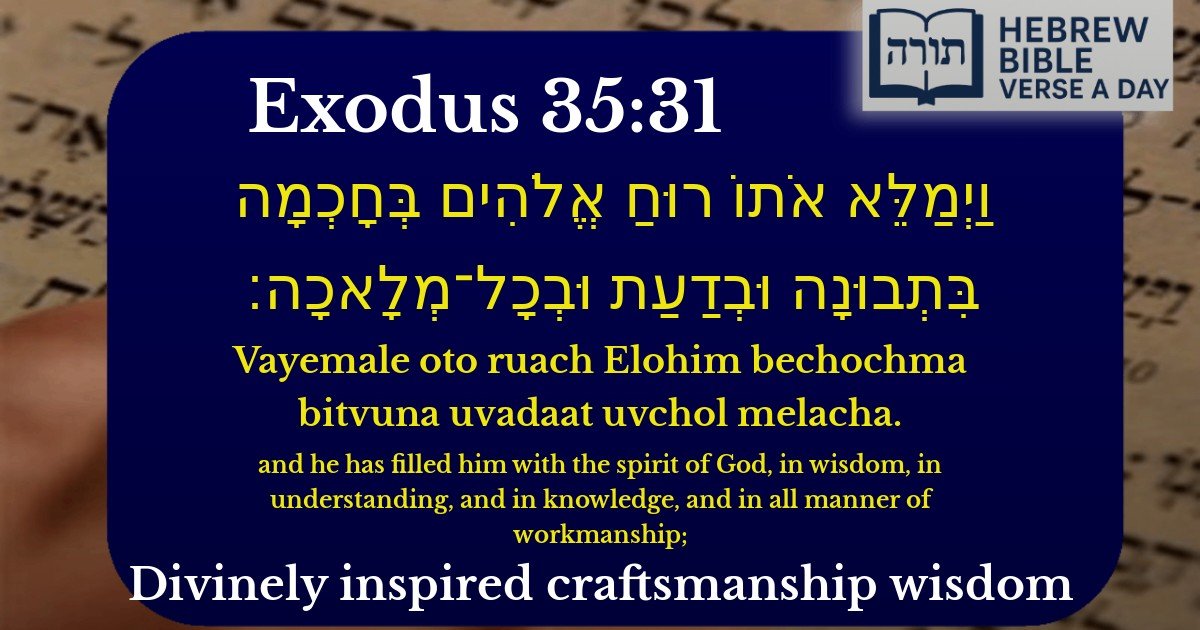

The Divine Inspiration of Betzalel
The verse describes how Betzalel, the chief artisan of the Mishkan (Tabernacle), was endowed with divine wisdom. The phrase "רוּחַ אֱלֹהִים" (spirit of God) indicates that his skills were not merely natural talents but were granted through divine inspiration. Rashi (Exodus 31:3) explains that this refers to prophecy—Betzalel was given divine insight to understand how to construct the Mishkan according to the heavenly blueprint.
The Three Levels of Wisdom
The verse enumerates three distinct intellectual gifts:
Practical Application in Craftsmanship
The phrase "וּבְכָל־מְלָאכָה" (and in all manner of workmanship) emphasizes that his divine wisdom extended to every detail of construction. The Talmud (Berachot 55a) teaches that Betzalel knew how to combine the letters with which heaven and earth were created, implying his work mirrored the divine act of creation itself.
Spiritual Significance
The Malbim (Exodus 31:3) highlights that Betzalel's abilities were not for personal glory but solely for the sanctity of the Mishkan. This teaches that true wisdom from God must be directed toward holy purposes, aligning with the Mishnah's teaching (Avot 4:1) that wisdom is sustained only through righteous deeds.