Frequently Asked Questions
Q: What does 'filled with wisdom of heart' mean in Exodus 35:35?
A: The phrase 'filled with wisdom of heart' refers to the special divine inspiration and skill that Hashem granted to the artisans who worked on the Mishkan (Tabernacle). According to Rashi, this wisdom was not just intellectual but a practical, God-given talent to create intricate craftsmanship for holy purposes.
Q: Why were specific colors like blue, purple, and scarlet mentioned in Exodus 35:35?
A: The colors blue (תְּכֵלֶת), purple (אַרְגָּמָן), and scarlet (תּוֹלַעַת הַשָּׁנִי) were used in the Mishkan's fabrics because they held symbolic significance in Jewish tradition. The Midrash teaches that these colors represent different spiritual concepts—blue resembles the sea and heaven (reminding us of divine revelation), while purple and scarlet signify royalty and sacrifice.
Q: What can we learn from the artisans' skills in Exodus 35:35?
A: This verse teaches that every talent, including artistic craftsmanship, is a gift from Hashem and can be used for holy purposes. The Rambam explains that just as the Mishkan's builders used their skills for sanctity, we too should dedicate our abilities to serving G-d and uplifting the world.
Q: How does Exodus 35:35 apply to us today?
A: Just as the artisans used their divinely inspired skills for the Mishkan, we are encouraged to use our own talents to contribute to holiness—whether through supporting Torah study, beautifying mitzvot (like crafting beautiful challah covers or menorahs), or helping build Jewish institutions. The Talmud (Berachot 10a) emphasizes that all work done for Heaven’s sake is sacred.
Q: Who were the 'weavers' and 'craftsmen' mentioned in this verse?
A: These were the skilled workers, including Betzalel and Oholiav (Exodus 35:30-34), whom Hashem chose to create the Mishkan’s textiles, metals, and woodwork. The Talmud (Berachot 55a) states that Betzalel possessed divinely granted knowledge to combine the letters with which Heaven and Earth were created, showing that craftsmanship for holiness connects to deeper spiritual wisdom.

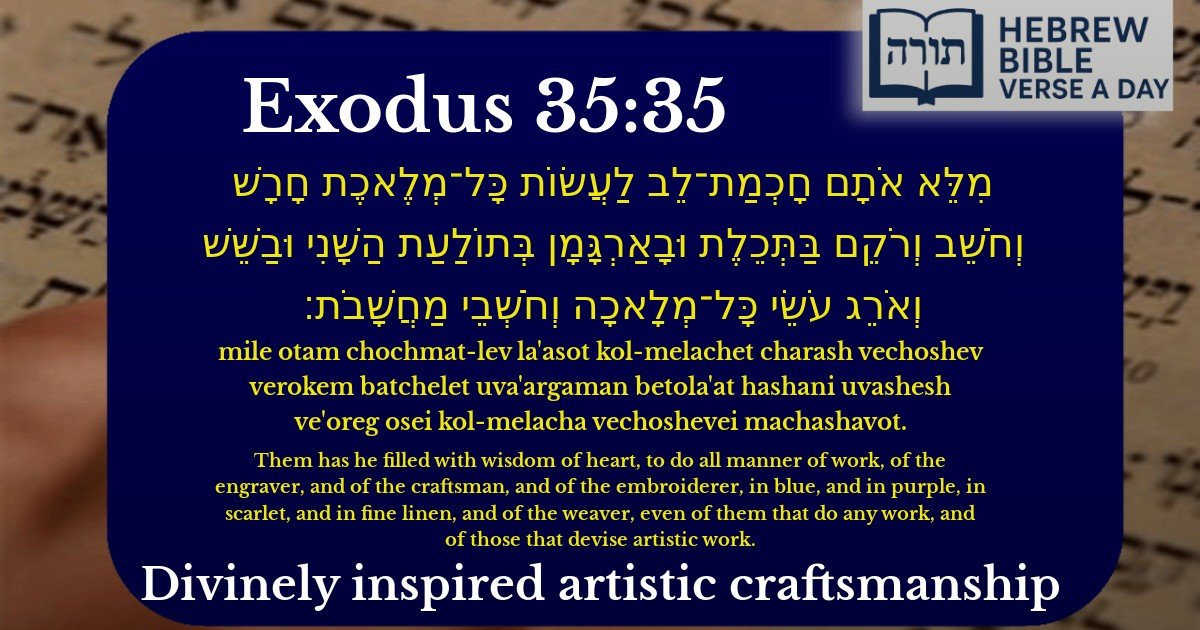

Divine Wisdom in Craftsmanship
The verse describes how certain individuals were endowed with חָכְמַת־לֵב ("wisdom of heart") to perform skilled labor for the Mishkan (Tabernacle). Rashi (Exodus 35:35) explains that this wisdom was not merely technical expertise but a ruach hakodesh (divine inspiration) granted by Hashem to enable them to execute intricate artistic work. The Ramban (Nachmanides) adds that this wisdom was a unique spiritual gift, elevating their craftsmanship to a sacred level.
The Scope of Their Skills
The verse enumerates various crafts, including:
The Midrash Tanchuma (Pekudei 11) emphasizes that these artisans did not learn their skills through apprenticeship but received them directly from Hashem, underscoring the divine origin of their abilities.
Sacred Materials and Symbolism
The materials mentioned—תְּכֵלֶת (blue), אַרְגָּמָן (purple), תוֹלַעַת הַשָּׁנִי (scarlet), and שֵׁשׁ (fine linen)—were used in the Mishkan’s construction. The Kli Yakar (Exodus 35:35) notes that these colors symbolize different spiritual concepts:
Weaving and Artistic Devising
The phrase וְחֹשְׁבֵי מַחֲשָׁבֹת ("those that devise artistic work") highlights the creative aspect of their labor. The Malbim explains that their work required not only manual skill but also intellectual and imaginative prowess, demonstrating that true artistry in divine service involves both thought and action.