

Join Our Newsletter To Be Informed When New Videos Are Posted
Hebrew Text
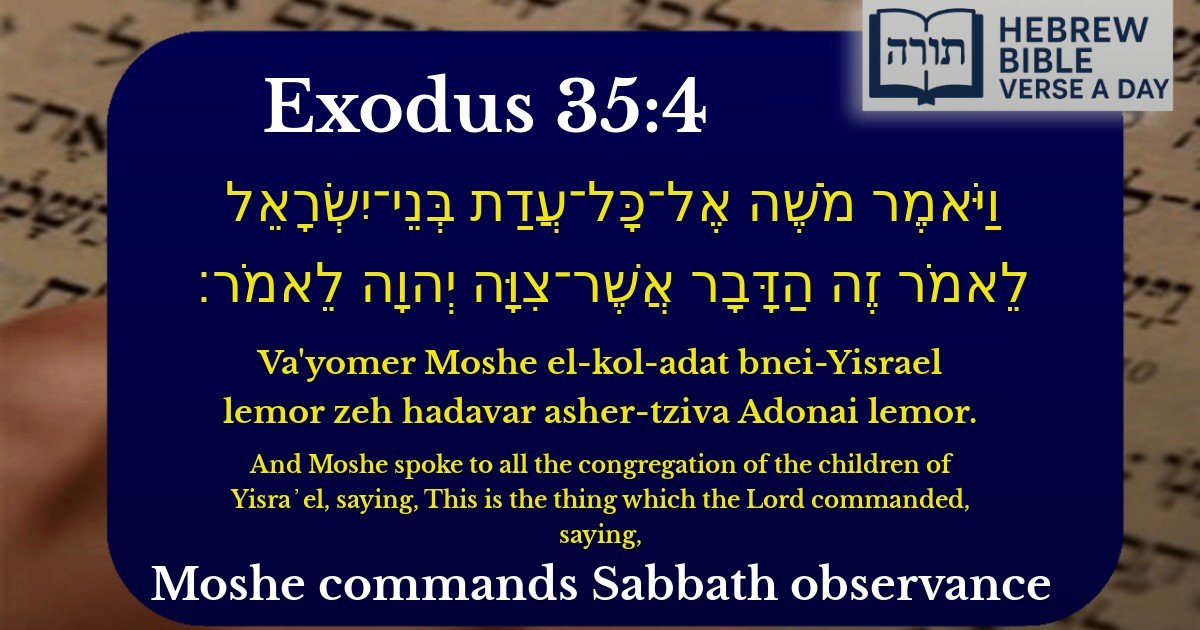
וַיֹּאמֶר מֹשֶׁה אֶל־כָּל־עֲדַת בְּנֵי־יִשְׂרָאֵל לֵאמֹר זֶה הַדָּבָר אֲשֶׁר־צִוָּה יְהוָה לֵאמֹר׃
English Translation
And Moshe spoke to all the congregation of the children of Yisra᾽el, saying, This is the thing which the Lord commanded, saying,
Transliteration
Va'yomer Moshe el-kol-adat bnei-Yisrael lemor zeh hadavar asher-tziva Adonai lemor.
Hebrew Leining Text
וַיֹּ֣אמֶר מֹשֶׁ֔ה אֶל־כׇּל־עֲדַ֥ת בְּנֵֽי־יִשְׂרָאֵ֖ל לֵאמֹ֑ר זֶ֣ה הַדָּבָ֔ר אֲשֶׁר־צִוָּ֥ה יְהֹוָ֖ה לֵאמֹֽר׃
🎵 Listen to leining
Parasha Commentary
📚 Talmud Citations
This verse is not quoted in the Talmud.
Context in the Torah
The verse appears in Shemot (Exodus) 35:4, introducing Moshe's transmission of Hashem's commandments regarding the construction of the Mishkan (Tabernacle). Rashi notes that this gathering took place on the day after Yom Kippur, following the atonement for the sin of the Golden Calf, emphasizing the renewed covenant between Hashem and Bnei Yisrael.
Phrasing: "Zeh HaDavar" (This is the thing)
The term "Zeh HaDavar" is interpreted by the Midrash Tanchuma (Vayakhel 1) as indicating precision in fulfilling mitzvot—Moshe conveyed the exact details of Hashem's command without adding or omitting anything. Rambam (Hilchot Yesodei HaTorah 9:1) derives from this phrase the principle that a prophet must relay divine commandments verbatim.
Addressing "Kol Adat Bnei Yisrael"
The inclusion of the entire congregation ("Kol Adat Bnei Yisrael") teaches, as the Or HaChayim explains, that Moshe ensured every individual—men, women, and leaders—understood their role in the Mishkan's construction. The Sforno adds that this collective address reinforced unity, rectifying the discord caused by the Golden Calf.
Connection to Shabbat
This verse precedes the mitzvah of Shabbat (Exodus 35:2), which the Mechilta links to the Mishkan to teach that even sacred work must cease for Shabbat. The Kli Yakar highlights that Shabbat's mention first underscores its supremacy over the Mishkan, as divine service does not override Shabbat.