Frequently Asked Questions
Q: What does Exodus 35:5 mean?
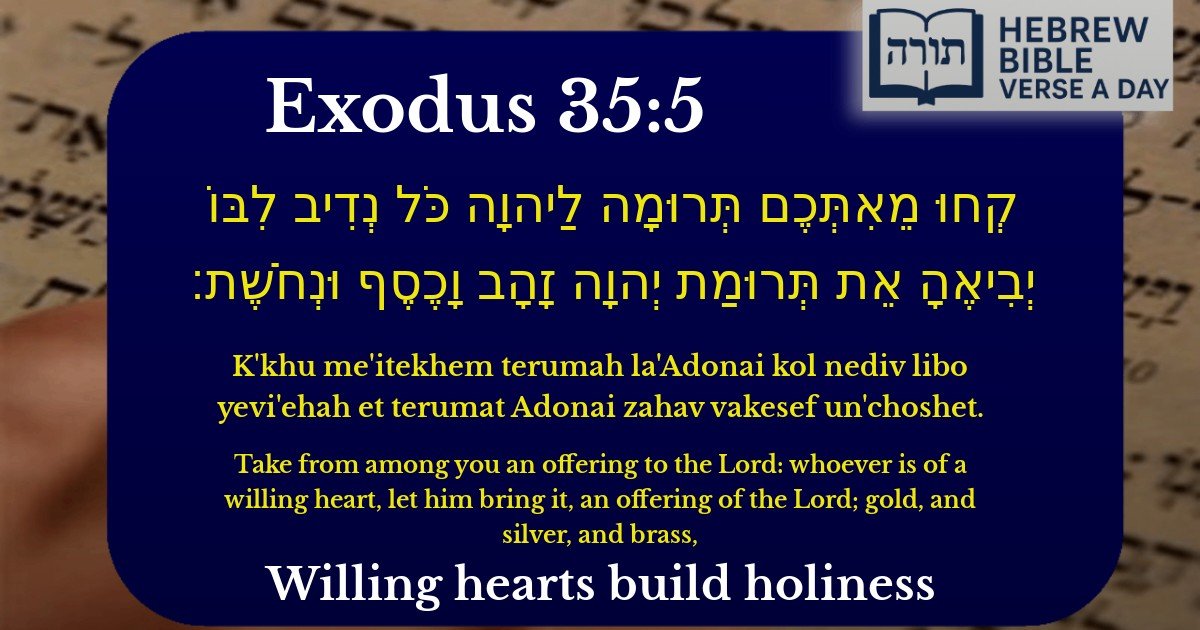
A: Exodus 35:5 instructs the Israelites to bring voluntary offerings (תְּרוּמָה, 'terumah') to Hashem for the construction of the Mishkan (Tabernacle). The verse emphasizes that only those with a willing heart (נְדִיב לִבּוֹ) should contribute, and it lists specific materials like gold, silver, and brass. Rashi explains that this was a call for generosity, not coercion, showing that divine service must come from sincere desire.
Q: Why is a 'willing heart' important in bringing offerings?
A: The Torah stresses a 'willing heart' (נְדִיב לִבּוֹ) because true service to Hashem must come from genuine devotion, not obligation. The Midrash (Shemot Rabbah 33:6) teaches that offerings given joyfully are more precious than those given reluctantly. Rambam (Hilchot Matnot Aniyim 10:4) extends this principle to all charity, emphasizing that the attitude behind the gift matters as much as the gift itself.
Q: What materials were requested for the Mishkan, and why?
A: The verse lists gold (זָהָב), silver (כֶּסֶף), and brass (נְחֹשֶׁת). These materials were used for different parts of the Mishkan: gold for the holiest items (like the Ark), silver for foundational sockets, and brass for the altar (Rashi on Exodus 38:2). The Talmud (Yoma 44b) notes that each metal symbolized varying levels of sanctity, reflecting the Mishkan's structure as a microcosm of divine order.
Q: How does this verse apply to giving charity today?
A: Just as Exodus 35:5 teaches about voluntary offerings for the Mishkan, Halacha (Jewish law) encourages giving charity (צְדָקָה) with a willing heart. The Shulchan Aruch (Yoreh De'ah 248:1) rules that one should give according to their means and with joy. The principle of 'נְדִיב לִבּוֹ' reminds us that the sincerity of giving—not just the amount—is what truly matters to Hashem.
Q: Why did the Mishkan require contributions from the people?
A: The Mishkan was built through communal contributions to foster a collective connection to the Divine Presence. The Midrash (Tanchuma Terumah 3) compares it to a king who asks his subjects to build a palace so they’ll feel ownership in it. By giving willingly, the Israelites demonstrated their commitment to creating a dwelling place for Hashem among them (Exodus 25:8).


The Command to Bring Voluntary Offerings
The verse (Shemot 25:2) opens with the instruction to take a terumah (offering) for Hashem. Rashi explains that this was a voluntary contribution for the construction of the Mishkan (Tabernacle). The phrase "כֹּל נְדִיב לִבּוֹ" ("whoever is of a willing heart") emphasizes that these offerings were not obligatory but given freely, reflecting the donor's generosity and love for Hashem.
The Significance of a Willing Heart
The Ramban notes that the Torah stresses the importance of the donor's intent. The Mishkan could only be built from contributions given with pure motivation, as the Midrash Tanchuma (Terumah 2) teaches: "The Holy One, blessed be He, desires the heart." This principle underscores that mitzvot performed with sincerity and joy are most cherished.
The Materials: Gold, Silver, and Brass
Spiritual Lessons from the Terumah
The Talmud (Yoma 75a) derives from this verse that one should not contribute under duress but with joy. The Ohr HaChayim adds that the phrase "תְּרוּמַת יְהוָה" ("an offering of the Lord") teaches that when one gives with sincerity, it is as if the offering ascends directly to Hashem. This mirrors the teaching in Mishlei (3:9): "Honor Hashem with your wealth," indicating that material generosity is a form of divine service.